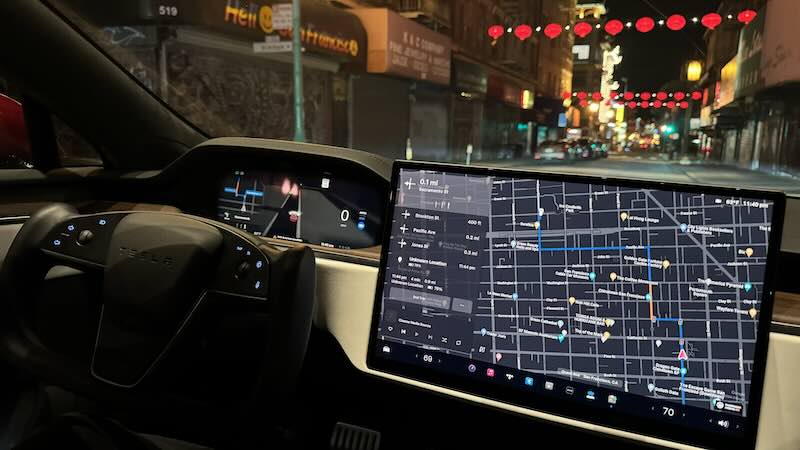
Elon confirmed that Tesla’s FSD is about to receive a dedicated pothole avoidance improvement, how soon we talking, cuz I need it baaaad, that’s a bigger deal than it might initially sound. Listed as an upcoming feature in FSD v14.3, Tesla’s FSD pothole avoidance has reportedly been in active development for four to five months. Yet the road to get here has been anything but straightforward.
Why pothole avoidance isn’t a new idea, just a new feature, here’s the thing: FSD and other driver-assistance systems have already demonstrated some pothole-avoidance behavior. Problem? It was never deliberately engineered as a defined product feature. It emerged organically from how the system behaved — inconsistently, and without the kind of reliability that makes a driver trust it.
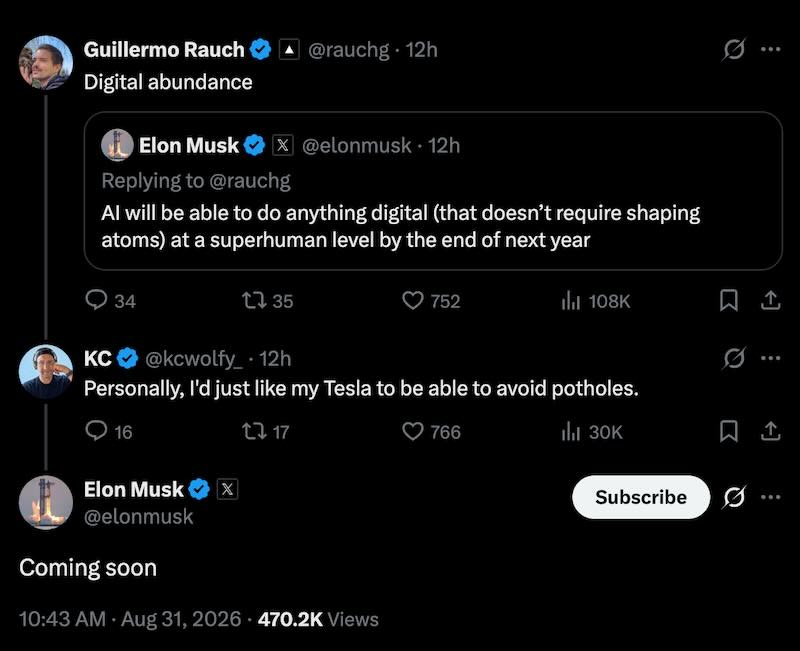
That distinction matters enormously from a product standpoint. Emergent behavior and intentional design are two very different things, and Tesla’s engineering team is now working to close that gap.
So what makes Tesla’s FSD pothole avoidance technically challenging? It’s actually harder than Automatic Emergency Braking in at least one important way: the system must continuously balance false positives against false negatives, both carry real costs.
If the system identifies a harmless patch of road as a pothole and swerves unnecessarily, drivers will notice and complain. If it misses an actual pothole entirely, drivers will also complain. Worse still, even experienced human drivers get this wrong. They’ll occasionally dodge a road imperfection that didn’t need avoiding, or blow straight past one that genuinely did.
That’s the crux of the judgment problem. Detection isn’t the limiting factor. Even Waymo — widely regarded as operating one of the most capable sensor suites in the autonomous-driving industry — can’t fully eliminate missed detections with hardware alone. Difficult part is determining when a detected road imperfection should actually trigger an avoidance maneuver. That’s a decisional challenge, not a sensory one, and it’s where autonomous systems still have meaningful ground to cover.
By formally committing to Tesla’s FSD pothole avoidance as a named, versioned feature in v14.3, Tesla is doing something strategically smart: setting a measurable standard. Named features carry accountability. They can be tested, benchmarked, and improved in future iterations.
Ultimately, the road to reliable pothole avoidance isn’t paved with better cameras, it’s paved with better judgment.
Related Post
Does Tesla FSD Have a Safety Fallback System? Here’s What Tesla’s AI Director Said
Tesla FSD Subscriptions Surge 56% to 1.48M in Q2 2026 — Here’s What the Data Shows