
Today is the day. Tesla is officially unveiling the production CyberCab at a launch event in Austin, Texas, its first vehicle designed purely for autonomy, built to run on the company’s FSD as part of a commercial Robotaxi fleet. And this isn’t a concept drop or a preview. CyberCab is no longer a concept, production commenced at Gigafactory Texas in the first half of 2026.
What makes this moment different from everything that came before it is what’s expected to happen immediately after the event ends: 45 registered CyberCabs in Austin are poised to enter service. Production vehicles with no steering wheel and no pedals, carrying paying passengers through city streets without a human in control. That’s not a test. That’s a Robotaxi service.
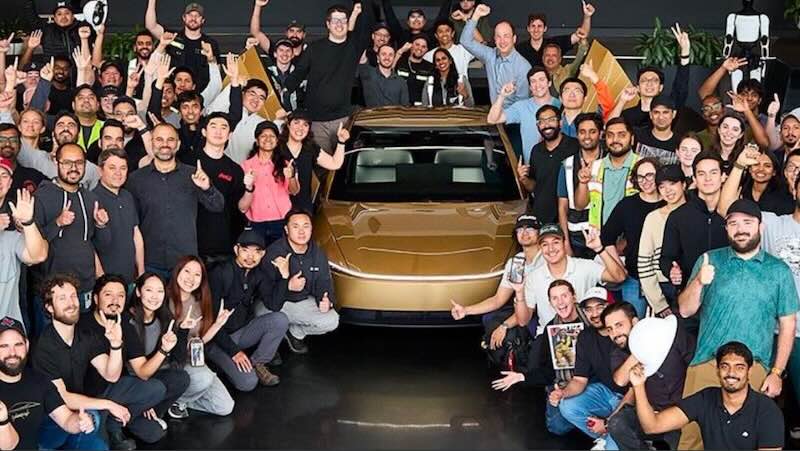
Tesla didn’t arrive at this moment overnight, even if it looks that way from the outside. The company began pilot Robotaxi operations in June 2025, meaning the service has now been running for more than a year. Since 2026, Tesla has gradually transitioned to unsupervised operations in cities where regulations allow it, removing the safety driver entirely. Some newly launched markets have gone directly into unsupervised operation from day one.
By the end of Q2 2026, Tesla had accumulated around 2.4 million paid miles of Robotaxi operation. That number isn’t close to Waymo’s mileage, but it represents an increasingly valuable pool of real-world operating experience, kind of data that can’t be replicated in a simulation lab.
The company already runs driverless Model Y Robotaxis in limited parts of Austin, Dallas, Houston, Miami, Orlando, and Tampa, so September 3 is about folding CyberCab into an existing commercial service rather than starting from zero.
Cybercab is a two-seat, fully autonomous design — no steering wheel, no pedals, powered by Tesla’s AI4 computer. Specs on record include a 48 kWh battery pack, a single 219-horsepower front motor, and an unadjusted range figure of 418 miles.
4 of the 7 major software improvements planned for FSD v15 have been incorporated into the Robotaxi model running CyberCab. Car itself runs the same FSD software stack that a Model Y Robotaxi uses today, same stack that’s been accumulating real-world miles across six cities in Texas and Florida.
Operationally, Tesla is building a purpose-designed infrastructure around the vehicle. The company is planning dedicated Robotaxi operations centers in Austin, Dallas, and Las Vegas, equipped with Superchargers (80 Wireless Charging Hub), cleaning robots, and vehicle inspection systems. Goal is a fully automated cycle: return, charge, clean, inspect, redeploy. No human hand required at any point.
Tesla hasn’t been operating in a vacuum. The company has been working with regulators across California, Texas, Florida, Arizona, Nevada, and other states to prepare for CyberCab deployment. It’s released dedicated CyberCab emergency-response guidelines and Robotaxi user instructions, and it’s been training local first responders on how to handle these vehicles in the field.
Nevada’s Transportation Authority unanimously approved permits clearing Tesla, Waymo, and Uber to run commercial Robotaxis in Clark County, where Las Vegas is located — authorizing up to 8,000 driverless vehicles over the next 12 months. Tesla drew the largest allocation of around 5,000 Robotaxis, though its CyberCab chief engineer told regulators the company expects to field around 2,500 within the year.
The regulatory groundwork, in other words, is done in key markets. Execution is what’s left.
Getting an autonomous machine like CyberCab integrated into the infrastructure of modern society requires countless operational decisions, regulatory coordination, engineering work, and significant resource investment. Car itself is only one part of the equation. Everything around it, ops centers, emergency protocols, software stack, regulatory permits, trained first responders, is what allows a driverless vehicle to function as a normal part of daily urban life.
Pace from here — Nevada going live, expanded hours, CyberCab displacing Model Y in the fleet, will tell us whether this timeline was an anomaly or the new normal for Tesla’s autonomous rollout.
Either way, autonomous urban mobility is no longer theoretical. CyberCab is in service. And it’s safe to say this launch is driving straight into history.
Related Post
Tesla CyberCab Launches in Austin: Public Robotaxi Rides Expected by Late August
Tesla Cybercab EPA Certificate Reveals Specs: Range, HP & Battery
Tesla True Unboxed Process Patent Could Transform EV Manufacturing for CyberCab Production