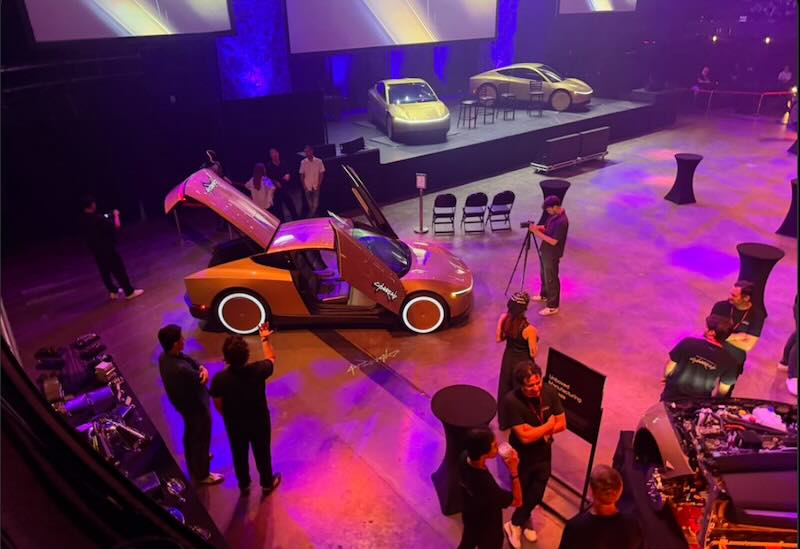
Tesla’s Cybercab launch event was, to put it plainly, an intimate affair — roughly 400 attendees, with nearly half of them Tesla employees. That said, what the event lacked in scale, it more than made up for in substance. Between the demo displays, quality food, and a tight 15-minute keynote, Tesla managed to pack a significant amount of product detail into a remarkably short window. And, of course, there were rides.
The engineering story behind the Cybercab is where things get genuinely interesting. Its drive unit features a simplified bar-wound stator and lubrication system, built around an architecture that supports fully automated, sub-10-second cycle times on the production line. Compared to other top-performing electric vehicle drive units, it’s 18% smaller, 25% lighter, and measurably more efficient, a set of specs that Tesla clearly engineered with manufacturing scale in mind.
Beyond the drive unit, the Cybercab is the first Tesla vehicle to receive the next-generation Supermanifold V3 thermal system. Tesla’s own description of it is worth noting: unnecessary refrigerant valves and lines have been removed, and the high- and low-voltage controllers have been consolidated to reduce both parts count and system complexity. Result is a modular design where production is 80% automated and overall thermal operation runs 38% more efficiently than comparable automotive thermal systems. That’s not incremental improvement, that’s a structural rethink.
Vehicle’s 4680 structural pack, Starlink V5 integration and the broader “unboxed” manufacturing process round out a platform that Tesla has clearly optimized from the ground up for autonomous, high-volume deployment. Cybercab launch event, in this sense, was as much a manufacturing announcement as it was a product reveal.
Timing, it turns out, was deliberate. Tesla pushed a new Robotaxi app update the same morning as the event, and it officially adds Cybercab support. Updated UI now lets riders choose between a Cybercab or a Model Y Robotaxi when booking a trip, a meaningful distinction that signals Tesla is building toward a multi-vehicle autonomous fleet rather than a single-model service.
New in-vehicle experience introduces “Hey Grok” voice interaction, adjustable interior accent lighting that may sync with music, and the ability to control media directly from a passenger’s phone. These aren’t trivial additions; they’re the connective tissue between hardware and rider experience.
Tesla’s own language in the update is notably direct: “Cybercab is bringing autonomy to everyone and every ride.” Designed for safety, accessibility, and comfort, the company is positioning this vehicle as the entry point for mass-market autonomous transport, currently exclusive to the Robotaxi app.
Cybercab launch event wasn’t a flashy consumer moment. It was a controlled, detail-forward preview aimed at demonstrating production readiness and platform maturity. Engineering specs, thermal system overhaul, the app integration, all of it points toward a company that’s moved well past concept territory.
Whether you’re a rider or an investor, with the Cybercab, Tesla isn’t just launching a vehicle — they’re launching a cab-ability.
Related Post
Tesla CyberCab Launches in Austin: Inside the Robotaxi Service That Changes Everything
Tesla Cybercab Production Begins: Robotaxi Miles Double in Q1 2026
Tesla Austin Robotaxi 80 Wireless Charging Hub Signals Cybercab Imminent Launch