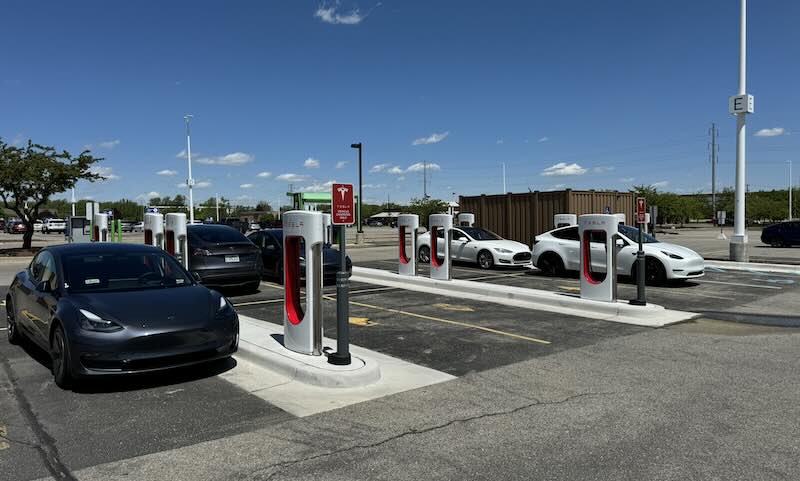
Tesla has quietly begun rolling out one of its most sobering software updates to date, a feature that lets drivers pull away from a Supercharger station with the charging cable still physically connected to the vehicle. It’s not a party trick. It’s a direct response to a tragedy, and the fact that it exists at all says something about the realities of charging an EV in public America today.
A fatal shooting in a Twin Falls, Idaho, parking lot adjacent to a Tesla Supercharger intensified debate among EV owners over whether cars should be able to drive away while still plugged in. Three of the victims were actively charging their Teslas when the attack began. Tesla’s software lockout, designed to prevent a driver from accidentally driving away and damaging Supercharger hardware, meant those drivers couldn’t simply shift into Drive and flee.
That design choice, reasonable on paper, became a liability in the worst possible circumstances.
Previously, shifting into Drive while connected to a Supercharger was impossible by design. Tesla’s new Tesla’s Emergency Drive-Away Mode changes that calculus entirely. Update, delivered over-the-air to U.S. vehicles, allows the charging-port lock to disengage and the vehicle to enter Drive so a driver can accelerate away without ever stepping outside.
Here’s where it gets complicated. Because Tesla’s Emergency Drive-Away Mode is a software-only OTA update, there’s no new breakaway hardware involved, driving away with the cable still plugged in can cause physical damage to both the vehicle’s charge port and the Supercharger equipment itself. Industry observers have noted that EV emergency egress would ideally involve breakaway couplings similar to those used at gas pumps, where fuel hoses are engineered to detach safely if a vehicle pulls away. Tesla hasn’t gone that route yet.
Instead, the company is differentiating between genuine emergencies and intentional misuse. Drivers who activate the feature without cause could face penalties reaching up to $25k, roughly the cost of replacing damaged Supercharger hardware. It’s a steep deterrent, deliberately so.
For now, the rollout is limited to the United States.
Some drivers have proposed that any emergency feature would need strong safeguards to prevent accidental activation, perhaps relying on prolonged button presses, audible alarms, and clear on-screen confirmations. Tesla appears to be threading that needle carefully — and given America’s particular context around public safety incidents, the decision to prioritize a domestic rollout first makes sense commercially and practically.
One U.S. Tesla owner captured the sentiment well: “I’m glad Tesla added this feature, but I’m frustrated that we actually need it.”
That’s the tension embedded in every aspect of Tesla’s Emergency Drive-Away Mode. It’s technically a product improvement. It’s also an acknowledgment that a Supercharger stop, something that averages close to 30 minutes for most drivers, can represent a period of genuine vulnerability.
Tesla hasn’t confirmed a timeline for international availability. $25k misuse penalty is likely to generate its own conversation, particularly as drivers weigh whether the feature is accessible enough to actually use under duress.
What’s clear is that the EV industry as a whole is now on notice. As coverage of these incidents spreads, industry observers are beginning to ask whether emergency egress from chargers should be addressed through new standards or recommended practices, not just left to individual manufacturers.
Tesla moved first. Whether it moved fast enough, or in the right direction, will depend on whether the next Supercharger emergency happens before or after the hardware catches up to the software.
Related Post
Tesla App 4.56 Rolls Out Virtual Queues for Superchargers
Tesla Supercharger for Business: New Pricing & Financial Calculator Explained
Tesla Ends V3 Supercharger Production, Shifts to V4 Cabinets at Giga New York