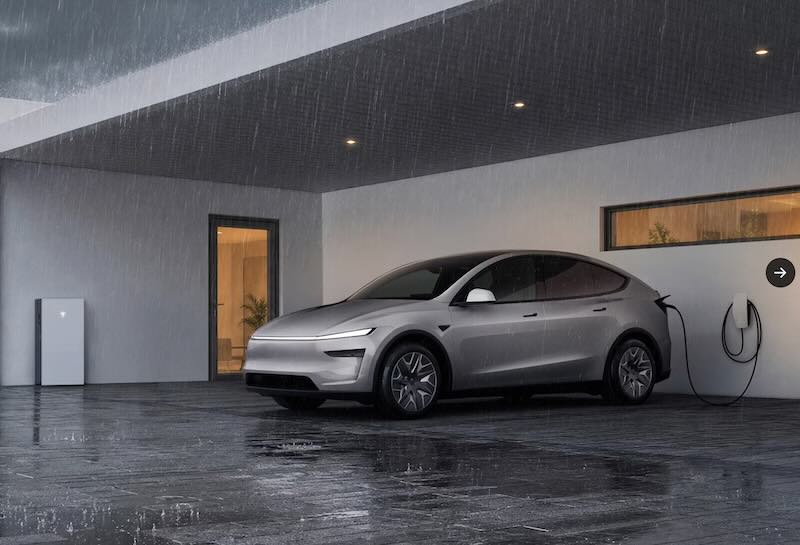
Tesla’s Powershare Home Backup is no longer a Cybertruck-exclusive privilege. As of October 1, 2026, Tesla has officially extended the feature to new Model 3/Y vehicles ordered on or after that date, it’s a bigger deal than it sounds. For the first time, a mainstream Tesla sedan and crossover can serve as a serious whole-home energy reserve, working alongside a Powerwall 3 to keep the lights on well beyond what any single battery storage unit could manage alone.
Powerwall 3 owners can now plug in their compatible vehicle and feed energy directly into their home electrical panel, while also recharging the Powerwall straight from the car’s battery pack. That’s a meaningful shift in what these vehicles represent, not just transportation, but critical infrastructure for the home.
Numbers here are worth pausing on. Every Model 3/Y in the Premium and Performance trim carries a battery equivalent to nearly six Powerwalls, and even base 2027 Model 3/Y qualify for new Powershare Home Backup capability. Paired with a Powerwall 3 and a compatible Wall Connector, that translates to over two additional days of home backup duration, without purchasing a single piece of new hardware.
For eligible homes, the existing Powerwall Gateway handles grid isolation during an outage, meaning no separate Powershare Gateway is required. That’s a significant cost and complexity reduction for homeowners who’ve already invested in Tesla’s energy ecosystem.
How to Verify Powershare Support on Your Vehicle Model 3/Y
Not every Tesla on the road qualifies, so it’s worth checking before assuming compatibility. Tesla has made the verification process straightforward. Navigate to Software > Additional Vehicle Info > Powershare Support on your vehicle’s touchscreen — if it reads “Enabled,” you’re good to go. Compatibility itself is delivered via an over-the-air software update, so no service appointment is needed.
V2H functionality is supported on Model 3/Y vehicles produced from 2024 onwards, with older configurations lacking the onboard power electronics required for bidirectional energy flow. If your vehicle predates that window, Powershare Home Backup simply isn’t on the table at least not yet.
Well, not entirely. Powerwall 2+ compatibility is confirmed to follow later in 2026, though no specific date has been announced. It’s a delay that’ll frustrate some, particularly those who built out their home energy setup years ago expecting full integration. Still, the direction of travel is clear, and the framework is already in place.
Tesla’s math on energy equivalency checks out, a single Powerwall holds 13.5 kWh, and nine of those lands right around the Cybertruck’s battery capacity. Model 3/Y Premium trims approach six Powerwalls each. For context, that’s a substantial on-wheels reserve that most standalone residential battery systems can’t approach without significant capital expenditure.
The broader implication here is that Tesla is repositioning its vehicle lineup as a core component of residential energy resilience, not a nice-to-have add-on. For homeowners already running solar and a Powerwall 3, Model 3/Y in the driveway is no longer idle capacity after sunset.
One thing’s certain: with Powershare Home Backup now standard on new orders, Tesla’s latest Model 3 and Model Y aren’t just vehicles to drive, they’re power shares worth owning.
Related Post
Tesla Model Y V2L Now Live for All U.S. Premium Trims — Here’s What You Need
Tesla Model Y L Premium Gets Major HVAC and Thermal Management Upgrades
Tesla Launches New 420W Solar Panel With Advanced Mounting System