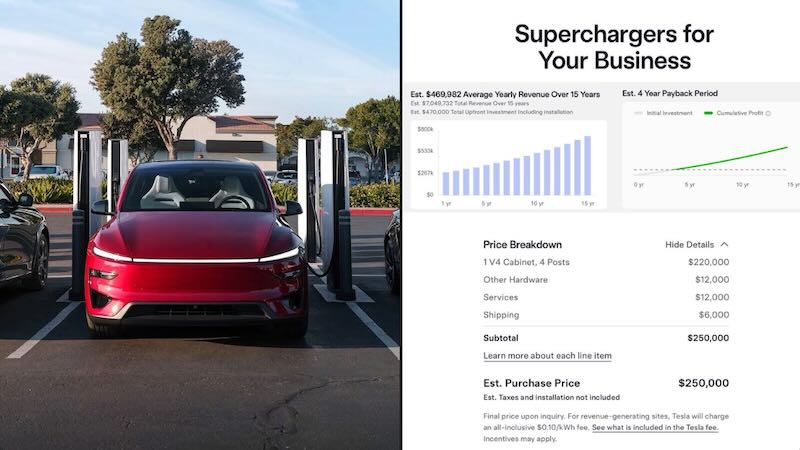
Transparency has never been the EV charging industry’s strongest suit — and Tesla knows it. That’s why the company has rolled out new pricing and a financial calculator for its Tesla Supercharger for Business program, targeting commercial operators ready to own and monetize their own charging infrastructure. Announcement cuts straight to the point: simplicity, clarity, and investment acceleration are the stated goals. Honestly, it’s about time someone said it plainly.
November, 2025, Tesla has officially launched its first third-party owned Superchargers in North America. The company’s Director of Supercharging, Max de Zegher, confirmed the milestone on X, marking a shift in how businesses can deploy charging infrastructure while maintaining Tesla’s technical standards.
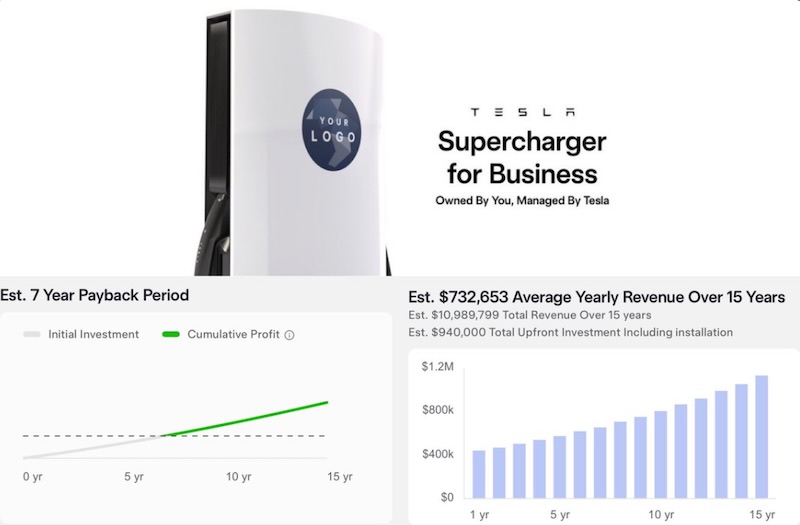
Tesla is charging revenue-generating sites an all-inclusive $0.10/kWh fee — a flat, predictable rate that removes the guesswork operators typically dread. Newly released financial calculator lets businesses adjust inputs like electricity cost, number of stalls, and expected utilization, then spits out an estimated purchase price alongside projected revenue figures.
Here’s where it gets compelling. An 8-stall white-labeled Tesla Supercharger site carries an estimated upfront cost of roughly $940,000, or $62,500 per stall. That’s the sell price to the business, Tesla’s own cost is presumably a fraction of that. Over 15 years, that same installation is projected to generate nearly $11 million in total revenue, with the hardware paying for itself in approximately seven years. For capital-planning purposes, that’s a defensible IRB.
Why Tesla Supercharger for business changes the equation, business case here isn’t subtle. Tesla has long profited from owning and operating its Supercharger network, now it’s essentially offering operators a licensed path into that same revenue stream. Financial calculator isn’t just a sales tool; it’s a transparency play designed to accelerate deal flow and expand charging ubiquity in markets Tesla hasn’t fully penetrated yet.
Operators who’ve wrestled with opaque pricing from other DC fast charger manufacturers will find this refreshing. Fact that a firm per-stall install price is now publicly available puts competitive pressure on the rest of the industry — pressure that’s frankly overdue.
Community response has been telling. EV drivers, particularly those navigating long interstate corridors, are already envisioning what a franchise-style rollout could look like — think truck stops, converted gas stations along major highways, leased Walmart parking lots. Logic is sound: high-traffic, underserved charging corridors exist everywhere, and private entrepreneurs are willing to finance the buildout if the unit economics pencil out.
Could this become financeable at scale? Potentially. Revenue-backed instruments tied to Supercharger throughput aren’t far-fetched — especially with 15-year revenue projections this strong. Tesla hasn’t announced a formal franchise model, but the infrastructure for one is clearly taking shape.
Tesla’s move brings institutional-grade financial clarity to a market that’s been operating on gut instinct for too long. For businesses evaluating EV infrastructure investment, the Tesla Supercharger for Business program doesn’t just lower the barrier — it rewires it. With returns like these, it’s fair to say Tesla isn’t just charging cars anymore; it’s charging the future of commercial energy investment.
And if you’re still on the fence? Well, the calculator’s right there — no charge for curiosity.
Related Post
Tesla Supercharger Locations Now Appearing on Highway Signs, Transforming EV Perceptions
Tesla Ends V3 Supercharger Production, Shifts to V4 Cabinets at Giga New York
Tesla Expands Live Supercharger Pricing to 550 New Stations, Real-Time EV Charging Rates