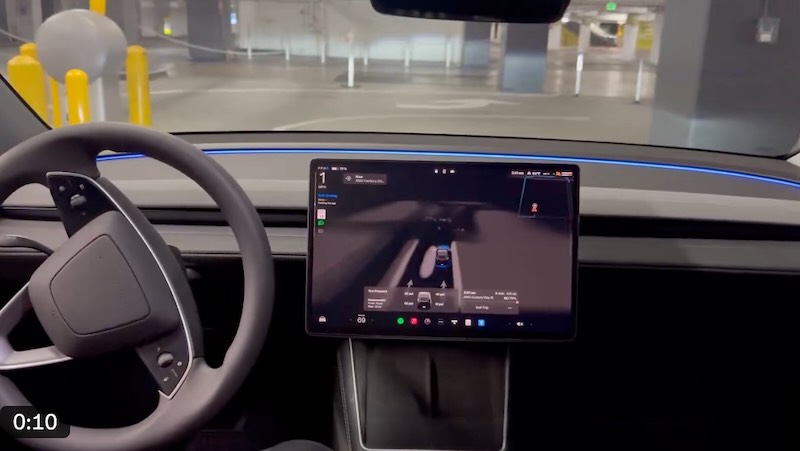
There’s a new line in the sand for automotive safety tech, and Tesla just crossed it. With FSD Supervised v14.3.9, Tesla is rolling out a feature called Automatic Collision Evasion, an active safety system capable of engaging FSD even while the driver is operating the vehicle manually. That’s not a minor firmware tweak. It’s a fundamental shift in how Tesla’s software relates to the driver, and the road.
Standard Automatic Emergency Braking applies brakes in a straight line. Automatic Collision Evasion goes further: it allows FSD to take directional control and steer around an obstacle when braking alone won’t be sufficient. For anyone who’s followed Tesla’s software journey, this is a notable evolution in the platform’s safety architecture.
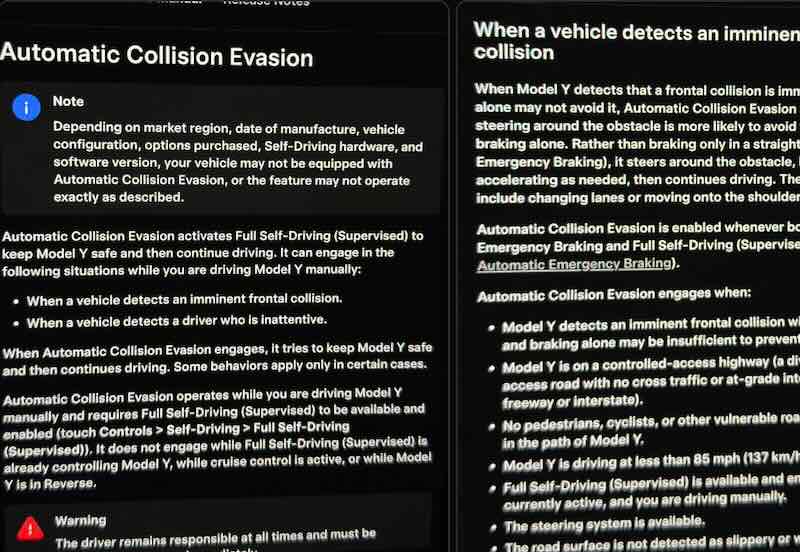
When does It actually kick in? system activates FSD (Supervised) during manual driving in two core situations: a frontal collision is imminent and braking alone may not prevent it, or the vehicle determines the driver isn’t sufficiently attentive, or that FSD may have been unintentionally disengaged.
Conditions governing the first scenario are specific. Vehicle must be on a controlled-access highway, think freeways and interstates with no cross traffic or at-grade intersections. No pedestrians, cyclists, or other vulnerable road users can be detected in the vehicle’s path. Speed must be under 85 mph. Steering system must be operational, and the road surface can’t register as slippery or wet. FSD must be enabled but not currently active. Meet all of those conditions simultaneously, and Automatic Collision Evasion may steer the vehicle into an adjacent lane or onto the shoulder, braking or accelerating as needed, then continue driving.
Here’s where things get interesting from a human-factors standpoint. Driver inputs work differently during the emergency maneuver. Pressing the accelerator has no effect while FSD is taking over. Pressing the brake pedal increases deceleration but does not cancel FSD or end the evasive action. Only way to cancel the maneuver is to apply strong counterforce through the steering wheel, requiring more steering force than canceling FSD normally would.
That’s a deliberate design choice. Tesla’s engineering rationale is clear: an accidental pedal press shouldn’t abort a life-saving maneuver mid-execution. After the event resolves, the vehicle transitions to a limited FSD state and prompts the driver to resume normal supervision.
Second trigger scenario for Automatic Collision Evasion is broader in scope and arguably more consequential. Tesla says the system may also engage if it detects the driver is heavily distracted or has accidentally disengaged FSD. Unlike the frontal-collision scenario, this trigger isn’t limited to controlled-access highways. It activates across a wider range of road environments, provided the vehicle is traveling between 22.5 mph and 85 mph.
Until now, most Tesla owners have thought of FSD as a system they intentionally activate: you turn it on, FSD drives, you supervise, you disengage, and you take over. Automatic Collision Evasion adds another possibility: you’re driving, Tesla detects an emergency, and FSD can step in. That’s a genuinely different value proposition for FSD subscribers — one that extends the system’s utility well beyond convenience.
Since it’s tied to FSD, Automatic Collision Evasion will only be available on vehicles with an active FSD license or subscription. Tesla has confirmed this is a last-resort safety function and explicitly states it does not replace an attentive driver.
Feature rolls out via software update 2026.27.5, currently progressing from internal employee testing toward broader early access deployment.
When it comes to Automatic Collision Evasion, the real question isn’t whether it works, it’s whether drivers are ready for a car that won’t take “no” for an answer. Tesla’s latest update doesn’t just evade collisions; it evades the assumption that you’re always in control.
Related Post
Tesla FSD Pothole Avoidance Is Coming — Here’s What Elon Musk Confirmed
Does Tesla FSD Have a Safety Fallback System? Here’s What Tesla’s AI Director Said
Tesla Summer 2026 Update: Grok Takes the Wheel — What’s New and What It Means