Tesla dropped something significant. Full release notes for FSD V15 are out, and if you’ve been following the autonomous driving space, you’ll want to pay attention. This isn’t a minor patch. It’s a fundamental rethinking of how Tesla’s FSD system sees the world, communicates its decisions, and adapts to individual drivers. From an entirely new visual interface to a 25x improvement in critical intervention rates, V15 is the kind of release that makes you stop and genuinely reconsider where this technology is headed.
At the technical core of this update is an upgraded vision encoder, it’s shared across FSD, Robotaxi, and Optimus. That alone should raise eyebrows. Tesla trained this encoder on millions of internet videos, pushing generalization and data efficiency in ways prior versions simply couldn’t achieve. Result? A 25x improvement in the critical intervention rate.
That’s not a small number. That’s the kind of leap that moves FSD V15 from an impressive driver-assistance tool into something that starts to feel genuinely reliable. Fact that the same encoder underpins Tesla’s robotaxi ambitions and its humanoid robot program suggests this wasn’t built for a single use case, it was built for a platform.
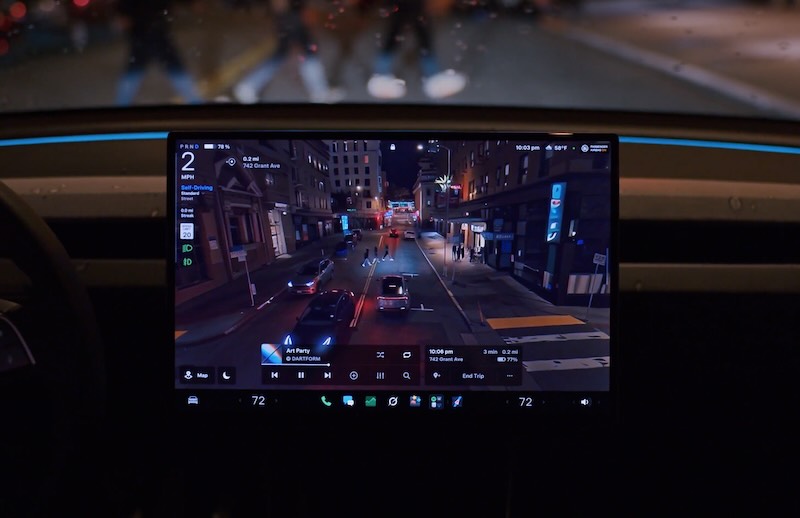
Here’s where things get visually striking. Tesla introduced Tesla Reality View, a real-time generative driving visualization that streams a live view from a virtual camera positioned above your vehicle. You can see exactly what FSD is planning—lane changes, turns, navigation decisions, all rendered continuously.
Drivers can switch between full-screen visualizations, a map view, or a split view. There’s also a quiet mode, available via a small moon icon, for those who’d rather have a calmer cabin experience. What’s particularly notable: the visualization is active even when FSD isn’t engaged. Navigation turns display directly within the driving scene, and all road markings render in real time, including active turn signals.
Early users are describing it as watching a video game. That’s not hyperbole, it’s a reasonable reaction to seeing your vehicle’s understanding of the world rendered with this level of detail. Christmas decorations on the side of the road, pothole locations, small animals crossing the street, all of it shows up. Switching between views is as simple as swiping the screen.
Alongside Reality View, Tesla introduced Tesla Augmented Reality, which replaces all explicit model signals with a single end-to-end visualization using less total compute. This is a meaningful architectural shift. Rather than surfacing individual data signals, lane markers, detected vehicles, speed zones, as separate visual elements, system consolidates everything into one coherent picture.
Less compute. More clarity. That tradeoff, if Tesla executes it well, matters enormously for scaling this system across the fleet.
Tesla FSD V15 brings an end-to-end learned navigation model built on route preference data collected from the fleet. Put simply: system gets better at choosing routes the way you prefer, not just the way a map algorithm would.
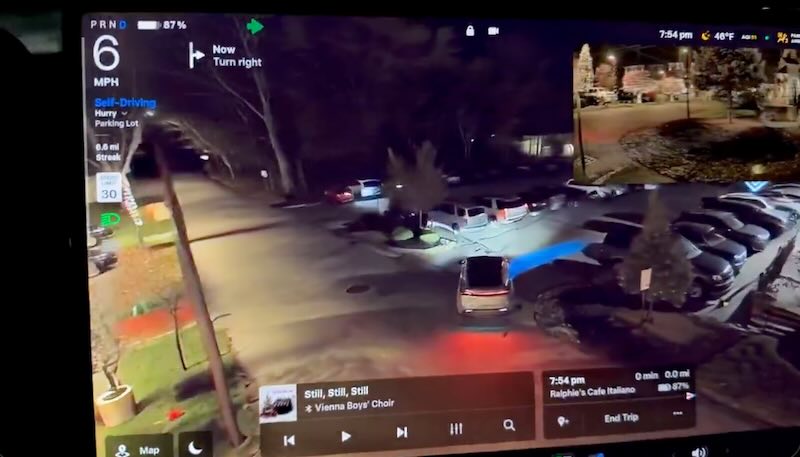
Parking has also received a substantial upgrade. Map now displays multiple parking options at your destination simultaneously, and the system uses your personal parking history to inform its selections. Users report being able to select a specific parking spot manually, with arrows populating the screen to indicate available options. FSD can also identify and point toward its chosen spot proactively, occasionally reconsider mid-approach if a better option presents itself.
For anyone who’s watched FSD confidently pull into an inconvenient spot, this is a welcome change.
A few additional features round out the release in practical ways. Speed Camera Slowdown enables FSD (Supervised) to automatically reduce speed upon detecting a speed camera. Drivers can override by pressing the accelerator or adjusting the speed profile. Cancel the slowdown twice at the same camera, and Tesla saves that location, no future slowdowns there.
Bike Rack Mode is a thoughtful addition for outdoor enthusiasts. When a bike rack or hitch accessory is installed, FSD pulls over near the destination without attempting to reverse. It’s a small quality-of-life feature, but it reflects genuine attention to real-world driver scenarios.
Driver monitoring also improved, with better vision-based attention detection now working with hats and sunglasses, and reduced strictness in higher-speed driver profiles. Turn signals are quieter and fade out after a few clicks, a minor change that removes an annoyance many drivers had quietly accepted.
Detection improvements in FSD V15 cover a wide range: road signs, small animals, road debris, tire chains, potholes, and deep standing water. System now actively avoids standing water rather than treating it as a navigable surface. Speed handling has also been refined across driver profiles, school zones, standard speed limits, and inclement weather conditions.
Autoshift has been unified with FSD-based gear predictions, streamlining the transition between manual and autonomous driving modes.
Whether you’re a Tesla owner eager to try it yourself or a technology observer tracking where autonomous driving is actually going, V15 represents a credible step forward. Visualizations alone would make this a noteworthy release. Architectural improvements underneath them make it significant.
Tesla may have a full self-driving future ahead, but with V15, it’s clear the full self-driving present just got a whole lot more real.
Related Post
Tesla Cuts AI5 and AI6 Memory Due to Supply Constraints, What It Means
Grok Bot Is Now Available in Robotaxi, Tesla Cybercab AI Assistant Explained
Tesla FSD V14.3.9 Automatic Collision Evasion: What Drivers Need to Know