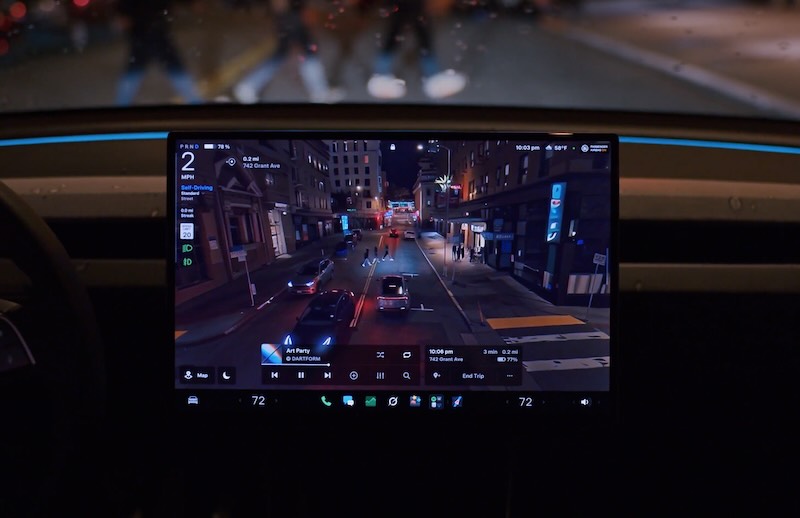
With the release of FSD V15, Elon Musk has finally pulled back the curtain on one of Tesla’s most technically ambitious features. Tesla’s Reality View isn’t just a visual novelty, it’s a window into how the company’s FSD system perceives and reconstructs the physical world in real time. Understanding the architecture behind it reveals just how much engineering horsepower Tesla has poured into its autonomous driving stack, and where the system still has room to grow.
Tesla’s approach to Tesla’s Reality View begins in the cloud. Starting last year, the company built a cloud-based world model capable of pixel-level accuracy. Model doesn’t just store map data, it generates synthetic training data that feeds directly into FSD. It’s a closed-loop system: real-world conditions inform the model, and model sharpens what the car sees next.
Onboard the vehicle, images from all the cameras pass through a general-purpose vision encoder. Think of this encoder as a note-taker, it compresses raw visual input into a compact sequence of features that the neural network can act on.
Those features then split into two distinct processing paths. First feeds a 3-billion-parameter FSD model, which handles the actual driving decisions. Second feeds a 1-billion-parameter diffusion model, that’s the engine behind Tesla’s Reality View. It’s a clean architectural separation: one branch drives, the other renders.
AI4 runs two main chips, SoC A and SoC B, each carrying three TRIP accelerators. Tesla’s Reality View runs on half of one accelerator on SoC B, consuming roughly 8% of the total AI4 compute budget. For a feature that generates a photorealistic video feed of the car’s surroundings, that’s a remarkably lean footprint.
There’s a catch, though. The TRIP accelerators were designed during the convolutional neural network era, optimized for INT8 integer operations. Modern transformer and diffusion models lean heavily on operations like softmax, calculations that require exponentiation and division, which are far better suited to floating-point arithmetic. TRIP accelerators can’t handle these natively; they approximate them through 28 smaller steps. That makes the process slower and more resource-intensive than it would be on newer silicon.
Here’s where the numbers get interesting. Diffusion model generates a sequence of eight frames at 36 frames per second per cycle. Divide eight by 36, and you get a video segment of approximately 0.22 seconds. That generation process runs across four cycles of the vision encoder, which operates at 18 Hz, four cycles at 18 Hz also equals roughly 0.22 seconds.
The practical implication: Tesla’s Reality View can generate images in real time as the environment changes, but the rendered view lags about 0.22 seconds behind the actual world outside the vehicle. It’s real-time enough to be useful, but not perfectly synchronized. Notably, Tesla AI VP Ashok had already disclosed a 220 ms latency figure at ICCV a year ago, though without the underlying technical breakdown that Elon has now provided.
Tesla isn’t stopping at 220 ms. The company plans to insert updated vision encoder features directly into the intermediate layers of the diffusion model. That architectural change is expected to cut latency by approximately 35%, bringing it down to around 0.14 seconds. It’s a meaningful improvement, tighter synchronization between what the car sees and what Tesla’s Reality View renders makes the system more trustworthy for both the driver and, eventually, regulators.
One more detail worth noting: Elon confirmed that Tesla won’t be retrofitting existing vehicles with AI5 chips. Elon says: “It’s going to Optimus. Cars will remain at AI4. That’s enough to solve superhuman driving.” That means every optimization Tesla makes for Tesla’s Reality View on current hardware matters, there’s no hardware upgrade coming to bail out inefficient software design.
What Tesla’s doing here isn’t just impressive from an engineering standpoint. It’s a signal that the company believes photorealistic environmental rendering is a core part of its autonomous driving roadmap, not an aftermarket feature. As FSD continues to mature, Tesla’s Reality View may well become the clearest indicator of how far the system has come, how much further it still needs to go.
For a company that’s always framed autonomy as a software problem, it turns out the view from the driver’s seat is becoming increasingly hard to distinguish from Reality.
Related Post
Tesla AI5 Chip Production Starts 2027: 40× Faster Performance, Elon Confirms Timeline
Tesla FSD v14 Already Has Reasoning Features, Says VP Ashok Elluswamy
Tesla FSD Hits 1.1M Users as Subscription Model Takes Over, 120 EFLOPS of Compute Power