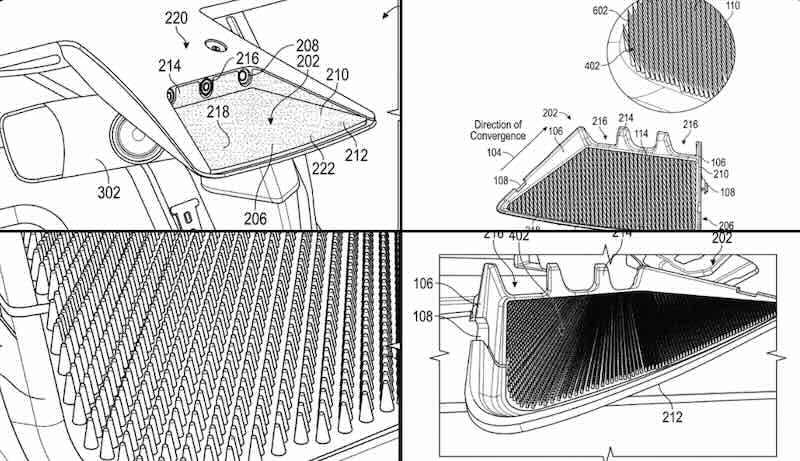
Tesla’s latest patent application addresses one of autonomous driving’s most persistent technical challenges—sun glare. The filing, designated US 2025/0334856-A1 and titled “Cone-Textured Glare Shield for Enhanced Camera Vision,” outlines a hardware solution that combines microscopic surface engineering with motorized positioning systems. Development arrives as camera-based autonomous systems continue struggling with light saturation events that compromise sensor reliability.
Current autonomous vehicle architectures rely heavily on optical sensors, yet these systems share the same vulnerability as human vision when confronted with direct sunlight. Light saturation degrades image quality, forcing Tesla’s FSD to either disengage or issue takeover warnings. The company has acknowledged that camera housing represents a critical engineering priority, particularly as competitors deploy LiDAR systems that bypass optical limitations through different sensing methodologies.
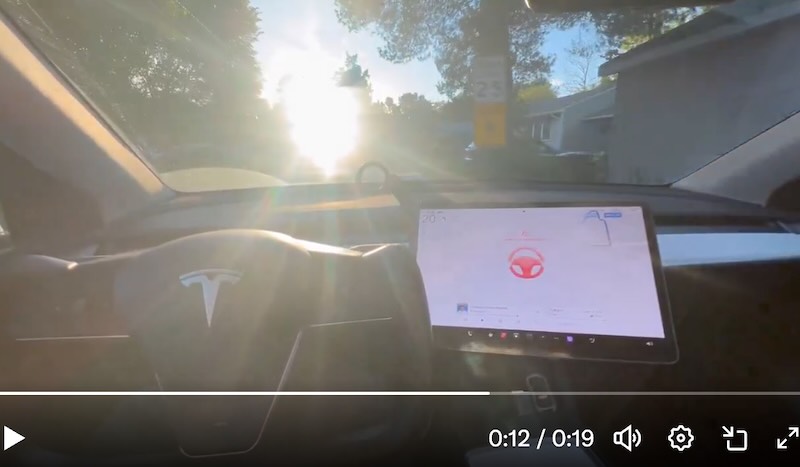
Existing camera shields use flat, textured plastic surfaces finished in black. Despite this design, shallow-angle light, particularly during dawn and dusk—reflects off housing surfaces at sufficient intensity to wash out image sensors. Total Hemispherical Reflectance measurements reveal that conventional matte finishes fail to achieve the absorption levels required for consistent autonomous operation.
The patent describes a surface topology inspired by natural anti-reflective structures. Tesla’s micro-cone camera shields feature precision-engineered formations ranging from 0.65mm to 2mm in height, each terminated with sharp tips. Cones function as light traps, scattering incident photons between cone walls until energy dissipates rather than reflecting toward the lens.
Geometric approach differs fundamentally from coating-based solutions. 3-dimensional array creates multiple reflection opportunities that redirect light away from critical sensor components. Tesla’s documentation indicates these surfaces can receive additional treatment with ultra-black coatings—materials employing carbon nanotube technology similar to Vantablack, to enhance absorption beyond what geometry alone achieves.
Perhaps the patent’s most significant innovation involves electromechanical adjustment capabilities. Tesla’s micro-cone camera shields incorporate stepper motors and actuators that reorient the housing in real time based on light source positioning. Dynamic response maintains optimal diffusion angles regardless of vehicle heading or time of day.
System effectively creates a moving shadow zone that keeps the lens protected as environmental conditions change. For autonomous systems operating across varied geographic locations and weather patterns, this adaptability addresses scenarios where static shields prove insufficient. Mechanism draws parallels to biological vision systems, though the engineering implementation relies on sensing and actuation rather than passive response.
Production of these textured surfaces requires sintered tool steel inserts that facilitate air evacuation during the molding process. Approach ensures dimensional accuracy across the micro-cone array while supporting high-volume manufacturing requirements. Patent documentation suggests Tesla has resolved technical challenges associated with creating and replicating complex surface geometries at scale.
Integration timing remains unconfirmed, though speculation points toward AI5 deployment as a potential platform. If implemented alongside next-gen compute architecture, these shields could eliminate sun blindness as a failure mode for camera-based autonomous systems. Represents a hardware-centric solution to a problem that software optimization alone cannot fully address.
Tesla’s investment in advanced camera housing technology reinforces the company’s position on sensor architecture. While competitors continue deploying multi-modal sensing stacks, this patent suggests Tesla views optical system refinement as preferable to adding sensor modalities. Whether Tesla’s micro-cone camera shields deliver sufficient performance improvements to validate this approach will depend on real-world validation across diverse operating environments and edge cases that currently challenge camera-based systems.
Related Post
Tesla FSD Struggles With Bright Sunlight – Safety Alerts Triggered by Intense Backlighting
Tesla Upgrades FSD Cameras for AI5 Hardware Platform, Called IMX00N
Tesla Grok Navigation Commands: Natural Voice Control for FSD Drivers