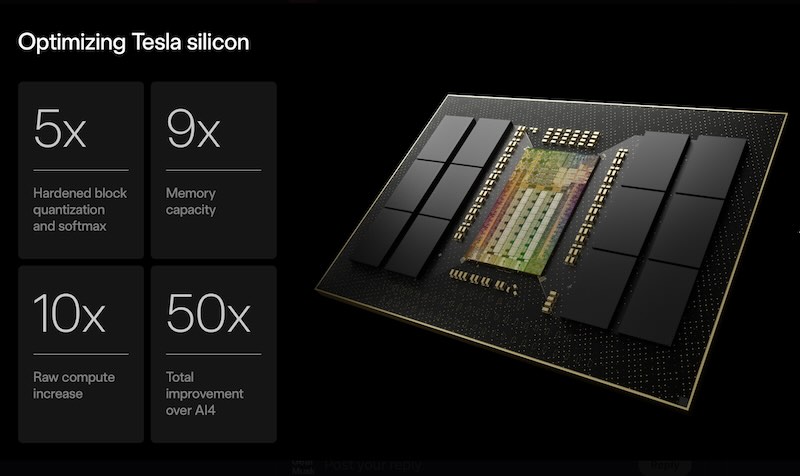
Tesla is working to reduce the power consumption of its upcoming AI5 chip to approximately 250W, according to Elon. Represents a significant engineering focus as the company develops more power-efficient computing for its vehicles and robots.
For context, Tesla’s current hardware progression shows a clear power escalation trend. HW3.0 chip consumes around 100W (with measured dissipation closer to 72W in typical operation), while the mass-produced AI4(HW4) chip draws approximately 170W.
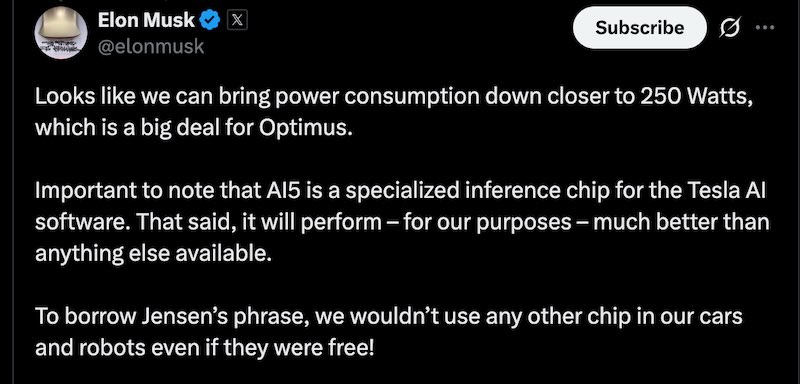
“Looks like we can bring power consumption down closer to 250 Watts, which is a big deal for Optimus,” Elon stated in response to X post comparison between Tesla’s AI5 chips and Nvidia’s Blackwell B200. “Important to note that AI5 is a specialized inference chip for the Tesla AI software.”
Despite progress on the AI5 chip’s design, Tesla fans shouldn’t expect to see it in vehicles anytime soon. Elon has indicated that the AI5 chip won’t be available in sufficient volume to switch Tesla production lines until mid-2027.
“We need several hundred thousand completed AI5 boards line side,” Elon explained, highlighting the manufacturing scale required before implementation.
Timeline suggests that Tesla’s upcoming Cybercab will launch with the current AI4 hardware. For consumers debating whether to wait for AI5-equipped vehicles, the extended timeline may make waiting impractical.
Even after AI5 hardware begins appearing in Tesla vehicles in mid-2027, software that fully utilizes its capabilities likely won’t arrive until late 2027 or early 2028.
Push for greater power efficiency isn’t merely about performance metrics. When designing chips for automotive and robotics applications, thermal and electrical constraints create hard engineering boundaries.
Elon emphasized the chip’s specialized nature, noting: “It will perform – for our purposes – much better than anything else available. To borrow Jensen’s phrase, we wouldn’t use any other chip in our cars and robots even if they were free!”
AI5 chip’s optimization specifically targets Tesla’s self-driving software stack rather than general-purpose computing, reflecting the company’s vertical integration strategy as it continues to chip away at the challenges of autonomous driving.
Related Post
Tesla Q3 2025: Record Revenue and AI5 Chip Breakthrough with 40× Performance
Tesla Dojo Shift: Synthetic Data Powers Next-Gen FSD Training Strategy
Tesla AI5 Chip: 40x Performance Boost Coming to Power Next-Gen FSD v14 | Elon Reveals