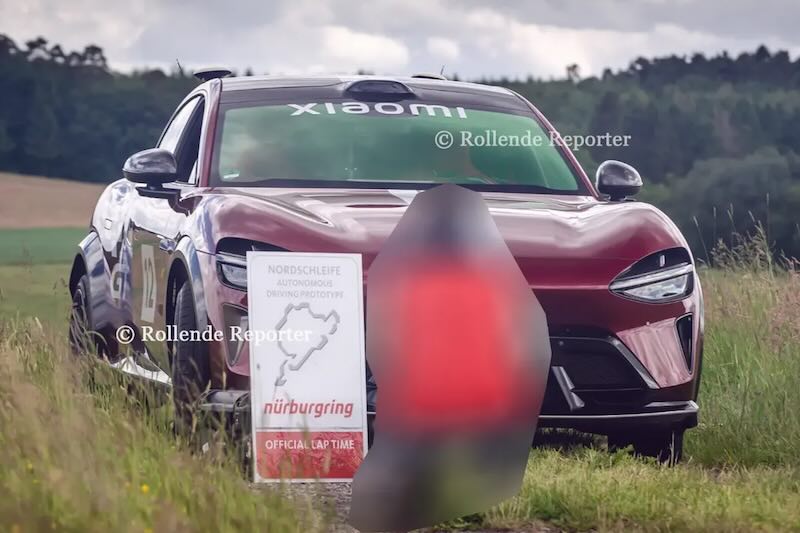
Xiaomi appears to be preparing a driverless lap attempt at one of motorsport’s most demanding stages. An Instagram post from user “rollendereporter” surfaced recently, claiming they’d stumbled onto a Xiaomi film crew at the Nürburgring Nordschleife with what looks very much like a Xiaomi YU7 GT autonomous prototype. The vehicle bears the number “12” on its side, and a nearby sign reportedly reads: “Nordschleife Autonomous Driving Prototype – Nürburgring Official Lap Time.”
Xiaomi hasn’t issued an official statement yet, but the imagery is difficult to dismiss.
Xiaomi YU7 GT has already made a serious statement on the Nordschleife. Earlier this year, Xiaomi officially unveiled the YU7 GT performance SUV, powered by its Super Motor V8s EVO dual-motor system. Combined peak output sits at 738 kW, and the SUV clears the 0–100 km/h sprint in just 2.92 seconds. Those aren’t numbers you associate with a brand that, not long ago, was primarily known for smartphones and scooters.
On May 19, 2026, Xiaomi’s chief test driver completed a timed run of 7 minutes 34.931 seconds. That result subsequently led to a certified lap of 7 minutes 22.755 seconds — making the YU7 GT the fastest production SUV ever officially recorded at the circuit. It’s a remarkable achievement for any automaker, let alone one that’s relatively new to performance vehicles.
Now, Xiaomi’s apparent next move isn’t simply shaving fractions of a second off a manned lap. If the leaked imagery is accurate, the company’s pushing into far more contested territory: a fully autonomous Nürburgring record.
The concept isn’t entirely without precedent. In early 2017, NIO used its EP9 electric hypercar to set a driverless record at Circuit of the Americas, completing a lap in 2 minutes 11 seconds at a top speed of 257 km/h. That bested the previous mark held by a McLaren P1 by six seconds — and it sent a message about where the performance EV conversation was headed.
That said, the Nürburgring carries a different kind of weight. The 20.8-kilometer Nordschleife is widely regarded as the most technically demanding road circuit in existence. Any result there — manned or autonomous — carries a level of global credibility that most other venues simply can’t match. That distinction matters enormously for a brand still establishing its engineering reputation in the automotive space.
It’d be easy to frame this as a marketing exercise, and honestly, the optics are hard to separate from the substance. But Xiaomi Auto has been fairly upfront about its philosophy here: the Nürburgring isn’t just a billboard. The company has stated that the track serves as a high-stress validation environment — a place to stress-test vehicle performance, handling, and engineering limits under real-world extremes that lab simulations can’t fully replicate.
For an autonomous system, that argument is even more compelling. Programming a vehicle to handle the Nürburgring’s 73 corners, elevation changes, and variable surface conditions without a human safety net is an engineering milestone, not just a PR stunt. If it works, it demonstrates a level of real-world system maturity that controlled test tracks simply can’t validate.
Xiaomi YU7 GT may have already lapped the Nürburgring faster than any production SUV — but if autonomous mode delivers, Xiaomi won’t just be setting records. It’ll be rewriting what it means to lap them.
Related Post
All-New Xiaomi SU7 2026: New Powertrain, Smarter Safety, and a Cabin Worth Talking About
Xiaomi Vision GT Supercar Debuts at MWC Barcelona
Xiaomi SU7 Ultra Sets New Nürburgring Production EV Record at 7:04.957 – Beats Porsche Taycan