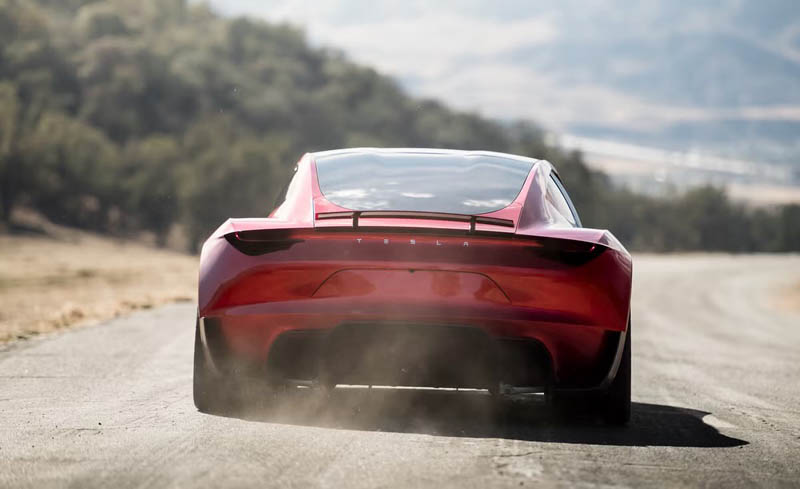
Tesla’s latest patent filing has unveiled a revolutionary active aerodynamic system that could transform the automotive industry’s understanding of vehicle performance. Multi-mode downforce generation technology promises to deliver unprecedented grip and stability for the long-awaited Tesla Roadster, potentially enabling acceleration figures that seemed impossible just years ago.
System represents a significant leap forward in automotive engineering, combining deployable ground-effect skirts with strategically positioned fans to create controlled low-pressure zones beneath the vehicle. Approach mirrors successful implementations in high-performance racing applications while adapting the technology for road-going vehicles.
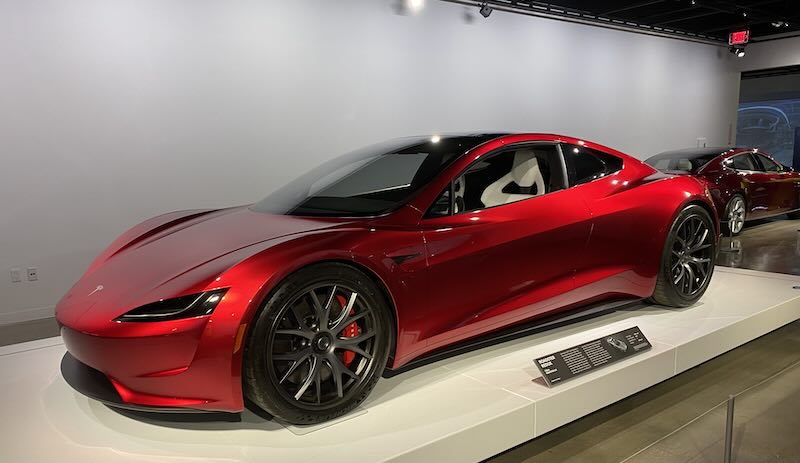
Tesla’s patent describes a sophisticated system that creates enclosed or semi-enclosed areas underneath the vehicle through selectively deployable skirts that make contact with the ground surface. Integrated fans within designated ventilation paths extract air from these sealed zones, establishing a low-pressure environment that generates substantial downforce through vacuum effects.
Patent documentation specifies that this active aerodynamic system operates across multiple modes, allowing drivers to adjust downforce levels based on driving conditions. Whether navigating tight corners on a race circuit or launching from a standing start, the Tesla Roadster’s active aerodynamics will provide optimal grip characteristics for each scenario.
Implementation of ground-effect aerodynamics in production vehicles presents numerous technical hurdles. Tesla’s engineers have addressed sealing concerns through innovative skirt designs that maintain contact with varying road surfaces while protecting sensitive components from debris and environmental factors.
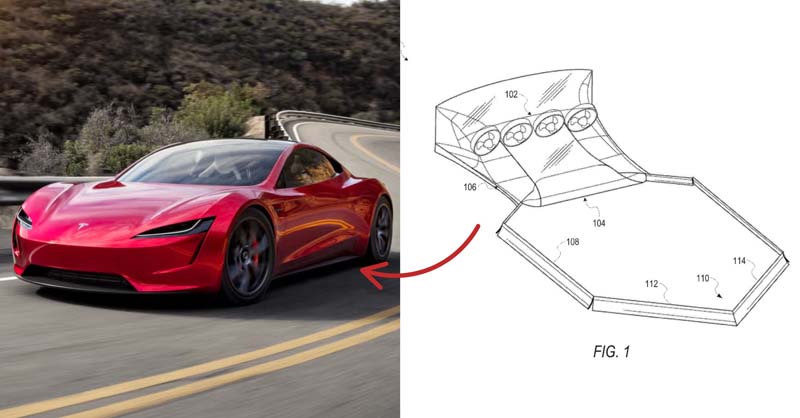
Power consumption represents another critical consideration, as the fan systems must operate efficiently without significantly impacting the vehicle’s range. Patent suggests intelligent control algorithms that activate the downforce generation system only when maximum performance is required, preserving battery capacity during normal driving conditions.
Current acceleration benchmarks in the hypercar segment have been established by vehicles like the McMurtry Spéirling, which achieves 0-60 mph times of 1.4 seconds through similar active downforce technology. Tesla’s system could potentially surpass these figures, particularly when combined with the company’s advanced electric drivetrain technology and SpaceX-derived innovations.
Elon’s February 2024 statements regarding sub-one-second acceleration targets initially appeared ambitious, but the patent filing provides concrete evidence of Tesla’s technical approach. Active aerodynamic system addresses the fundamental challenge of maintaining tire contact with road surfaces during extreme acceleration events.
Beyond straight-line acceleration, the Tesla Roadster’s active aerodynamics will significantly enhance cornering performance and overall track capabilities. Ability to generate substantial downforce at low speeds—something traditional aerodynamic solutions cannot achieve—opens possibilities for record-setting lap times at renowned circuits like the Nürburgring.
Multi-mode operation allows for dynamic adjustment of aerodynamic characteristics throughout a lap, optimizing grip levels for different corner types and track sections. Adaptability provides a significant advantage over fixed aerodynamic packages found on conventional supercars.
Tesla’s entry into the hypercar segment has faced delays since the original 2017 announcement, allowing competitors to advance their own performance offerings. However, the active aerodynamic patent suggests Tesla’s development timeline has focused on revolutionary rather than evolutionary improvements.
Positions the Tesla Roadster beyond traditional performance categories, potentially creating an entirely new class of vehicle that combines electric efficiency with unprecedented dynamic capabilities.
Current hypercar manufacturers rely primarily on passive aerodynamic solutions and advanced materials to achieve performance targets. Tesla’s active approach could render these traditional methods obsolete, forcing industry-wide reconsideration of performance vehicle design philosophies.
While Tesla has not announced specific production dates for the next-gen Tesla Roadster, the patent filing indicates substantial progress in core technology development. Complexity of the active aerodynamic system suggests extensive testing and validation periods will be necessary before market introduction.
Manufacturing considerations include the precision required for deployable skirt mechanisms and the integration challenges of fan systems within vehicle architecture. Tesla’s experience with complex manufacturing processes from their existing vehicle lineup provides advantages in addressing these technical requirements.
The company’s vertical integration strategy could prove beneficial in developing specialized components for the active aerodynamic system, reducing dependency on external suppliers and maintaining quality control throughout the production process.
Tesla’s Roadster patent filing demonstrates that sometimes the most revolutionary advances happen when engineers refuse to accept traditional limitations—and this time, they’re not just raising the bar, they’re launching it into orbit.
Related Post
Rimac Weighs In on New Tesla Roadster’s Outrageous Sub-1 Sec 0-60
Tesla Hits 110 EFLOPS AI Milestone for Autonomous Driving
Tesla Affordable EV is Model Y Variant, Elon Musk Confirms in Q2 Earnings Call