Tesla’s recent organizational changes have sparked widespread speculation about the company’s artificial intelligence roadmap. Bloomberg’s coverage of the Dojo supercomputer team dissolution and Pete Bannon’s departure has generated significant industry discussion, yet the narrative doesn’t capture the full strategic picture. Rather than retreating from custom silicon development, Tesla’s evolving approach represents a fundamental shift toward synthetic data generation for autonomous vehicle training—a move that positions the company at the forefront of next-generation AI development methodologies.
Real transformation occurring within Tesla’s AI division centers on how the company trains its FSD models, Elon confirm Tesla uses AI-generated scenarios to create unusual training examples, Genie 3 AI creates interactive game worlds from text in real-time, Tesla has had for a few years. Isn’t about abandoning custom hardware development but rather reimagining how that hardware fits into a more sophisticated training pipeline.
Tesla’s original FSD training methodology followed a straightforward path: collect real-world driving data from the global vehicle fleet, process that information in cloud-based training clusters, then deploy updated models back to vehicles. This approach, while effective initially, presented scalability challenges and coverage gaps for edge-case scenarios.
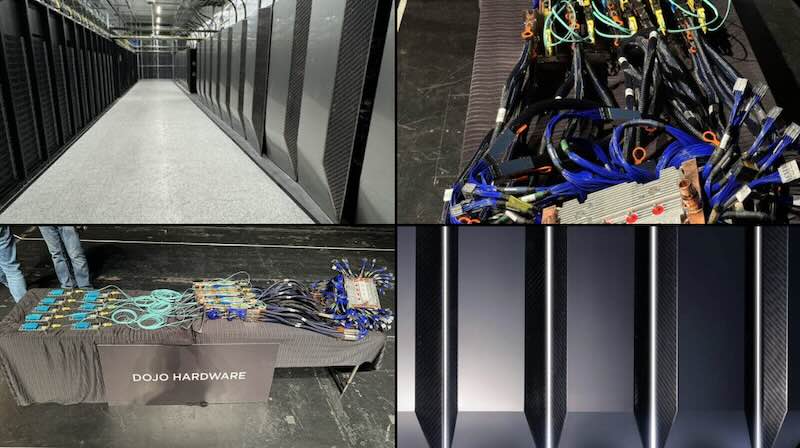
Tesla AI’s new strategy incorporates synthetic data generation as a core component of the training process. Shift fundamentally changes how Tesla approaches model development, moving from purely data-reactive training to proactive scenario creation.
Synthetic data generation offers several strategic advantages over traditional real-world data collection. First, it provides controllability—engineers can create specific driving scenarios, weather conditions, and traffic patterns that might occur infrequently in the real world. Second, it addresses coverage gaps by generating edge cases and rare events that would otherwise require years of real-world driving to encounter naturally.
The efficiency gains from synthetic data can’t be understated. Rather than waiting for specific scenarios to occur organically across Tesla’s fleet, the company can generate targeted training data on demand. This accelerates iteration cycles and allows for more focused model improvements.
Cost considerations also drive this strategic shift. While real-world data collection requires maintaining and processing information from millions of vehicles, synthetic data generation can scale more predictably through cloud infrastructure investments.
The misconception surrounding Tesla’s Dojo program stems from viewing it as either operational or discontinued. Reality’s more nuanced—Tesla’s planning a hybrid infrastructure approach that leverages both custom silicon and external suppliers strategically.
Dojo 3, built around Tesla’s AI5 and AI6 chips, won’t primarily serve as a training cluster but rather as a high-bandwidth inference platform. This inference capability becomes crucial when generating synthetic datasets at scale. System will run Tesla’s world model to create vast amounts of synthetic driving scenarios, which then feed into the broader training pipeline.
Tesla’s AI5 and AI6 chips aren’t disappearing—they’re being repositioned for specific use cases where Tesla’s custom architecture provides advantages. These chips will power inference operations in vehicles, drive synthetic data generation in cloud environments.
The company’s maintaining Nvidia GPU clusters for training massive-parameter world models, recognizing that established hardware excels in certain computational tasks.
Tesla’s synthetic data strategy aligns with broader AI industry trends. Leading AI companies increasingly rely on synthetic data for model training, recognizing its potential to overcome real-world data limitations.
The autonomous vehicle industry faces unique challenges regarding data quality and scenario coverage. Traditional approaches require extensive real-world testing to encounter rare but critical driving situations. Synthetic data generation allows companies to train models on scenarios that might never occur during standard testing periods.
Understanding the distinction between training and inference clarifies Tesla’s strategic positioning. Training occurs in cloud environments where computational resources can be pooled and scaled dynamically. Inference happens at the edge—in vehicles and robots—where efficiency and latency matter more than raw computational power.
Tesla’s hybrid approach optimizes both operations: cloud-based training leverages the best available hardware regardless of manufacturer, while edge inference utilizes custom silicon designed specifically for Tesla’s use cases.
Pete Bannon’s departure represents more than just a personnel change—it signals Tesla’s evolution beyond traditional hardware development toward integrated AI systems. Bannon oversaw not only Dojo development but also AI5 and AI6 chip programs, vehicle low-voltage electronics, and Optimus hardware integration.
Since Jim Keller’s departure in 2018, Bannon served as Tesla’s primary semiconductor and electronics leader. His exit doesn’t indicate program cancellation but rather reflects the company’s shifting priorities toward software-hardware integration rather than pure silicon development.
The timing of these changes coincides with Tesla’s broader AI strategy maturation. Rather than developing hardware in isolation, the company’s focusing on how custom silicon integrates with synthetic data generation, real-world deployment, and continuous model improvement cycles.
Tesla’s AI development roadmap for the next two to three years outlines a sophisticated multi-platform strategy. The company will continue using Nvidia GPU clusters for world model training while developing Dojo 3 as a dedicated inference platform for synthetic data generation.
This dual-track approach allows Tesla to optimize different aspects of its AI pipeline independently. World model training benefits from Nvidia’s mature ecosystem and extensive software tools, while synthetic data generation can leverage Tesla’s custom silicon advantages.
Tesla’s strategy doesn’t abandon custom silicon development—it reimagines how that hardware contributes to a comprehensive AI ecosystem. The company’s betting that synthetic data generation will become increasingly important for autonomous vehicle development, positioning Dojo as the foundation for this capability rather than a traditional training cluster.
Related Post
Tesla DOJO Supercomputer and Custom Network Protocol at Hot Chips 2024
Tesla Hits 110 EFLOPS AI Milestone for Autonomous Driving
Tesla Raw Vision Gambit: Vision-Only Active Safety, Pure Vision and Sensor Fusion