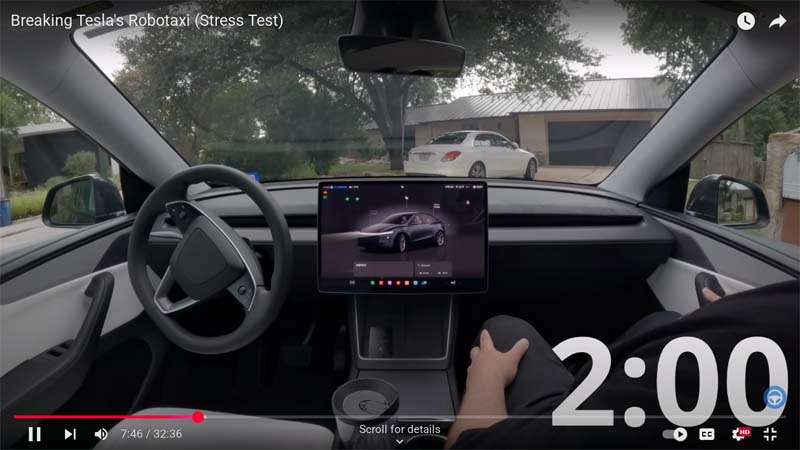
Tesla’s autonomous vehicle ambitions took center stage recently when a dedicated content creator – ΛI DRIVR, spent nearly $300 testing the company’s Robotaxi service across four intensive days. The results? A mixed bag that reveals both impressive capabilities and lingering limitations in Tesla’s approach to self-driving technology.
The testing involved 69 individual rides at $4.20 each, providing substantial real-world data about Tesla’s Robotaxi performance. What emerged wasn’t the revolutionary FSD v14 system many expected, but rather what appears to be an enhanced version of the existing v13+ platform.
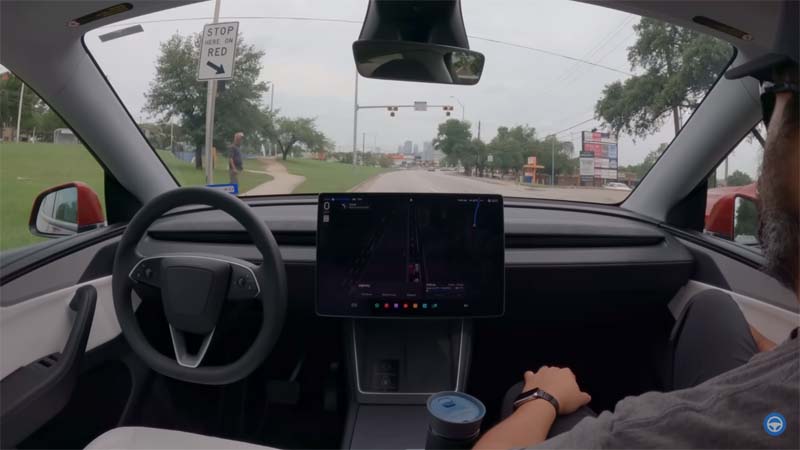
However, Tesla’s system demonstrated remarkable sophistication in areas where competitors often struggle. The vehicle consistently avoided problematic pickup and dropoff locations, even when passengers set destinations in no-parking zones or busy street centers. Instead of stopping illegally, Tesla’s Robotaxi would cruise forward, actively searching for appropriate stopping points that wouldn’t disrupt traffic flow.
This behavior represents more than simple programming—it requires genuine semantic understanding of urban environments.
The navigation system showed equally impressive decision-making when encountering blocked routes. Rather than waiting for map updates, Tesla’s Robotaxi made independent routing decisions, often turning or detouring before the navigation system completed recalculation. Suggests Tesla’s neural networks operate faster than traditional mapping systems.
Austin’s challenging weather conditions during the test period provided an unexpected stress test. Continuous heavy rain and flooding created scenarios that typically force human drivers to exercise extreme caution. Tesla’s Robotaxi navigated these conditions confidently, using curbs as reference points when roads became partially flooded.
Performance highlights a key distinction between Tesla’s production FSD v13 and the Robotaxi variant. While consumer vehicles prompt driver intervention during adverse weather, Robotaxi system operates without these safety restrictions. Underlying hardware and software clearly possess the capability—it’s regulatory caution that limits production vehicles.
Testing revealed sophisticated safety protocols that extend beyond basic autonomous driving. When the reviewer simulated falling asleep at the destination, Tesla’s remote monitoring system contacted the passenger within two minutes. Demonstrates Tesla’s prepared contingency planning for edge cases that competitors might overlook.
Perhaps most intriguingly, the safety operator remained virtually invisible throughout rides, only maintaining contact with the door release mechanism. This simple but effective override system allows instant Autopilot disengagement without complex modifications. Tesla’s decision to leverage existing safety mechanisms rather than developing proprietary solutions suggests practical engineering priorities.
The reviewer’s accidental nap during one ride highlighted Tesla’s Robotaxi’s unique psychological advantage—complete consistency. Unlike human drivers who might experience road rage, impairment, or emotional volatility, every Tesla Robotaxi delivers identical performance. This predictability fostered enough trust for a typically cautious passenger to fall asleep comfortably.
Despite impressive achievements, Tesla’s Robotaxi revealed notable technical gaps. Front surround cameras appear inactive, creating dangerous blind spots directly ahead of the vehicle. Objects placed in the windshield camera’s blind spot—but visible to surround cameras—remain undetected, potentially causing collisions.
The comprehensive testing positions Tesla’s Robotaxi as competitively viable against established players like Waymo and Zoox, particularly in practical operational scenarios. While technical limitations exist, Tesla’s advantages in pickup logistics, weather performance, and passenger safety protocols demonstrate meaningful differentiation.
Tesla’s approach prioritizes real-world usability over perfect technical execution—a strategy that might prove more commercially viable than competitors’ comprehensive but slower development approaches. The willingness to deploy systems with known limitations while maintaining safety through remote monitoring and simple override mechanisms suggests confidence in iterative improvement strategies.
For passengers seeking reliable, consistent autonomous transportation, Tesla’s current offering appears surprisingly taxi-fying.
Related Post
Tesla vs Waymo: Kyle Vogt Explains the Real Robotaxi Divide That Matters Most
Tesla Robotaxi First Collision Has Been Recorded, Raises Autonomy Questions
Tesla Robotaxi Doubles Austin Coverage: 80 Square Miles of Autonomous Service