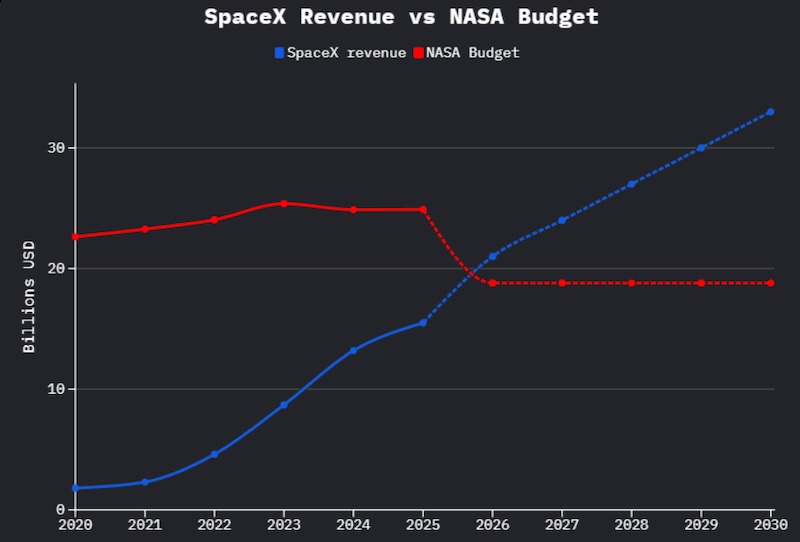
Elon Musk has announced that SpaceX’s revenue will reach approximately $19 billion by 2026, representing a 27% increase from its current $15 billion in 2024. Projection puts the private space company on track to surpass NASA’s entire annual budget, marking a watershed moment in the commercialization of space.
“Total revenue that SpaceX will receive from NASA this year is ~$1B out of ~$15B total, so ~7%,” Elon stated, emphasizing the company’s decreasing reliance on government contracts. “Moreover, NASA is paying SpaceX for astronaut & cargo transport to the Space Station, launching research satellites and some work for returning to the Moon.”
SpaceX’s relationship with NASA represents a new model of public-private partnership in space exploration. According to Elon, all contracts with the space agency were secured through competitive bidding processes, saving taxpayers significant amounts while providing critical capabilities.
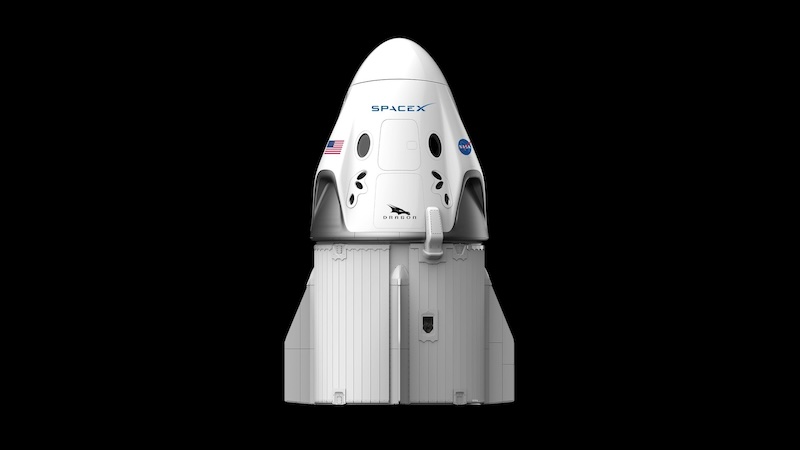
August 25, 2024, NASA has announced a significant change to its plans for returning astronauts from the International Space Station (ISS). SpaceX’s Dragon capsule will now bring back Astronauts Butch Wilmore and Suni Williams, replacing Boeing’s Starliner in this crucial mission.
“All of these contracts were won in competitive bids, so the government would either be paying a lot more or, in some cases such as astronaut transport, have no other means of safely getting the job done,” Elon noted. “There are zero handouts. Zero.”
This arrangement has transformed what was once exclusively government territory into a competitive commercial landscape. SpaceX’s revenue is increasingly driven by its Starlink satellite internet service, which now funds much of the company’s ambitious Starship development program.
The company’s satellite internet constellation has become the primary engine behind SpaceX’s remarkable growth. With over half a million subscribers globally, Starlink has transformed from an experimental side project to the financial backbone supporting SpaceX’s most ambitious technical goals.
Starship, the company’s next-generation fully reusable spacecraft, is “primarily privately funded via Starlink revenue,” according to company statements. Self-funding capability gives SpaceX significant autonomy in pursuing its long-term vision of Mars colonization without depending on government appropriations or shifting political priorities.
Projected $19 billion revenue by 2026 represents more than just financial success—it signals a fundamental restructuring of the space industry’s economic model. SpaceX has consistently driven down launch costs through reusability and vertical integration, creating new markets and opportunities previously constrained by prohibitive expenses.
While NASA continues to play a critical role in space science and exploration, the agency increasingly partners with private companies rather than building and operating all systems internally. Allows NASA to leverage commercial capabilities while focusing resources on scientific missions and deep space exploration.
As SpaceX’s revenue approaches the scale of NASA’s budget, the question isn’t whether private enterprise will replace government space programs—it’s how these complementary approaches will reshape humanity’s future beyond Earth.
Related Post
SpaceX Installs Massive Fuel Transfer Tube in Next Generation V3 Super Heavy Booster
Starlink V3 Satellites Promise Sub-20ms Latency Launch in 6-9 Months
Elon Mars Presentation: Starship V3 Launch 2025, Tesla Optimus Robots to Mars 2027