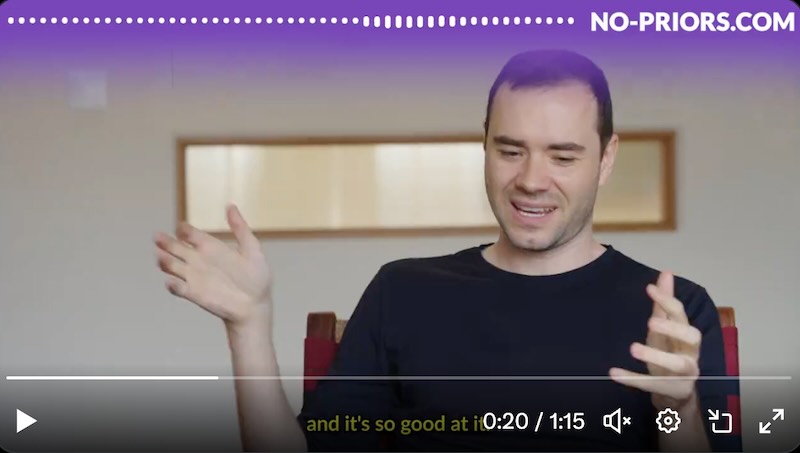
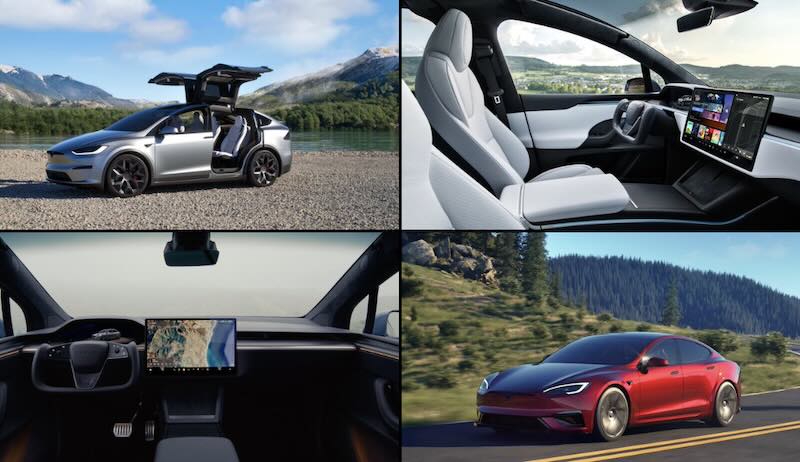
Andrej Karpathy, Tesla’s former Director of AI, shared his first impressions of Tesla’s FSD system after taking delivery of a new Model X equipped with HW4. His detailed assessment of version 13.2.9 has sparked renewed interest in the company’s autonomous driving progress, particularly among those who followed his tenure from 2017 to 2022. Review comes as Tesla continues advancing its end-to-end neural network approach, which processes sensor data through what Karpathy describes as a dedicated “driving brain.”
Performance gap between HW3 and HW4 appears significant based on Karpathy’s observations. His previous vehicle ran the older hardware configuration, which now seems noticeably less refined than the current generation. HW4 system demonstrated smooth operation throughout his test drive, handling various scenarios without requiring driver intervention.
Tesla’s FSD has progressed substantially since Karpathy’s early days at the company. He recalled his first test drive on Highway 280 nine years ago, when the system required constant corrections during basic maneuvers. Today’s version operates with what he characterized as confidence and consistency, particularly on highways where the vehicle maintains precise lane positioning.
Karpathy’s evaluation covered multiple challenging scenarios that previously troubled Tesla’s FSD development. System managed tight lane negotiations with oncoming traffic, navigated around construction zones and stationary vehicles, and executed complex left turns with cross-traffic from multiple directions. It yielded appropriately at a four-way stop when another driver broke protocol, merged into dense traffic, and even overtook a bus while still observing a partially obscured stop sign.
The drive concluded with autonomous parking lot navigation, vehicle identified an available space and completed the parking maneuver independently. Karpathy noted this marked a departure from his previous testing routine, which typically generated approximately 20 improvement clips per neighborhood drive. This session produced zero.
Recent presentations by Ashok Elluswamy Tesla’s VP of AI at ICCV25 revealed technical details behind Tesla’s FSD improvements. Architecture processes multiple sensor streams, including video, maps, kinematics, and audio, across extended timeframes of roughly 30 seconds. Data feeds into large neural networks that output steering and acceleration commands, occasionally with visualization data.
Full video of the ICCV '25 presentation pic.twitter.com/x7xWvYEUIa
— Ashok Elluswamy (@aelluswamy) October 24, 2025
In a recent 30-minute presentation, Ashok revealed how the company is creating fully synthetic driving environments that could fundamentally transform neural video engine creates synthetic driving worlds, how self-driving systems are trained, tested, and improved. Virtual world-building capability represents a significant advancement in Tesla’s quest to achieve full autonomy.
Approach represents what Karpathy calls the transition from V1.0 to V2.0, replacing hand-coded abstractions with systems that scale through fleet data and computational capacity. Vision-only, end-to-end methodology differs from competitors’ sensor fusion approaches, relying entirely on camera inputs processed by neural networks trained on millions of miles from Tesla’s vehicle fleet.
Despite his positive assessment of Tesla’s FSD, Karpathy maintains that true self-driving remains distant. When questioned about statements he made on Dwarkesh Patel’s podcast weeks earlier, calling self-driving “not even near done”, he clarified his perspective. His definition extends beyond current capabilities to a future where autonomous vehicles dominate street traffic, operating at the level depicted in science fiction.
The gap between HW3 and HW4 performance has raised questions about older vehicles. Karpathy suggested the engineering team might employ distillation techniques, methods proven effective in large language models to transfer HW4 capabilities to HW3. Could potentially elevate performance across Tesla’s existing fleet without hardware upgrades.
Continues advancing toward fully autonomous operation, though the timeline for widespread deployment remains uncertain. For now, Tesla’s FSD represents incremental progress rather than the complete autonomy Karpathy envisions, even if the current system drives remarkably well.
Related Post
Elon Musk ‘Insane’ AI Ambitions for Tesla Revealed by Key Engineer Ashok Elluswamy
Tesla FSD V14.1.2 Introduces Mad Max Mode: Higher Speeds, Aggressive Lane Changes
Tesla AI Visionary Reveals Roadmap for Self-Driving Cars and Robots