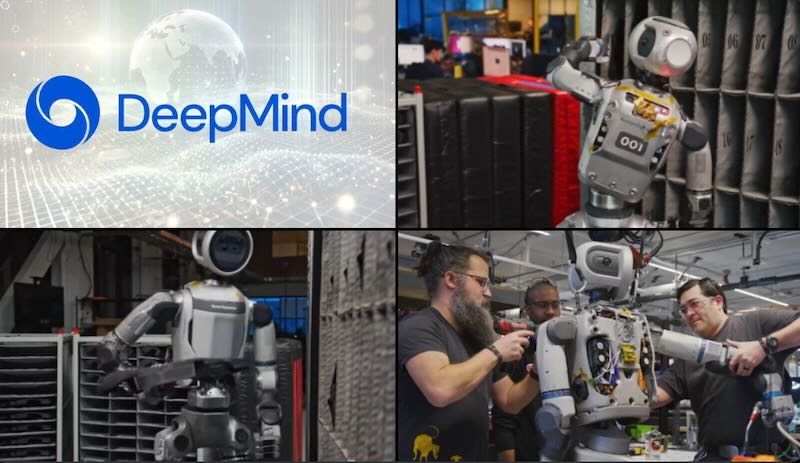
Google DeepMind has officially entered the robotics race with a strategic hire that signals serious intent. The AI research lab just brought on Aaron Saunders, former CTO of Boston Dynamics, to lead hardware engineering efforts. A departure from Google’s traditional approach of backing smaller robotics startups through investments. Instead, DeepMind is building its own hardware capabilities in-house, and the implications for the robotics industry could be substantial.
Goal behind this hire isn’t just to build another robot. Demis Hassabis, CEO of Google DeepMind, wants to turn Gemini into a universal brain for robots. Concept is straightforward yet ambitious: create one unified AI operating system that can work across any physical form, whether that’s humanoids, warehouse bots, or entirely different configurations.
“You can sort of think of it as a bit like an Android play,” Hassabis explained in an interview with WIRED. “We want to build an AI system, a Gemini base, that can work almost out-of-the-box, across any body configuration. Obviously humanoids, but nonhumanoids too.”
This approach could fundamentally change how the robotics market develops. Rather than each company developing proprietary AI systems for their specific hardware, multiple manufacturers could leverage the same cognitive foundation. Think of it as Android for robots — one shared brain, many competing bodies. Moment that happens, robotics shifts from niche prototypes to a full-fledged ecosystem.
Potential market impact is worth considering. If Google DeepMind succeeds in creating this universal robotic brain, the barriers to entry for new robotics companies could drop significantly. Hardware manufacturers wouldn’t need to invest billions in developing their own AI systems from scratch. Could focus on mechanical innovation while relying on Gemini for intelligence.
However, this raises questions about competition and control. Would this world look like paradise of collaboration or chaos of machines? Answer likely depends on implementation, licensing terms, and how open DeepMind makes its platform.
Aaron Saunders isn’t a random hire. He helped build Atlas and Spot at Boston Dynamics, where he started working on an amphibious six-legged prototype before being promoted to VP of engineering in 2018. He became CTO in 2021, overseeing the development of legged robots known for impressive acrobatic capabilities.
Boston Dynamics itself has changed hands multiple times. Google’s parent company Alphabet sold it to SoftBank in 2017, which then sold its stake to Hyundai Motor Company. The South Korean automaker now holds majority ownership.
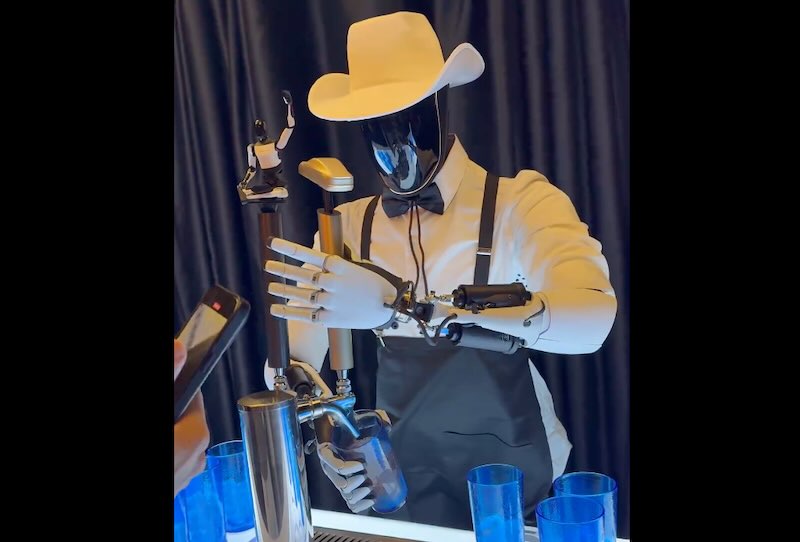
Components and expertise required to build legged robots have become more accessible. Several US startups are working on humanoids, including Figure AI, 1X Tech, and Tesla. Elon recently stated that his company aims to Optimus V3 will be ‘biggest product ever,’ production target of 100K monthly, pushing forward with construction on what appears to be a dedicated production facility for its Optimus humanoid robots at the Giga Texas campus.
Chinese companies are making strides too. Unitree, based in Hangzhou, has overtaken Boston Dynamics as the largest supplier of four-legged systems for industries like manufacturing and construction. Their products are remarkably affordable compared to US alternatives.
Hassabis admits he’s impressed with Unitree but maintains his focus remains on software. “I’m most interested in the brain part of it,” he says, noting that Gemini’s multimodal capabilities are particularly well suited to robotics applications.
Demis Hassabis has proven his ability to execute on ambitious visions. He’s taken DeepMind from a period when few believed in AI’s potential to a position where it’s competing directly with OpenAI. Some observers suggest he’s positioned himself as a potential future CEO of Google.
Hassabis predicts that AI-powered robotics “is going to have its breakthrough moment in the next couple of years.”
Related Post
Tesla Unveils Optimus v3 Humanoid Robot with Hyper-Realistic Hands and Streamlined Design
Tesla Optimus Robot Masters Complex Tasks Through Revolutionary Video Learning