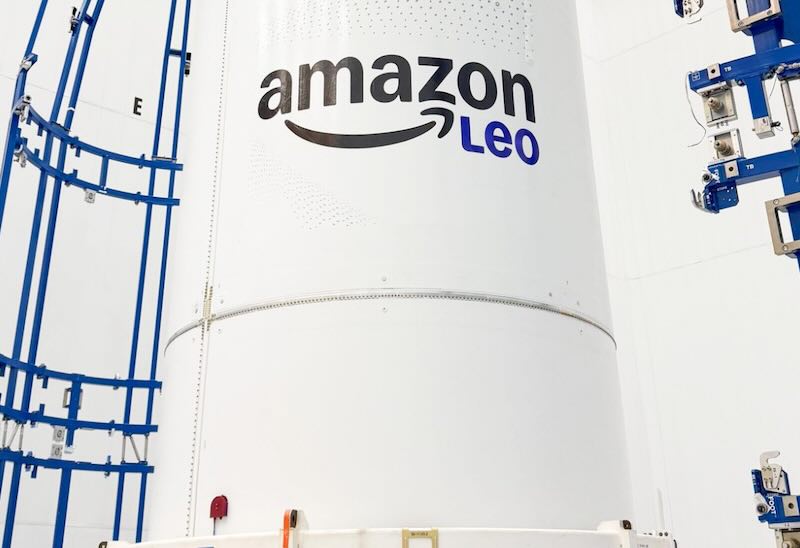
Amazon is officially entering the satellite internet arena. The company just unveiled three new terminals for Amazon Leo, its long-awaited answer to SpaceX’s Starlink service. Though it faces considerable challenges in catching up to its well-established competitor. With varying sizes and capabilities, these terminals are designed to serve everyone from individual consumers to large enterprises.
Amazon Leo’s terminal family includes three distinct models, each targeting different use cases. Nano measures just 7×7 inches and weighs 2.2 pounds, offering download speeds up to 100 Mbps, making it ideal for portable applications. Pro model steps up to 11×11 inches at 5.3 pounds, delivering up to 400 Mbps. Flagship Ultra, a 20×30-inch unit weighing 43 pounds that promises download speeds up to 1 Gbps and upload speeds reaching 400 Mbps.
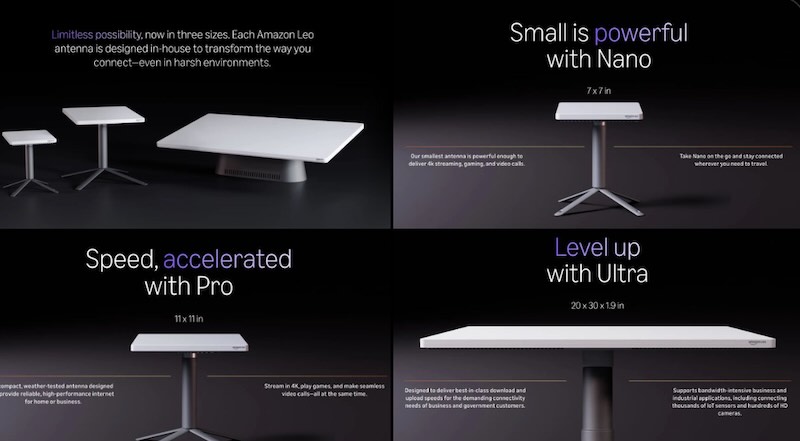
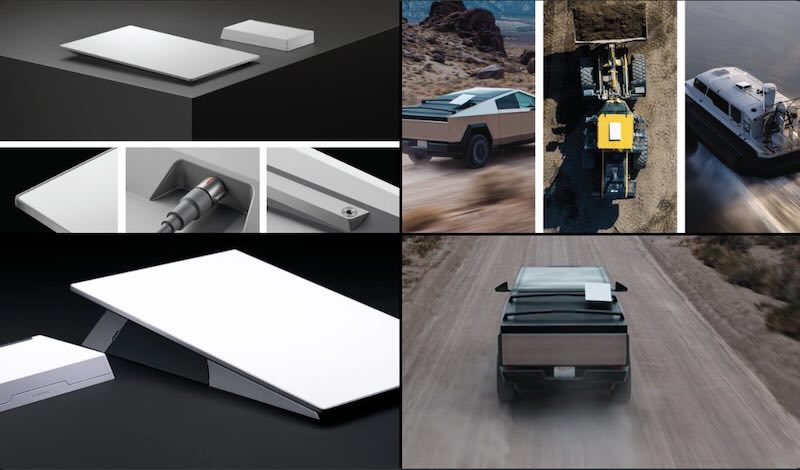
Ultra represents Amazon’s most serious attempt to compete directly with Starlink’s high-performance offerings. Built with full-duplex phased array technology and custom Amazon Leo silicon, the terminal can handle simultaneous upload and download traffic at maximum speeds. Its weatherproof design incorporates an integrated heat sink and measures 20x30x1.9 inches, requiring pole mount installation. However, pricing and availability for all three terminals remain under wraps for now.
Amazon Leo kicked off its preview program this week, marking the first time real users will access the network. Initial rollout is deliberately limited, only select enterprise customers like JetBlue and Hunt Energy Network can participate. Early adopters will receive Leo Ultra terminals to test the network’s capabilities in real-world conditions.
“The full-duplex phased array antenna provides download speeds of up to 1Gbps and upload speeds up to 400Mbps, making it the fastest commercial phased array antenna in production,” Amazon stated. The company emphasized that these speeds can be achieved simultaneously, a feature that could prove valuable for bandwidth-intensive applications like video conferencing and cloud computing. Preview will gradually expand to include Leo Pro users as Amazon adds more coverage and capacity.
Here’s where Amazon faces its biggest challenge. Starlink currently operates approximately 9,000 satellites in orbit, serving over 2 million customers across the US. Amazon Leo? Just 150 satellites. Massive gap matters because satellite internet requires extensive constellation coverage to provide consistent, reliable service. Amazon will need to launch hundreds, if not thousands—more satellites before it can match Starlink’s geographic reach.
Delays in satellite launches have already pushed back Amazon’s timeline. The company previously mentioned beta testing but couldn’t confirm when trials might begin due to launch setbacks. Meanwhile, SpaceX has been steadily expanding its network, signing up businesses, airlines, and even naval vessels. Amazon clearly faces an uphill battle, though network congestion issues that have plagued Starlink in some US regions could create openings for competition.
Amazon Leo’s custom silicon chip incorporates proprietary radio frequency design and signal processing algorithms aimed at maximizing throughput while minimizing latency. Ultra terminal’s weather-resistant design can withstand extreme temperatures, precipitation, and strong winds, critical for enterprise deployments. These technical specifications position Amazon Leo as a serious contender, at least on paper.
Recent regulatory filings with the Federal Communications Commission reveal additional progress. Last week, the FCC granted equipment authorization for an Amazon Leo Wi-Fi router, clearing it to emit radio signals over 2.4 and 5GHz bands. Router supports mesh mode and Bluetooth LE connectivity, suggesting a well-integrated user experience. Documents reference a mobile app for managing the system, though Amazon requested to withhold photos and manuals for 180 days—indicating a launch is approaching.
Amazon executives have indicated that a broader commercial rollout could begin in Q1 of next year, starting with five markets including the US. Leo Pro and Ultra terminals won’t reach general availability until 2026, giving SpaceX plenty of time to further entrench its market position. Preview program serves as Amazon’s testing ground to work out technical issues before the wider launch.
Pricing remains the elephant in the room. Starlink has been aggressively discounting its service, introducing a $40-per-month plan and new $80-per-month plan in certain US areas. Amazon hasn’t disclosed its pricing strategy, though it described Amazon Leo as “affordable, high-speed, low-latency broadband” in FCC correspondence. The company noted its system was “architected with the most demanding customers in mind, including large enterprises, critical infrastructure operators, and the US military, not to mention residential consumers who expect high levels of service.”
Amazon’s entry into satellite internet creates a genuine alternative to Starlink’s dominance, but only if the company can execute quickly. The technical specifications look promising, particularly for the Ultra terminal’s gigabit capabilities. However, Starlink isn’t standing still. SpaceX’s $1,999 Performance dish already delivers 400+ Mbps and is slated to reach gigabit speeds next year. Customers can already achieve gigabit speeds by combining multiple Starlink dishes.
Question isn’t whether Amazon can build competitive hardware. The company has demonstrated it can manufacture quality terminals with impressive specifications. Real challenge lies in launching enough satellites to create a functional network, then attracting customers away from an established competitor. Enterprise customers might be willing to test Amazon Leo as a backup or complement to existing connectivity solutions, but consumer adoption will depend heavily on pricing and availability.
For now, Amazon’s satellite internet ambitions remain more Leo than lion, prowling the edges of the market while trying to build the strength needed to compete head-on with Starlink’s established territory.
Related Post
Amazon Project Kuiper Readies First Production Satellites for April 9 Launch
Amazon Project Kuiper Hits Turbulence: Starlink Rival Delayed to Q4 2024
SpaceX Raptor 3 Engine to Beat Merlin by 4X on Cost Efficiency | Elon Musk Confirms