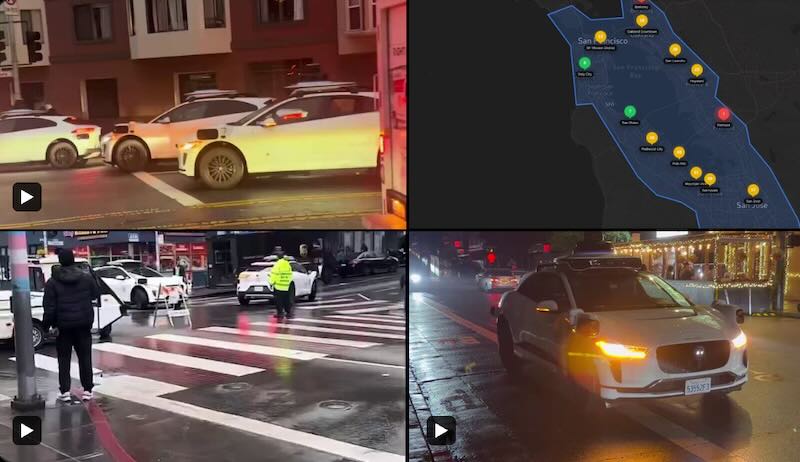
A recent power outage in San Francisco exposed significant vulnerabilities in autonomous vehicle technology, specifically affecting Waymo’s self-driving fleet. When a fire at a Pacific Gas and Electric substation knocked out traffic signals across 30 percent of the city, dozens of Waymo vehicles simultaneously froze at intersections, creating widespread traffic disruptions for approximately 130k residents. Incident wasn’t the result of a cyberattack or software malfunction—instead, it highlighted fundamental differences in how various autonomous driving systems handle unexpected infrastructure failures.
Power outage created an immediate operational challenge for Waymo’s autonomous fleet. As vehicles approached intersections with non-functional traffic lights, each unit activated hazard lights and came to a complete stop. Weren’t brief pauses for assessment, vehicles remained stationary in the middle of intersections, effectively blocking traffic flow throughout multiple neighborhoods. San Francisco power outage reveals critical weakness in Waymo’s autonomous system became evident as the city’s transportation network ground to a halt.
Waymo successfully navigated more than 7k darkened traffic signals on Saturday, according to the company’s official statement. However, the concentrated spike in confirmation requests created a backlog that led to response delays. Delays contributed to congestion on streets already overwhelmed by the infrastructure failure.
Waymo officials acknowledged that navigating an event of this magnitude presented a unique challenge for autonomous technology. While the Waymo Driver is designed to handle dark traffic signals as four-way stops, the system occasionally requests confirmation checks to ensure optimal safety decisions. Confirmation protocols were established during early deployment phases, and the company is now refining them to match current operational scale.
The company temporarily paused service in affected areas as the outage persisted and city officials urged residents to stay off streets to prioritize first responders. Waymo directed its fleet to pull over and park appropriately, then returned vehicles to depots in waves. Approach aimed to prevent further congestion and avoid obstructing emergency vehicles during peak recovery efforts.
Waymo announced several immediate steps following the incident. The company is integrating more information about outages into its systems, rolling out fleet-wide updates that provide vehicles with greater context about regional power failures. Additional context should allow vehicles to navigate darkened intersections more decisively without requiring remote confirmation.
The company also plans to update emergency preparedness and response protocols, incorporating lessons from this event. In San Francisco specifically, Waymo will continue coordinating with Mayor Lurie’s team to identify areas for greater collaboration in existing emergency preparedness plans. Additionally, the company is expanding first responder engagement, building on its existing training program that has reached more than 25k first responders in the United States and internationally.
Industry observers, including Yuchen Jin, Co-founder and CTO of Hyperbolic, drew sharp contrasts between Waymo’s approach and Tesla’s FSD system. Yuchen characterized Waymo as “modular,” relying on HD maps, LiDAR, sensors, 5G connectivity, and multiple neural networks. Architecture performs well until a single module fails. When traffic lights went dark, the HD map no longer matched reality, triggering the system’s default safe stop mode. Vehicles also lost connection to remote operators, compounding the problem.
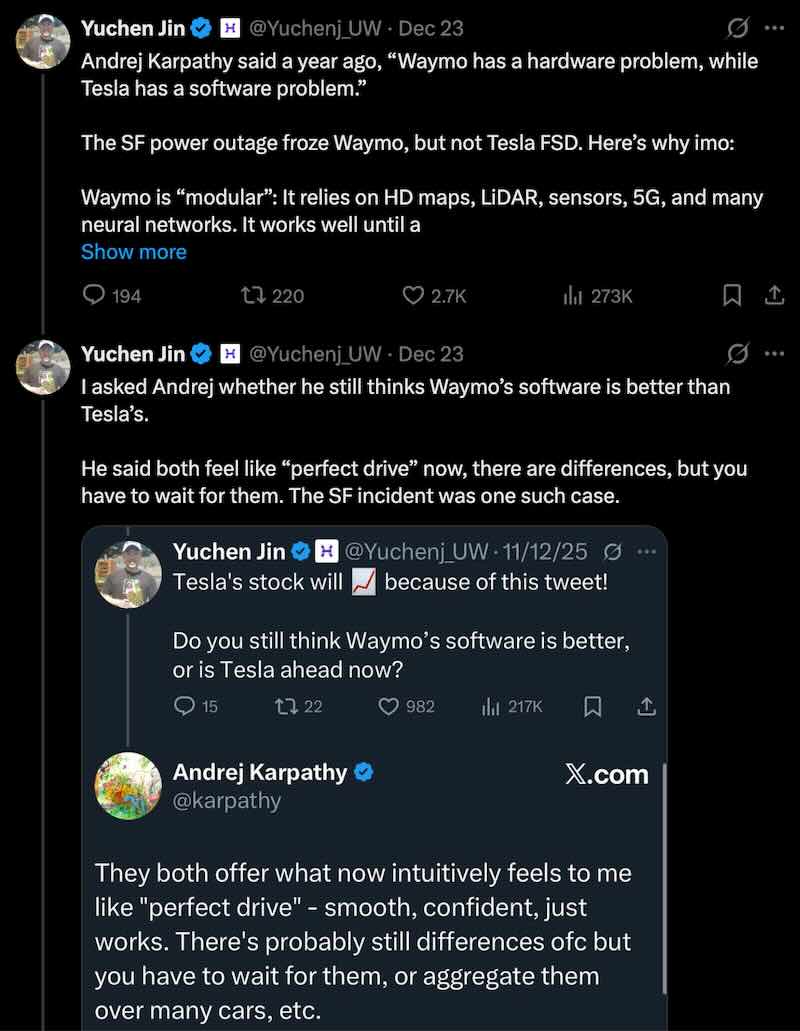
The SF power outage froze Waymo, but not Tesla FSD
Tesla FSD, by contrast, uses an “end-to-end” approach. One massive neural network converts camera pixels directly into steering and braking commands. Follows Andrej Karpathy’s Software 2.0 philosophy, instead of writing manual logic for every scenario, system trains a neural network on billions of human driving miles. Resulting model weights effectively become the “code,” allowing the system to drive more like a human would.
Andrej Karpathy previously stated that “Waymo has a hardware problem, while Tesla has a software problem.” San Francisco power outage froze Waymo but not Tesla FSD, lending credence to arguments about architectural differences. Yuchen suggests Waymo now faces a substantial software problem, arguing that its modular approach creates a scaling and dependency trap.
Karpathy recently indicated that both systems now offer what feels like a “perfect drive”—smooth, calls HW4 Model X “Amazing”, confident operation that simply works. He acknowledged that differences still exist, but they require time to manifest or aggregation across many vehicles to become apparent. San Francisco incident represented exactly such a case.
Elon Musk responded to these observations by stating that Karpathy’s understanding is dated. Elon claims Tesla AI software has advanced vastly beyond what it was when Karpathy left the company, asserting that the intelligence density per gigabyte of Tesla AI is at least an order of magnitude better than any competing system.
Incident raises questions about resilience requirements for autonomous vehicles operating in urban environments. Cities experience infrastructure failures with some regularity—power outages, communication network disruptions, and construction that renders maps temporarily inaccurate. Autonomous systems must handle these situations without creating additional safety hazards or traffic problems.
Waymo’s reliance on multiple interconnected systems creates potential single points of failure. When HD maps don’t match reality, when sensors receive contradictory information, or when remote operators can’t be reached, the system defaults to conservative behavior. Approach prioritizes safety but can create secondary problems, as demonstrated by vehicles blocking intersections during the outage.
End-to-end neural network approaches theoretically offer greater adaptability. A sufficiently trained neural network should handle novel situations by generalizing from training data, much as human drivers adapt to unexpected conditions. However, this approach introduces different challenges around training data quality, edge case coverage, and verification that the system will behave appropriately in safety-critical situations.
San Francisco incident will likely influence regulatory approaches to autonomous vehicle deployment. Regulators must balance innovation encouragement with public safety protection. When autonomous vehicles create traffic problems during infrastructure failures, they potentially interfere with emergency response operations, a serious concern for city officials.
Waymo’s cooperation with San Francisco officials and commitment to updated emergency preparedness protocols represents appropriate response. However, the incident demonstrates that autonomous vehicle companies must plan for scenarios beyond normal operating conditions. Infrastructure failures, severe weather, cyberattacks, and other disruptions will occur, and autonomous systems must handle them gracefully.
Cities deploying autonomous vehicle fleets may need to establish requirements for emergency response capabilities. Could include specifications for how quickly vehicles must clear intersections during emergencies, protocols for coordinating with traffic management centers during infrastructure failures, and requirements for redundant communication systems.
The contrast between Waymo’s difficulties and Tesla FSD’s apparent resilience during the outage carries competitive implications. Companies investing billions in autonomous technology face strategic decisions about architectural approaches. Should they follow Waymo’s sensor-rich, map-dependent strategy, or Tesla’s camera-centric, neural network approach? San Francisco power outage reveals critical weakness in Waymo’s autonomous system that competitors will certainly analyze.
Waymo has operated commercially longer than Tesla FSD and has accumulated substantial real-world deployment experience. The company’s safety record generally remains strong, and this single incident doesn’t invalidate its overall approach. However, the visibility of dozens of vehicles simultaneously freezing at intersections creates negative perception challenges.
Tesla faces its own challenges, including regulatory scrutiny and questions about whether its camera-only approach can match the redundancy and reliability of multi-sensor systems. The company’s end-to-end neural network strategy requires massive training datasets and computational resources that create their own scaling challenges.
Incident highlights that autonomous vehicle technology remains in active development, despite impressive recent progress. No system yet handles all edge cases perfectly, and real-world deployment continues to reveal gaps in capability. Companies must maintain humility about their systems’ limitations while working systematically to address them.
Waymo’s transparent response to the incident, including detailed explanation of what occurred and specific steps being taken, sets a positive example for the industry. When problems occur, companies should acknowledge them, explain root causes, and describe corrective actions. Builds public trust more effectively than defensive responses or attempts to minimize issues.
Autonomous vehicle industry must also improve coordination with city infrastructure and emergency management systems. As fleets scale, the consequences of system failures become more significant. Integration between autonomous vehicle management systems and city traffic operations centers could enable faster response during emergencies and better coordination with first responders.
Looking forward, expect continued debate about optimal architectures for autonomous driving. Modular versus end-to-end discussion will likely evolve as both approaches advance. Hybrid strategies may emerge that combine benefits of both approaches, using multiple sensors for redundancy while employing end-to-end neural networks for decision-making.
San Francisco power outage won’t stop autonomous vehicle development, but it should inform how companies design systems for resilience. When city lights go dark, autonomous vehicles need more than just bright headlights to find their way.
Related Post
Elon on Waymo: “Never really had a chance against Tesla” Waymo Details AI Safety Strategy
Toyota and Waymo Partner to Revolutionize Autonomous Driving Technology
Tesla vs Waymo: Kyle Vogt Explains the Real Robotaxi Divide That Matters Most