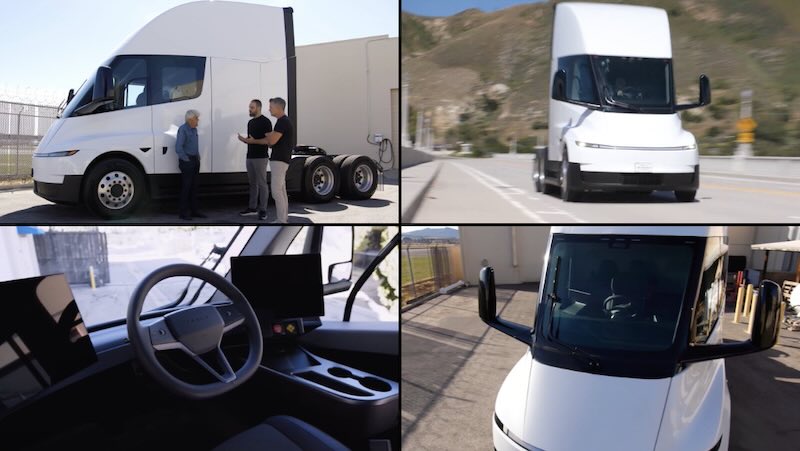
There’s a moment in Jay Leno’s latest 47-minute video where he steers the redesigned Tesla Semi through a tight turn, pauses, and simply says, “Nice turning radius. Boy, that’s pretty amazing.” Coming from someone who’s driven just about everything with an engine, that’s not a throwaway comment. Tesla handed Leno the keys, making him the first person outside the company to drive the redesigned truck, and what came out of that session is one of the more revealing looks at where commercial EV technology actually stands today.
Sitting alongside Leno was Dan Priestley, Tesla’s head of Semi engineering, and Franz von Holzhausen. Together, they walked through a set of upgrades that signal a serious second-generation effort, not a cosmetic refresh.
Redesigned Tesla Semi now runs on a 48-volt architecture, ditches hydraulic steering in favor of fully electric steering assist using beefed-up Cybertruck actuators, and integrates 4680 cells engineered to last one million miles. Notably, Tesla’s engineers cut roughly 1,000 lbs from the truck compared to its predecessor — a meaningful reduction for any freight operator watching payload margins.
Tesla is offering the Semi in two configurations : a Standard Range model rated at 325 miles with a shorter wheelbase, and a Long Range variant pushing 500 miles. That shorter wheelbase on the Standard Range delivers something operators rarely associate with Class 8 trucks — a turning radius comparable to a Model Y.
Dan described a pattern he’s observed repeatedly during test drives: “During rides, it’s common for drivers to comment on how good the turning radius is, but they’re only 3/4 of the way to lock. I’ll chime in ‘oh you can keep going’ and they turn the wheel more and are blown away.” For fleet managers running urban distribution routes, that kind of maneuverability isn’t a nice-to-have — it’s operationally critical.
Beyond the engineering, Dan made the financial case directly. In California, the Tesla Semi costs 50% less to operate on an energy basis than a diesel equivalent. Across the broader U.S., that figure settles at 20% cheaper per mile — and that’s all-in, accounting for reduced maintenance and fuel costs together.
Those numbers land differently when paired with real-world fleet data. Tesla currently has several hundred Semis logging miles commercially, with a combined 13.5 million miles traveled. One truck alone has hit 440,000 miles, hauling at 82,000 lbs gross combined weight for nearly 18 million ton-miles — with total energy throughput exceeding 1 GWh. Fleet uptime sits at 95%, and 80% of breakdowns result in the truck returning to the customer within 24 hours. Half are resolved in under an hour.
To contextualize the scale: achieving the same ton-miles in a Model Y would require over 7 million miles of driving.
Redesigned Tesla Semi isn’t just a truck — it’s a data-backed argument that electric freight is no longer speculative. With a production-ready platform, verifiable fleet performance, and an architecture built for longevity, Tesla appears to have shifted the conversation from “can it work?” to “can competitors keep up?”
For Tesla’s Semi program, the miles are just getting started — and it’s safe to say this truck means serious haul-ness.
Related Post
Pilot Travel Centers and Tesla Launch Semi Charger Network at 35 US Locations
Tesla Semi Refresh: New Design, Same Range Before 2026 Launch
Tesla First SemiCharger Launch: V4 Superchargers & 1.2 MW Power Set for Carson, CA