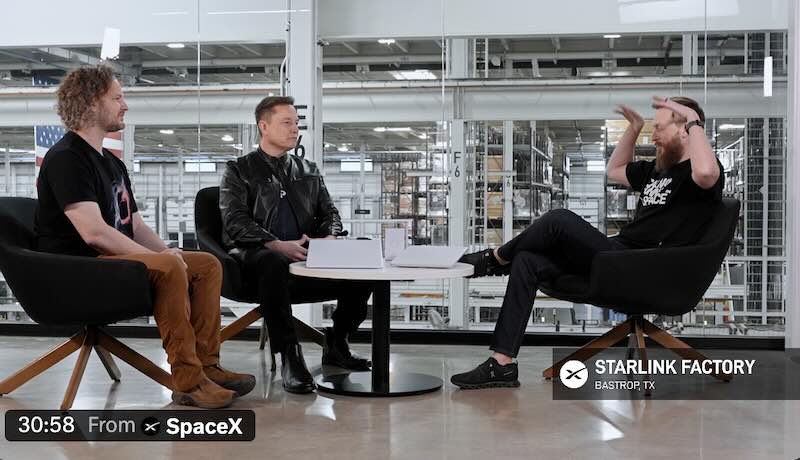
SpaceX didn’t come to play. In a sweeping video interview filmed at its Starlink terminal factory in Bastrop, Texas, the company dropped a series of announcements that, taken together, signal a fundamental shift in how it sees its role — not just in satellite internet, but in global compute infrastructure, energy, and the long-term trajectory of human civilization. There’s a new generation of Starlink terminals, a first-of-its-kind AI satellite, and a manufacturing footprint that makes even Tesla’s Giga Texas look modest by comparison.
If you thought SpaceX was just an internet provider that happened to build rockets, it’s time to recalibrate.
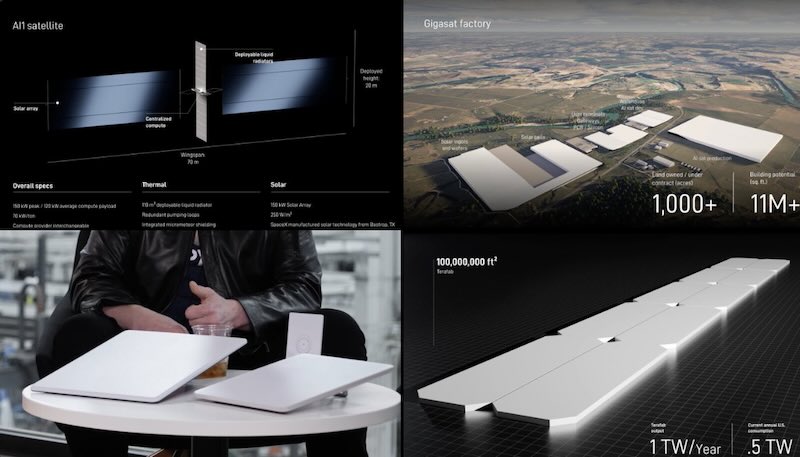
During the video, Elon stood beside two new Starlink dish models and confirmed they’re already in production. “These are the new Starlink terminals, which we made in much higher volume than the current terminals,” he said. The goal? “A few hundred million Starlink terminals out there.” That’s not a typo.
Both designs appear thinner and lighter than current-generation hardware, and early visuals suggest they’re compact enough to fit inside a standard backpack. Portability factor matters — it points to a consumer-facing strategy where Starlink isn’t just for rural homesteads but for travelers, remote workers, and anyone who needs reliable connectivity away from fixed infrastructure. No pricing has been confirmed yet, and the new units haven’t appeared on the official Starlink site.
Timing isn’t accidental. Starlink recently crossed 12 million active customers, and SpaceX is widely reported to be preparing for a public offering. Scaling terminal volume is one of the clearest levers for growing subscriber counts ahead of that milestone.
Perhaps the most technically striking announcement was SpaceX’s official unveiling of its AI1 satellite — the first generation of what the company is calling its AI compute satellite platform.
Specs are worth reading carefully. AI1 carries a 150 kW peak compute payload (120 kW average), with an efficiency rating of 70 kW per ton. Its wingspan stretches 70 meters, with a deployed height of 20 meters.
Thermal management is handled by a 110 m² deployable liquid radiator with redundant pumping loops and integrated micrometeoroid shielding — a system designed to handle the heat loads that come with running serious compute workloads in orbit. Solar array delivers 150 kW at 250 W/m², and SpaceX is manufacturing that solar technology itself, in Bastrop.
Compute provider is listed as interchangeable, which leaves room for enterprise or government partnerships down the line.
Elon framed the AI1 as architecturally simpler than a Starlink satellite, despite its physical scale. “You don’t have all of the super complex antennas that you have on a Starlink satellite,” he explained. Much of it builds on existing Starlink V3 satellites technology, which means SpaceX isn’t starting from scratch — it’s leveraging a production advantage it’s spent years building. Strategic framing is clear: take the orbital infrastructure SpaceX already knows how to build and repurpose it as an AI compute layer, accessible from space.
To produce the AI1 at scale, SpaceX announced the Gigasat factory, also in Bastrop. Facility will begin producing AI satellites by the end of 2027, with over 1,000 acres of land already owned or under contract and more than 11 million square feet of building potential. It’ll also manufacture solar ingots, wafers, and cells on-site — full vertical integration, SpaceX-style.
But the Gigasat is just a stepping stone. Elon described a longer-term facility called TERAFAB, projected at roughly 100 million square feet — approximately ten times the size of Giga Texas. Its target output is 1TW per year of solar generation capacity, which, for context, exceeds the entire current annual electricity consumption of the United States.
Kardashev framing Elon used wasn’t incidental: “In order to make some progress on the Kardashev scale, we need to launch satellites to orbit Earth and capture solar power.” Cooling, he noted, is far easier in space than on the ground — a practical consideration for data centers that typically burn enormous energy just managing heat.
Taken individually, each announcement is notable. Taken together, they outline a company that’s pivoting — deliberately and at scale — toward becoming a vertically integrated provider of orbital infrastructure, energy, and compute. New Starlink terminals address consumer reach. AI1 satellite addresses enterprise and sovereign compute demand. Gigasat and Terafab address production constraints before they become bottlenecks.
Starship ties it all together. With a planned trajectory from 2,500 tonnes to orbit annually to potentially one million tonnes per year within three years, SpaceX is betting that launch economics will eventually make all of this cost-effective. “It’s going to revolutionize space,” Elon said of Starship. “By version 4, we’ll be 3x the thrust of the Saturn V rocket.”
Whether or not every timeline holds — and SpaceX’s track record on timelines is, to put it charitably, ambitious — the direction is unmistakable. SpaceX isn’t building toward a moment. It’s building toward an era.
Related Post
SpaceX Terafab Tax Break Approved: What Grimes County Gets in Return
SpaceX TeraFab Eyes Grimes County TX for $119B Chip Fab Megaproject
Starlink Standard 4 vs Standard 4 X: SpaceX New Dish & Router Bundles Explained