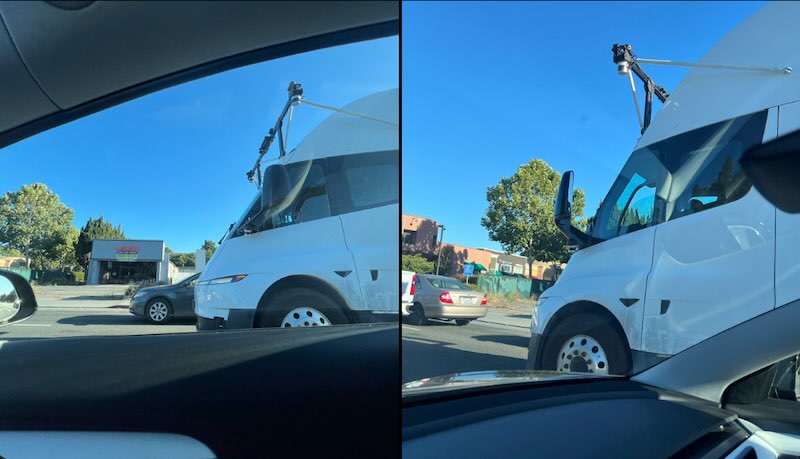
Tesla’s FSD program has long centered on passenger vehicles — but that’s changing. The company is now directing meaningful engineering resources toward Tesla Semi FSD, and sightings on public roads suggest the program has moved well past early-stage validation. An X user named Danny posted: “Spotted the new semi adorned with ground truthing equipment. Haven’t seen anyone post this so figured I’d share. The future is autonomous!!” That’s not a trivial observation. It signals a structured, disciplined push toward commercial-scale autonomy.
Tesla Semi isn’t a Model 3/Y. It’s a long-wheelbase, high-mass vehicle built for long-distance highway transport, that distinction matters enormously. Semi FSD must contend with longer braking distances, extended high-speed stability requirements, prolonged monotonous highway conditions, and greater exposure to adverse weather. Even minor perception errors can compound across long horizons, affecting downstream path planning in ways that passenger-car FSD simply doesn’t encounter at the same scale.
Interestingly, ground-truth calibration LiDAR spotted on the Semi doesn’t appear to be Luminar’s hardware. Based on physical design and scanning behavior, it looks closer to Ouster’s hybrid mechanical–solid-state architecture. Worth clarifying, though: LiDAR isn’t part of the final decision-making pipeline. It’s functioning as a precision measurement instrument, providing spatial ground-truth references for vision models, aligning training data in sensor fusion workflows, and improving 3D environmental consistency in highway scenarios.
Tesla hasn’t abandoned its camera-first approach. Broader strategy remains intact: primary decision-making runs through a vision-based neural network, while auxiliary LiDAR data reduces spatial error and delivers training supervision signals. Both outputs feed into the FSD planning stack.
This isn’t a strategic pivot. It’s the introduction of stronger geometric supervision during training — a pragmatic engineering decision given the Semi’s unique operational profile. Higher-precision spatial alignment tools reduce long-horizon error accumulation, which is non-negotiable when you’re talking about an 80,000-pound vehicle traveling at highway speeds for hours at a stretch.
Related Post
Tesla Semi Charging for Businesses: Pricing, Hardware & Network Fees Explained
Jay Leno Drives the Redesigned Tesla Semi — Here’s What He Found
Tesla Semi Production Specs Released: Standard vs Long Range Trims Detailed