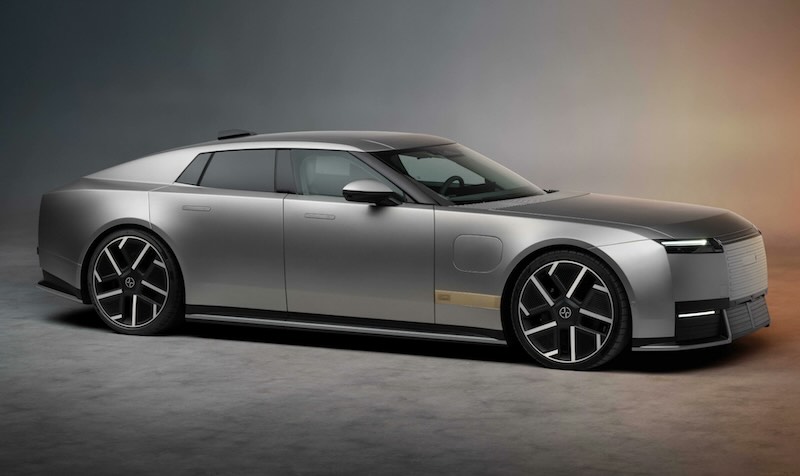
There’s a moment in every legacy automaker’s lifespan where it faces a decision: evolve incrementally or burn the blueprint entirely. Jaguar, a brand that’s spent two decades oscillating between cultural relevance and quiet irrelevance, has chosen the latter. Jaguar Type 01 isn’t a refresh. It isn’t a platform update dressed in new sheet metal. It’s a company-wide wager that radical repositioning — priced, proportioned, and engineered for a buyer who’s never owned a Jaguar before, is the only viable path forward.
That’s either visionary or reckless. Possibly both.
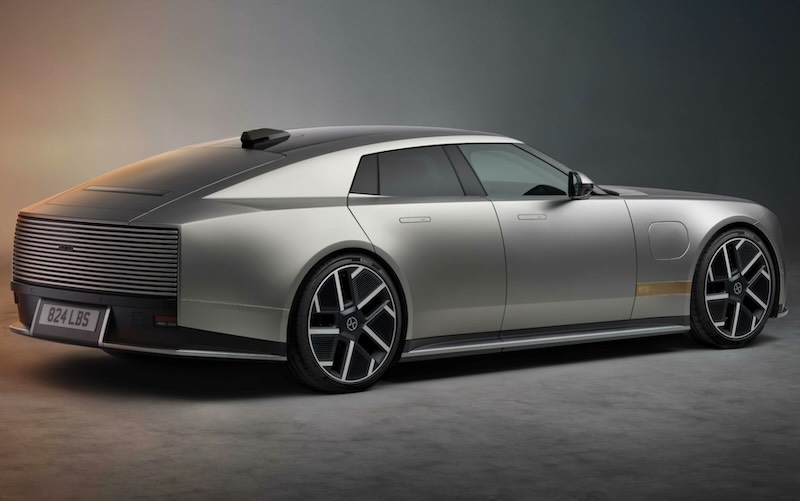
At 5,235 mm long and just 1,403 mm tall, Jaguar Type 01 presents an immediate contradiction. It’s longer than a standard UK parking bay allows, yet somehow delivers less interior room than vehicles with significantly smaller footprints. Rear door openings are narrow. Rear headroom is a compromise. And the 23-inch standard wheels leave minimal room for error in day-to-day urban driving.
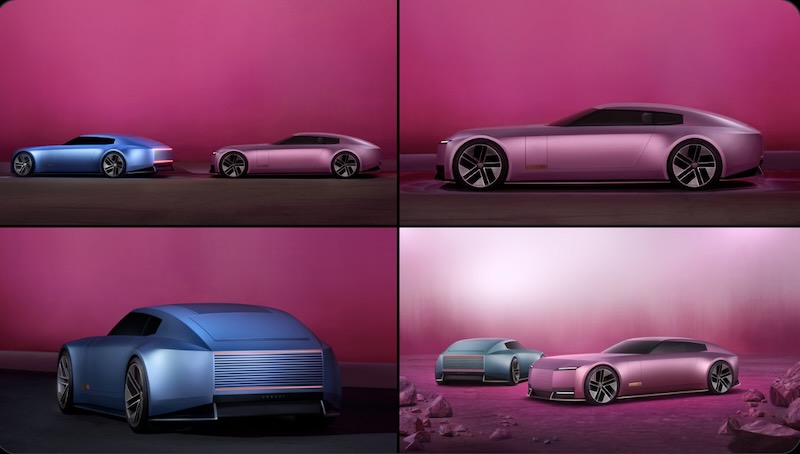
None of that was accidental. Jaguar’s design team locked in the production proportions as early as mid-2021, before the concept car was completed. Subsequent Type 00 concept was effectively engineered backward from production vehicle, functioning more as a public preview of intent than a true design exercise. Design dictated engineering. Full stop.
That reversed process created real problems. Existing EV platforms weren’t configured for this combination of extreme length, width, low roofline, and low seating position. A conventional flat skateboard battery would’ve reportedly required the car to sit roughly 200 mm taller. Instead, Jaguar’s engineers sculpted the battery pack around rear-seat footwells and relocated high-voltage hardware toward the front. Result is near-perfect 50:50 weight distribution, a seat cushion just 83 mm thick, and a 118 kWh battery, three variables that, under normal development logic, simply don’t coexist.
Engineering the Jaguar Type 01’s exterior pushed manufacturing into uncomfortable territory. Signature stamped body panel, what Jaguar calls the “Impossible Panel”, required a four-story stamping press applying 2,500 tons of force. Tooling alone consumed 22 weeks and more than 1,500 hours of iteration.
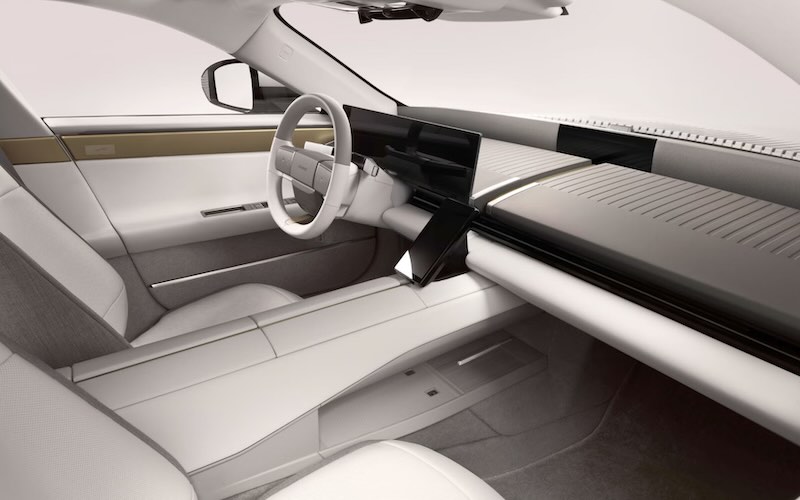
Then there’s the rear window situation. As engineers tightened the rear crash structure and narrowed the tail to satisfy the design team, the rear glass opening shrank until it was barely larger than a mailbox slot. Eventually, Jaguar eliminated it altogether. In its place: a centrally mounted digital rear-view display positioned near the front of the instrument panel, calibrated to roughly match the viewing height of the exterior mirrors.
It’s an unconventional solution, and it’s kind of engineering decision that makes sense only when design priority is non-negotiable.
The “luxury gap” 898 mm distance between the front axle and the door, accounts for roughly 17% of the car’s total length. It’s one of the few deliberate callbacks to classic Jaguar proportions, echoing the ratio found on the original E-Type. Beyond that single reference point, Jaguar Type 01 reads as something entirely disconnected from the brand’s past. Intentionally.
Production Jaguar Type 01 runs a three-motor configuration — two up front, one at the rear, producing 1,016 hp and 1,365 Nm of torque. Makes it the most powerful road-going Jaguar ever built. Its 0–96 km/h time sits at 3.2 seconds, respectable but not the primary engineering focus. 100–180 km/h sprint takes 4 seconds, which is where Jaguar’s engineers say they concentrated their attention.
This is a notable stance. Rather than competing directly with Model S Plaid or the growing list of high-performance Chinese EVs on sub-three-second launch times, Jaguar tuned for real-world driving character, kind of sustained, effortless acceleration that defines grand touring over canyon carving.
Early prototype drives back that positioning. Reviewers described the power delivery as closer to a high-end combustion engine than a typical performance EV.
Despite weighing approximately 2.7 tonnes, Type 01 reportedly carries itself with surprising agility, an impression shaped by dual-valve CDC dampers, air
suspension, and 6 degrees of rear-wheel steering. Jaguar’s engineers drove a 1975 XJC during development, specifically to extract the subjective feel of that car and translate it into Type 01’s chassis behavior.
Of roughly 50k people who’ve registered interest in Type 01, over 80% have no prior Jaguar ownership history. A survey across 2,500 respondents on six continents produced both the highest concentration of 9-and-10 ratings and the highest concentration of 1-and-2 ratings of any Jaguar model tested. Jaguar’s managing director called that result encouraging. Polarization, in this context, signals relevance.
Pricing reflects the repositioning. Entry configuration starts at $130k. For a brand that’s historically competed in the upper-mid luxury segment, this represents a substantial upward move, one aligned with Jaguar Land Rover’s broader strategy of reducing annual break-even volume to around 300,000 units by focusing on higher-margin product.
Over 73% of the body-in-white is aluminum. Development program has produced applications for more than 360 patents. Inverter chips come directly from Jaguar’s Formula E racing program. Peak charging reaches 350 kW, adding up to 320 km of range in 13 minutes. EPA-rated range stands at 640 km.
The charging ports, positioned at the front of the vehicle, are worth noting, especially given that Jaguar has already confirmed Type 01 won’t go on sale in China, where front-mounted charging would create practical complications given local infrastructure habits.
Jaguar isn’t asking whether Jaguar Type 01 fits the current luxury EV market. It’s asking whether the car can define a new corner of it, one where design provocation and engineering ambition matter more than cargo volume benchmarks or five-star practicality scores.
Whether buyers follow is a separate question. But with 80% of interested parties being first-time Jaguar customers, the brand seems to have found an audience it never had before.
Related Post
Porsche Taycan Turbo GT Manthey Kit Sets New Nürburgring EV Lap Record at 6:55.553
Vision-First Autonomy: Horizon HSD Approach to LiDAR and Camera Perception Systems
Tesla Model S End of Production: The Car That Rewrote the Auto Industry
Jaguar Type 01 might just be the car that finally puts the “type” back in typebreaker.