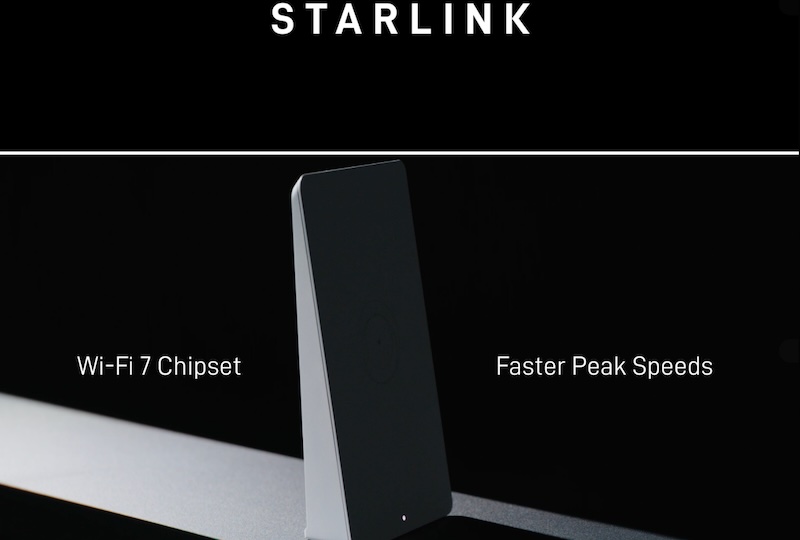
SpaceX doesn’t do incremental. When the company updates its hardware, it tends to make the previous generation feel genuinely obsolete, forthcoming Starlink Router 4 is shaping up to be no exception. SpaceX has developed its first Wi-Fi 7 router for Starlink, a major step forward for a company that has relied on Wi-Fi 6 hardware until now. This isn’t just a spec bump; it’s a foundational shift in how Starlink delivers connectivity to homes and businesses.
What makes the Starlink router 4 different? Router is filed under model number UTR-261, and it appears to be the next version of Mini (UTR-251), which received FCC approval back in April 2025 and was Starlink’s newest router at the time. Headline feature is straightforward: Starlink Router 4 is the first in Starlink’s lineup to ship with a Wi-Fi 7 chipset.
FCC filing links the device to 802.11be in its EHT20 and EHT40 modes, technical designation for Wi-Fi 7. Router also supports older Wi-Fi bands, meaning backward compatibility isn’t sacrificed. In practical terms, Wi-Fi 7’s Multi-Link Operation simultaneously transmits across multiple frequency bands, reducing latency and improving throughput in ways its predecessor simply couldn’t match.
Built for modern households and small offices alike, the Starlink Router 4 covers up to 3,500 sq ft (325 m²) and supports up to 510 devices simultaneously, a number that accounts for smart home ecosystems, laptops, streaming devices, and everything in between. Its tri-band radio configuration, 4×4 MU-MIMO on 2.4 GHz and 4×5 MU-MIMO on 5 GHz — combined with OFDMA support, means congested network environments won’t throttle performance the way older architectures did.
Worth noting, though: the Starlink Router 4 won’t make the satellite connection itself faster. Starlink dishes are still limited to around 400 Mbps, well below what Wi-Fi 7 hardware can actually handle. SpaceX has stated it wants to push the service toward gigabit speeds, but that depends on upgrades to the satellites and dishes, not the router alone.
Weighing just 0.9 lbs (0.4 kg) and measuring 1.8″ × 8″ × 4.5″, Starlink Router 4 is compact without sacrificing connectivity. Rated at IP56 for water resistance, it’s built to withstand less-than-ideal environments while remaining configured for indoor use. The device supports Power over Ethernet (PoE), with AC power also handled through a PoE adapter, alongside two LAN ports.
Security hasn’t been deprioritized. Router ships with both WPA2 and WPA3 support, offering enterprise-grade protection without locking users into a single configuration. 3-party hardware integration is also supported, removing the port cover and connecting an ethernet cable to a LAN port lets users build custom network setups without being constrained by Starlink’s ecosystem. Operating temperatures range from -22°F to +122°F, making it viable across climates that would otherwise stress consumer-grade hardware.
Regulatory filings of this type typically precede a product announcement or limited release, though SpaceX hasn’t made any official statement about pricing or availability timelines yet.
New router is expected to launch soon and will likely accompany Starlink’s upcoming V5 dish terminal for consumers. With Starlink’s global network now sitting at 12 million customers, up from 6 million in July 2025, adding 1.7 million in Q2 2026 alone, timing of a hardware upgrade couldn’t be more strategically sound.
With Wi-Fi 7 now baked in and device capacity pushing past 500, upgrading the entire Starlink experience from the ground up.
Looks like SpaceX is finally routing its hardware ambitions in the right direction.
Related Post
Starlink Standard 4 vs Standard 4 X: SpaceX New Dish & Router Bundles Explained
Starlink V5 Terminal Review: Smaller, Lighter, 50% More Power Efficient Than V4
SpaceX Unveils AI Satellites, New Starlink Terminals & Terafab Factory Plans