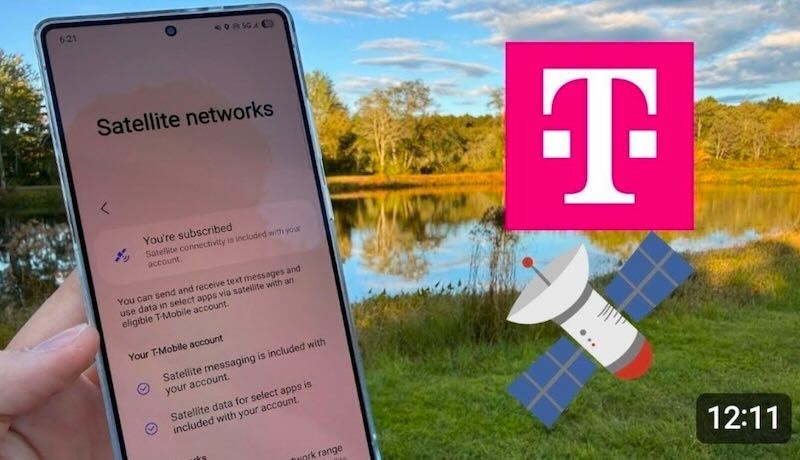
SpaceX’s cellular Starlink service is rolling out support for mobile apps, and one user has already tested the feature and posted a video of the results.
While the official launch isn’t scheduled until October 1st, YouTuber Jake Pimental gained early access through Samsung’s beta software on his Galaxy S25 Ultra. “It turns out that the T-Satellite data connectivity is enabled on One UI 8 beta on the Galaxy S25,” he explained in his video demonstration.
The satellite internet service, designed primarily for connectivity in cellular dead zones, is officially slated to support Google’s Pixel 10 phones for T-Mobile subscribers with the T-Satellite plan. Michael Nicolls, VP of Starlink Engineering, confirmed: “Many data rich applications (like Google Maps, X, and WhatsApp) are now supported on Starlink direct to cell on certain devices.”
What’s particularly noteworthy about Pimental’s demonstration is how well certain applications performed over the satellite connection. Google Maps, often a data-intensive application, functioned surprisingly well.
“I am pleased to report it does work,” Jake says during his car-based test. “I am using satellite imagery, and it loads very well. I really have no issue, even with the satellite version of Maps loading, never mind just the basic standard map.”
Imagery loaded within seconds as he zoomed through different map views. That said, there were limitations—occasional 30-second pauses occurred as the system attempted to retrieve data, and connection quality varied throughout the test.
The satellite internet capabilities extended beyond navigation. Jake successfully tested both X and WhatsApp, two of the 13 mobile apps currently supported by Starlink’s cellular service.
His X demonstration was particularly impressive, showing the ability to load not just text posts but also images and videos. Video quality was limited to lower resolutions (240p or 360p), but the fact that streaming worked at all over a satellite connection represents significant progress.
WhatsApp testing revealed both voice and video calling capabilities, though Jake noted the quality “wasn’t the best.” and “I think the best way to show this will be with a video showing performance on WhatsApp video calls/voice calls in action.” Still, for emergency communications in areas without traditional cellular coverage, such functionality could prove invaluable.
“There are still some gaps where you do not have a data connection or you do not have a good satellite connection,” Jake Pimental cautioned, highlighting that satellite internet isn’t quite ready to totally replace terrestrial networks.
As Starlink’s cellular service approaches its official launch, these early tests suggest SpaceX may have found its calling in connecting the unconnected—right from your smartphone.
Related Post
T-Mobile Cellular Starlink Exits Beta With $10 Monthly Fee for Non-Customers
SpaceX Starlink Offers Emergency Support for FAA Failing Communication System
T-Mobile Cuts Starlink Direct to Cell Service to $10/Month for All Carriers Starting July