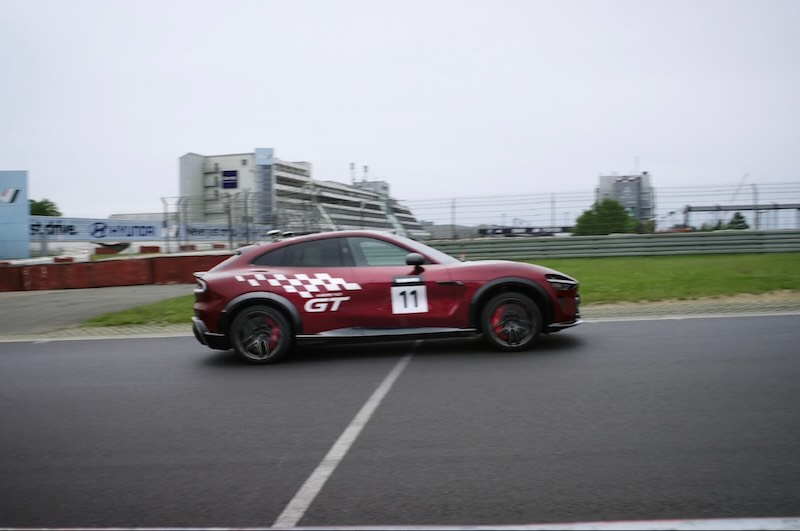
Autonomous driving just got a racetrack résumé. Xiaomi Auto has confirmed that its YU7 GT electric SUV completed what the company is calling the world’s first autonomous driving lap record at Germany’s Nürburgring circuit, posting a time of 10 minutes and 29.483 seconds. No driver. No intervention. Just software, sensors, and a 1,003-horsepower electric SUV doing what it was engineered to do.
To put that in perspective, a professional racing driver piloting the same vehicle is about three minutes and seven seconds quicker. That gap matters less than it sounds — because the point here was never to beat a human. It was to prove that the underlying control system can operate at the absolute edge of tire physics without human input.
Track selection wasn’t arbitrary. Nürburgring is one of the most technically demanding circuits in the world, combining elevation changes, blind corners, and surface inconsistencies that punish any system — human or algorithmic — that isn’t paying attention at every millisecond.
Xiaomi’s engineers were direct about a question they anticipated: if there’s no other traffic and the route is fixed, how hard can autonomous lapping really be? Their answer cuts to the heart of the engineering challenge. You can’t simply record a fast human lap and replay it. Physical world doesn’t repeat itself. Wind direction shifts. Track temperatures fluctuate. Tires wear unevenly between laps. Tire pressure drifts. Each of these variables, negligible at normal road speeds, becomes a potential destabilizing factor when a vehicle is operating at the limits of grip.
That’s the core problem the system had to solve — not navigation, but nonlinear physics. In everyday driving, inputs produce roughly predictable outputs. Steer more, turn more. Accelerate harder, go faster. At the limit of traction, that relationship collapses. Excess steering or throttle can trigger understeer, oversteer, or complete loss of control. The autonomous system had to build and continuously update a real-time dynamic model of how the vehicle and its tires were actually behaving under those specific conditions at that specific moment, then compute and apply corrections at millisecond-level frequency.
Hardware supporting this run is worth examining. YU7 GT, officially unveiled in May, carries a 101.7 kWh ternary lithium battery on an 897V silicon carbide architecture. It delivers up to 738 kW of peak output, accelerates to 100 km/h in 2.92 seconds, and reaches a top speed of 300 km/h. The CLTC range figure sits at 705 km, with up to 570 km of charge recoverable in 15 minutes.
On the sensing side, the vehicle runs one LiDAR unit, one 4D millimeter-wave radar, 11 high-definition cameras, and 12 ultrasonic sensors, all processed through an NVIDIA DRIVE AGX Thor compute platform. Flagship ADAS hardware by any current standard.
Xiaomi was transparent that this lap time is far from the ceiling of what the YU7 GT’s hardware can achieve, and further still from the limits of its intelligent driving software. Stated long-term goal is transferring what’s learned at the track into production behavior — giving everyday drivers a system that can respond correctly when roads become dangerous.
Related Post
Xiaomi YU7 GT Eyes Autonomous Nürburgring Record After SUV Lap Milestone
All-New Xiaomi SU7 2026: New Powertrain, Smarter Safety, and a Cabin Worth Talking About
Xiaomi SU7 Ultra Sets New Nürburgring Production EV Record at 7:04.957 – Beats Porsche Taycan