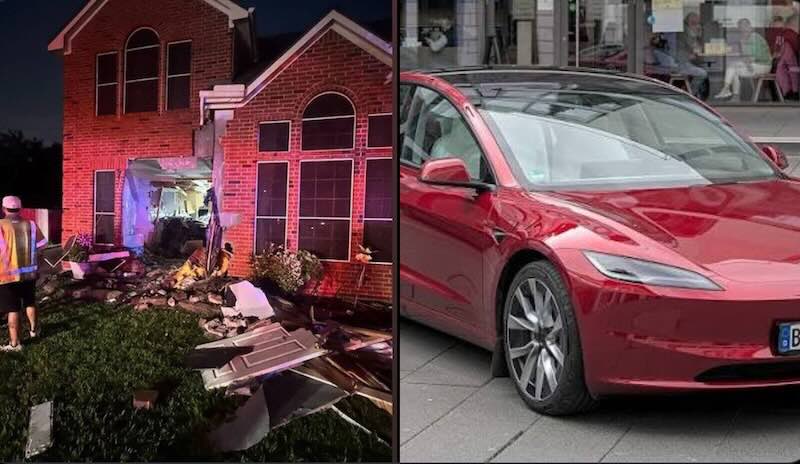
A Tesla Model 3 crashed into a residential home in Katy, Texas on Friday night, killing 76-year-old Martha Avila, who was standing inside the front room she shared with her daughter’s family. It’s a devastating loss — and it’s already been buried under a wave of inaccurate headlines. The story that spread across major outlets framed this as a “self-driving car” killing someone in her home. That framing isn’t just careless; it’s materially wrong, and it matters.
Investigators are examining the vehicle’s event data recorder and onboard logs to verify whether an automated driving-assistance system was actually engaged — and if so, which one. That’s a critical distinction. Claim that Autopilot was active comes solely from the driver, Michael Butler, who told Harris County deputies the system was engaged at the time of the crash. No official confirmation exists yet.
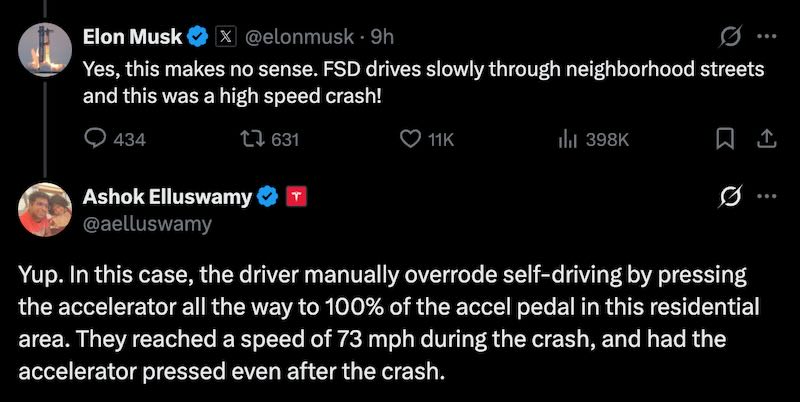
What has been confirmed: Tesla’s VP of AI, Ashok Elluswamy, shared vehicle log data showing that Michael Butler manually pressed the accelerator pedal to 100% capacity in a residential zone, reaching 73 mph at the point of impact — with the pedal still depressed after the collision. That profile is simply incompatible with how Tesla FSD (Full Self-Driving) behaves in a neighborhood setting. As Elon noted on X, “FSD drives slowly through neighborhood streets and this was a high speed crash!” FSD handles maneuvers including route navigation, steering, lane changes, and parking, but still requires the driver to actively supervise the system at all times.
Here’s where it gets consequential. Calling this a “self-driving car crash” isn’t just imprecise — it actively distorts public risk perception. Ashok Elluswamy put it directly: outlets planting misinformation in the minds of the general public, who might not know all the facts, could prevent people from using technology that’s statistically safer than manual driving, a claim Tesla measures across FSD more than 10 billion miles of data.
That’s a fair point worth examining. But the inverse critique also holds: media outlets that conflate “driver claimed Autopilot was on” with “Autopilot caused the crash” do the same disservice from the other direction. Tesla’s standard driver-assistance option was previously marketed under the name “Autopilot” before February 2026, when the company changed the name under legal pressure from California’s DMV, following a ruling that Tesla had engaged in false advertising around its Autopilot systems.
The NHTSA confirmed it’s opening a special crash investigation — the latest in more than 40 such probes the agency has launched into Tesla crashes believed to involve advanced driver-assistance systems. That scrutiny is warranted. A new NHTSA probe into Tesla FSD opened in October 2025 after reports of the system running red lights and crossing into oncoming lanes, with Tesla twice delaying responses to federal data requests.
None of that backstory, however, makes a 73 mph manual override by Michael Butler the fault of Tesla FSD system. Martha Avila’s family, including her daughter Jennifer Barbour, who told local outlet KHOU that her mother was in good health when she died, deserves accurate answers — not a narrative shaped before the data’s been reviewed.
The vehicle logs exist. Investigation is underway. Until it concludes, outlets reporting this as a confirmed autonomous vehicle failure aren’t informing the public — they’re full self-driving the story off a cliff.
Related Post
Tesla Warns NJ Owners: Proposed Laws Could Block Autonomous Vehicles Statewide
Tesla FSD Supervised Approved in Denmark — Europe’s 4th Country to Say Yes
Autonomous Driving AI Is Learning to Think — Here’s What That Actually Means