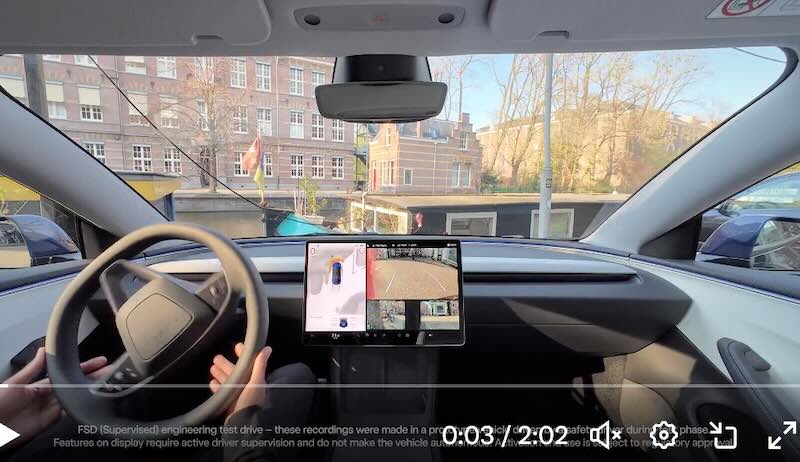
There’s a post circulating on X that reads something like a product wish list most EV owners didn’t know they needed. A Tesla FSD user wrote: “Tesla FSD is Magic. Need to be able to converse w/ Grok like we can with an Uber driver: ‘Hey Grok, turn right here.’ ‘Drop us off right here, we’ll walk due to traffic.’ ‘Drop at entrance first, then park far away.'” Elon’s reply was characteristically brief: “This functionality will be there in about 3 months or so.”
3 months. That’s either a product roadmap or a mood—hard to say with Elon. Either way, it signals something worth paying attention to.
Tesla’s 2025 annual update landed with what appeared to be a modest lead feature: Grok with Navigation Commands (Beta). At first glance, the addition seemed underwhelming—just another voice assistant layered onto navigation requests. But beneath that “(Beta)” label, something structurally different had arrived.
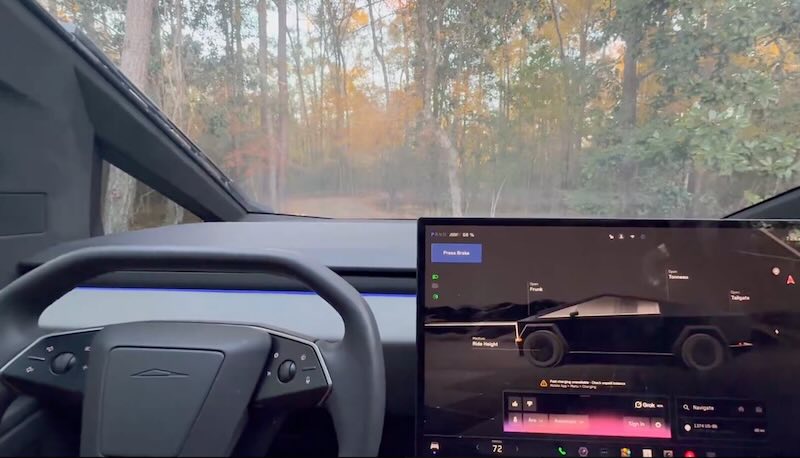
xAI and Tesla had built a system demonstrating genuine semantic understanding of location data. xAI employees confirmed that Grok 4.1-Fast was running directly inside Tesla OS—not as a cloud-dependent feature, but as an on-device capability with real processing weight behind it. That distinction matters. It means Tesla FSD + Grok Voice Control isn’t dependent on a strong data connection to function, which changes the reliability calculus entirely for drivers in low-coverage areas or high-speed scenarios.
Tesla’s in-cabin integration with FSD appears to be entering a genuinely different stage of development. Premise is straightforward: rather than issuing rigid, keyword-dependent commands, drivers could soon communicate with Grok the way they’d direct a human driver—contextually, conversationally, and in real time.
This isn’t a new idea in the automotive industry. Several automakers have attempted voice-controlled driving assistance over the past decade. Most of those efforts, however, ran into the same wall: brittle command mapping. If a driver said “pull over” instead of “stop vehicle,” the system often returned a blank stare. The gap between natural human speech and machine-parseable instructions proved difficult to bridge at production scale.
Tesla’s implementation of Tesla FSD + Grok Voice Control is reportedly built on a multi-agent architecture—a design that separates intent interpretation from execution. When a driver says “drop us here, we’ll walk because of the traffic,” Grok processes the high-level meaning first, then passes a structured directive to the FSD agent, which handles the physical driving response.
This two-layer model also pulls in live data: navigation state, real-time traffic conditions, and visual inputs from the vehicle’s onboard cameras. That environmental awareness is what makes a request like “park far away and drop me at the entrance first” technically actionable rather than ambiguous.
Conversational vehicle control sounds compelling, but two significant obstacles remain before it scales reliably.
Latency is the first. Grok’s in-vehicle variant is reportedly a low-latency build—something along the lines of Grok 4.1-fast—because driving is inherently time-sensitive. A command like “pull over behind that bus” needs processing in fractions of a second. Wait too long, and the bus has moved, the lane has changed, and the window is gone.
Safety validation is the second. Not every driver request is a legal or safe one, whether intentional or not. If a voice command conflicts with traffic regulations, or if an obstacle appears mid-execution, the FSD planner must retain authority to override and reject that command without hesitation. Human intent layer and the safety layer can’t operate at the same level of priority—FSD has to win.
3-month window Elon suggested should be treated cautiously. Tesla has shipped meaningful FSD updates consistently, but natural language driving commands at production quality represent a non-trivial integration challenge. It’s not just software—it’s the intersection of LLM response quality, in-vehicle compute constraints, and regulatory variance across markets.
That said, the technical architecture being described is credible, and the demand is clearly there.
If Tesla pulls this off, your next commute might feel a lot less like operating a machine—and a lot more like riding with someone who actually listens. With Tesla FSD + Grok, it turns out the future of driving might just come down to how well your car can take direction.
Related Post
Tesla FSD V14.3.3 Update: 8 MPH Summon & Intervention Tracking
Tesla FSD V14.3 Released: Faster Reactions, Smarter Vision and Major RL Upgrades
Tesla AI Engineer Yun-Ta Tsai Explains Why More Sensors Could Actually Hurt Autonomous Driving