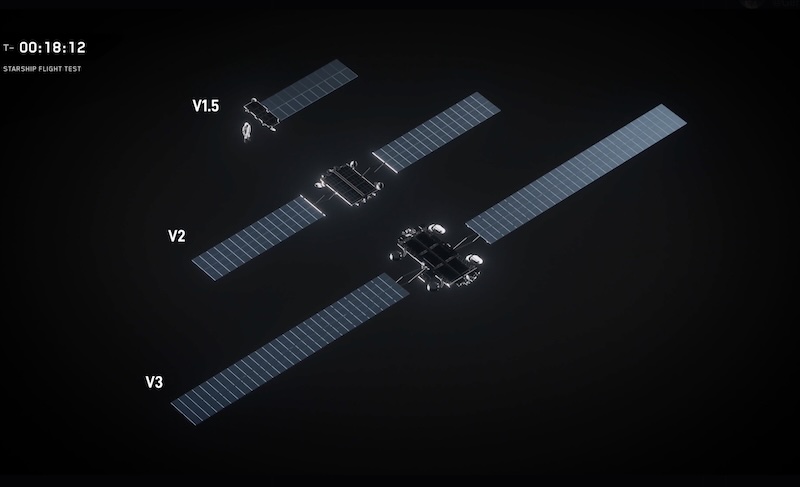
SpaceX is offering the clearest look yet at the next major upgrade to Starlink, confirming the upcoming “V3” satellite is significantly longer and larger than its predecessors. The company revealed the new design during Monday’s 11th flight test of its Starship vehicle, showcasing a comparative image that puts the evolution of Starlink hardware into stark perspective.
The third-generation Starlink satellite represents a dramatic size increase compared to earlier models. Standing next to a human astronaut figure in the comparison image, V3 towers with its extended dual solar arrays and considerably larger central satellite bus. These aren’t just cosmetic changes — the increased dimensions support enhanced “phased array antennas” that will enable the system to deliver genuine gigabit internet speeds to users for the first time.
Scale-up necessitates SpaceX’s transition from Falcon 9 to Starship for deployment. Regulatory filings suggest each Starlink V3 could weigh up to 2,000 kilograms (4,409 pounds) — nearly four times heavier than the current V2 Mini Optimized satellites at approximately 575 kilograms each.
Starlink V3 satellites aren’t just bigger — they’re substantially more powerful. Each unit will bring:
- 1Tbps of download bandwidth (10x increase over V2 models)
- Combined 60 Terabits-per-second of downlink capacity per launch
- More than 20 times the capacity added with each V2 Mini launch on Falcon 9
During Monday’s test flight, Starship successfully deployed eight dummy V3 Starlink “simulator” satellites, demonstrating the vehicle’s capability to carry the larger hardware.
While SpaceX has begun testing the deployment mechanisms, actual Starlink V3 launches remain on the horizon. Elon has projected the first real V3 deployments could occur by late 2025 or early 2026.
Several hurdles remain before the enhanced network becomes operational. The company still needs Federal Communications Commission approval to operate these next-generation satellites as part of an expanded constellation approaching 30,000 units. Additionally, existing Starlink users will need hardware upgrades to access the promised gigabit speeds.
As SpaceX continues to push the boundaries of satellite internet, these V3 units represent their biggest “Starlink” forward yet.
Related Post
SpaceX Secures FCC Approval to Boost Starlink Dish Power for Enhanced Internet Speeds
SpaceX Starship Rocket Completes Historic Tenth Flight Test with First Starlink Satellite Deployment