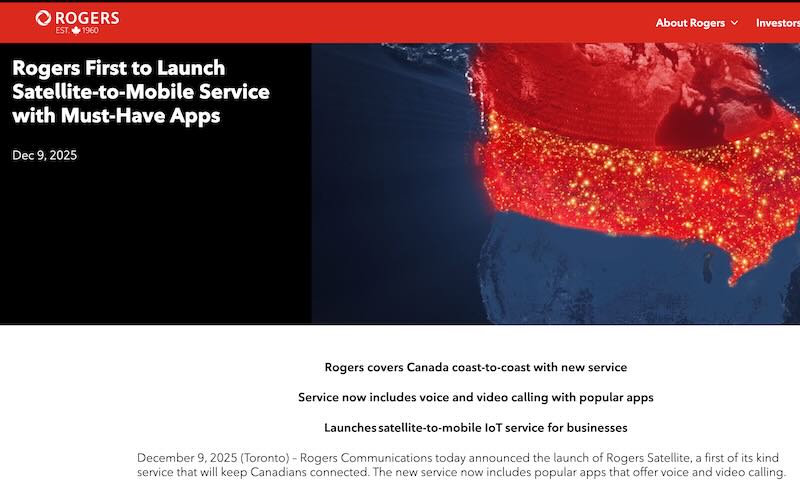
Rogers has officially transitioned its Starlink-powered satellite connectivity from beta testing to a commercial service. The Canadian carrier’s Rogers Satellite service now supports data transmission to popular applications, transforming how consumers and businesses operate in areas where traditional cellular networks simply don’t exist.
Starting December 9, Rogers Satellite enables data connectivity for applications including WhatsApp, Google Maps, AccuWeather, X, and CalTopo on compatible Samsung and Google Pixel devices. iPhone support is scheduled to arrive soon, according to the carrier’s announcement. Expansion represents a significant shift from the text-only capabilities available during the July beta launch.
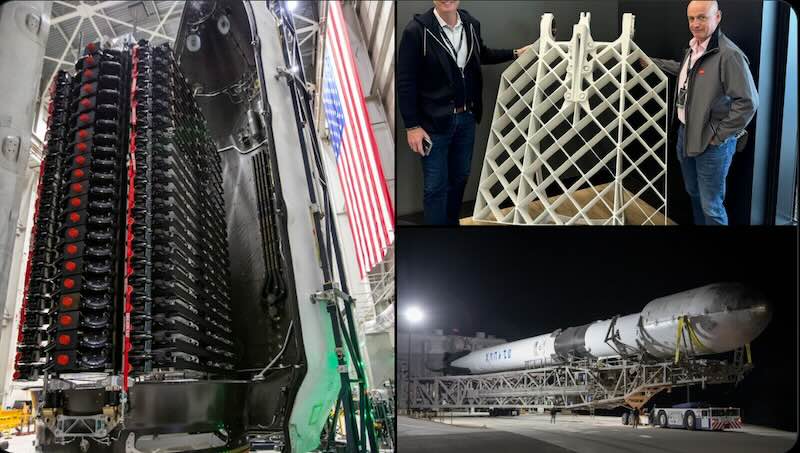
Service operates through SpaceX’s orbiting infrastructure, utilizing a secondary eSIM slot in compatible devices. Allows users from any carrier to maintain their existing mobile plan while adding satellite connectivity as a supplemental feature. Tony Staffieri, Rogers’ President and CEO, emphasized that no other provider in Canada offers this technology, positioning Rogers as the sole option for satellite-to-cellular connectivity in the country.
Rogers Satellite costs CA$15 monthly, though the carrier is offering 12 months of complimentary access to customers on select plans. Beta participants receive a discounted rate of CA$10 monthly for their first year. Unlike T-Mobile’s implementation in the United States, which charges $10 monthly and restricts free access to premium plan subscribers, Rogers’ approach makes satellite connectivity accessible across carrier boundaries.
Data consumed through Rogers Satellite draws from users’ existing data allotments, meaning video calls via WhatsApp or navigation through Google Maps will impact monthly data caps. Carrier has confirmed plans to expand beyond app-based data transmission, with traditional voice services and broader data access scheduled for future rollout.
Rogers has simultaneously launched satellite connectivity for IoT businesses, addressing Canada’s unique geographical challenges. Fleet tracking along isolated highways, rail corridor monitoring, and automated sensors for forestry and mining operations now have access to reliable connectivity where terrestrial networks can’t reach.
This industrial capability differentiates Rogers Satellite from consumer-focused implementations elsewhere. The carrier has also enabled Apple Watch connectivity, another feature absent from T-Mobile’s current offering.
As developers continue updating applications for satellite compatibility, the roster of supported apps will grow. For now, Rogers has successfully brought cellular connectivity to areas where staying connected seemed impossible.
Related Post
Rogers Partners with SpaceX: Bringing Starlink Direct-to-Cell Service to Canada
iPhone Users Can Now Access Apple Apps via T-Mobile Cellular Starlink Satellite Service
SpaceX Offers Free Starlink Dishes to Canadians: 12-Month Commitment Required