Elon Musk has never been shy about building things that don’t exist yet. But tonight, during a live presentation, he unveiled something that even veteran chip industry observers hadn’t anticipated: TERAFAB — a unified, closed-loop semiconductor fabrication facility set to be built at Giga Texas, jointly operated by Tesla, SpaceX, and xAI. If it delivers even half of what Elon is promising, it’s a genuine inflection point for AI hardware.
Core pitch is surprisingly straightforward. TERAFAB would house, under one roof, the lithography masking equipment, chip fabrication tools, testing infrastructure, and the iterative feedback loop necessary to go from design to tested silicon and back to a revised mask, all without leaving the building. “To the best of my knowledge, this doesn’t exist anywhere in the world,” Elon said tonight. That’s a bold claim, but it’s not an implausible one. Foundry giants like TSMC and Intel Foundry Services operate at massive scale but don’t offer this kind of vertically integrated, single-building recursive design loop that Elon is describing.
TERAFAB is designed to produce two distinct chip types. First targets edge inference — destined primarily for Tesla vehicles and the Optimus humanoid robot platform. Second is an AI chip purpose-built for space deployment aboard SpaceX’s upcoming mini-satellite constellation, with the Tesla D3 (Dojo 3) design reportedly slated to fly inside those spacecraft.
Why does the split matter? Elon’s reasoning on the humanoid side is notable: he expects Optimus units to be manufactured at 10 to 100x volume of cars. That’s a staggering production multiple, and it implies a chip supply chain that can’t rely on third-party foundry lead times alone.
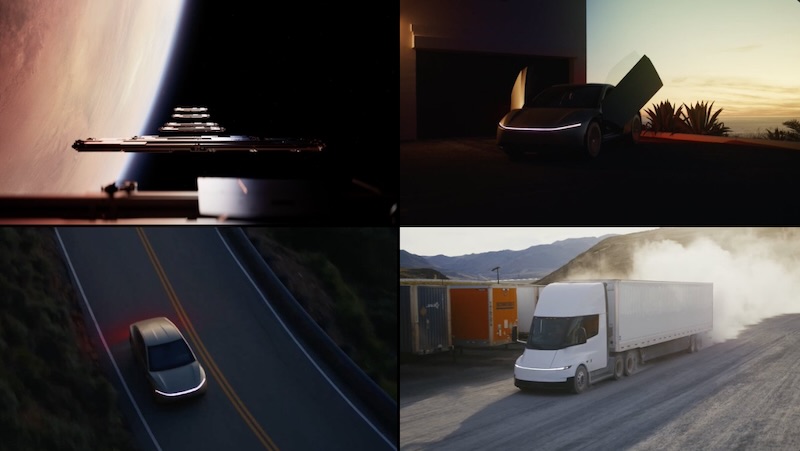
The satellite side of the TERAFAB story is where the presentation got genuinely provocative. Elon laid out a structured case for why deploying AI in orbit will, within 2 to 3 years, become cheaper than running equivalent workloads terrestrially.
Logic runs like this: solar irradiance in space is roughly five times greater than ground-level averages, and without weather, panels don’t need the heavy glass and structural framing that drives up terrestrial solar costs. Meanwhile, the mini-satellites are rated at 100kW each, with Elon flagging a future trajectory toward the megawatt range — heat rejection in vacuum, a SpaceX engineering specialty, makes that thermal scaling manageable.
Crucially, Elon framed the economic curve as asymmetric. On Earth, power gets harder and more expensive to provision over time. In orbit, scaling gets easier. That’s a compounding advantage, not a static one.
Strip away the ambition for a moment, TERAFAB proposition is really about dependency reduction. Tesla, SpaceX, and xAI are all chip-hungry in ways that make them vulnerable to foundry capacity constraints, geopolitical supply chain risk, and the slow iteration cycles that come with outsourcing silicon development. A vertically integrated fab changes that calculus — provided Elon can staff and capitalize it at the required level, which isn’t a trivial assumption.
“We will go beyond the Moon and Mars,” he added at one point, almost as an aside. Saturn trips, apparently, are on the table.
Elon’s ambitions have always operated in tera-tory of their own — and with TERAFAB, he’s building the hardware to match.
Related Post
Tesla Launches Terafab: Inside the Company In-House Chip Manufacturing Ambition
SpaceX and xAI Bet AI Compute Will Move to Orbit Within Three Years
FCC Fast-Tracks SpaceX Million-Satellite Plan, Public Comments Open Until March 6