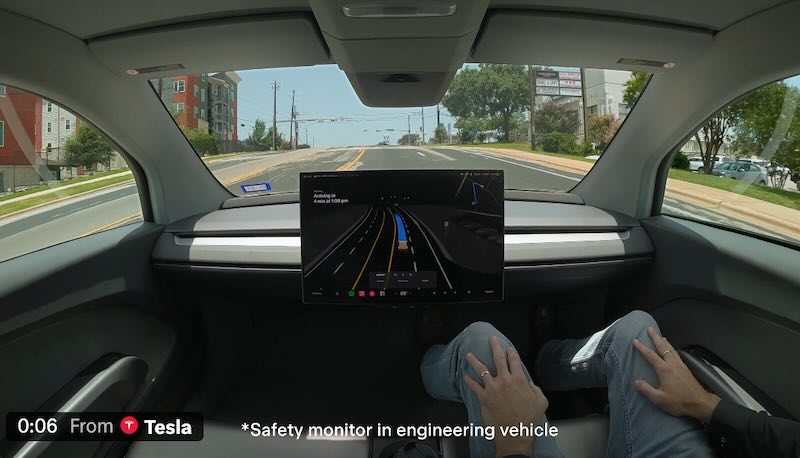
Tesla’s autonomous vehicle ambitions just took a tangible step forward. The company has begun testing its Cybercab on public roads in Austin, Texas, and the footage tells a story that’s hard to ignore. No steering wheel. No pedals. No clear line between who’s driving and who’s simply along for the ride. This isn’t a concept sketch or a stage demo anymore — it’s a vehicle moving through real traffic, and that distinction matters quite a bit for anyone tracking where autonomous transportation is headed.
Elon shared a video on X showing Cybercab navigating Austin’s streets, captioning it plainly: “Cybercab with no steering wheel or pedals driving around Austin.” The simplicity of that statement undersells what’s actually happening here. Tesla has stripped away the hardware that’s defined the driver’s seat since the automobile was invented, and in doing so, it’s betting heavily on a future where humans aren’t expected to intervene at all.
Let me walk through what’s actually changed, because the details reveal more than the headline does.
Inside the Cybercab, there’s no steering column, no pedal assembly, and consequently, no meaningful difference between the front and rear seats. Everyone’s a passenger now. onboard safety operator, who does appear to be present during these tests, seems limited to one function: triggering an emergency stop if something goes wrong. There’s no indication this person can grab a wheel or tap a brake, simply because those components don’t exist in the cabin.
Tesla has also expanded the central infotainment display to 20.5 inches, which is a notable jump and reinforces the idea that this screen is meant to be the primary interface for everyone inside, not a secondary convenience for whoever happens to be sitting up front.
There’s been chatter that Tesla might eventually add a steering wheel to make the Cybercab more palatable to traditional buyers, and on paper, that argument has some logic to it. A wheel could broaden the customer base and ease the transition for people who aren’t ready to fully release control.
However, the physical design of this vehicle suggests otherwise. Front overhang has been shortened further, which helps with crash safety and interior packaging, but it also leaves less room for manual driving components. A-pillars are visibly reinforced on both sides, and combined with that oversized central screen, retrofitting a wheel into this layout would require a substantial redesign rather than a simple addition.
Concept of a purpose-built robotaxi has circulated in the industry for years, often as a talking point rather than a working product. What’s happening in Austin right now is one of the first real attempts to build that idea into something that actually drives.
Ford’s head of safety has noted that what kills people in a head-on collision is frequently the steering wheel itself, an observation that frames Tesla’s hardware decisions in a different light. Autonomous vehicle development has involved years of engineering effort, plenty of false starts, and ongoing competition among companies racing to solve the same problem.
Whether or not the Cybercab succeeds commercially, it represents a clear statement about where Tesla believes the technology is headed. Road ahead for autonomous transport just got a little less hypothetical, and the Cybercab is leading the charge.
Related Post
Tesla Cybercab Robotaxi First Responders Guide: What the Docs Reveal
Tesla Cybercab EPA Certificate Reveals Specs: Range, HP & Battery
Tesla Cybercab Production Begins: Robotaxi Miles Double in Q1 2026