
SpaceX isn’t playing by anyone else’s rules anymore. The company’s Q2 2026 earnings report landed this week with the kind of numbers that force even the most skeptical analysts to sit up straight. Total revenue hit $7.81B, a 92% jump year-over-year and a 66% leap from Q1. That’s not incremental growth; that’s a structural shift in what kind of company SpaceX actually is.
The net loss narrowed to $541M, improving by $467M compared to the same period last year, while adjusted EBITDA surged to $3.53B, nearly tripling from Q1’s $1.127B. Operationally, the company is clearly closing the gap between capital expenditure and profitability, even as it’s spending at a historically aggressive pace.
Perhaps the most striking line item in the entire report is AI revenue: $2.56B in a single quarter, up 247% YoY and 213% from Q1 alone. That trajectory is difficult to contextualize without acknowledging just how fast SpaceX has scaled its compute infrastructure.
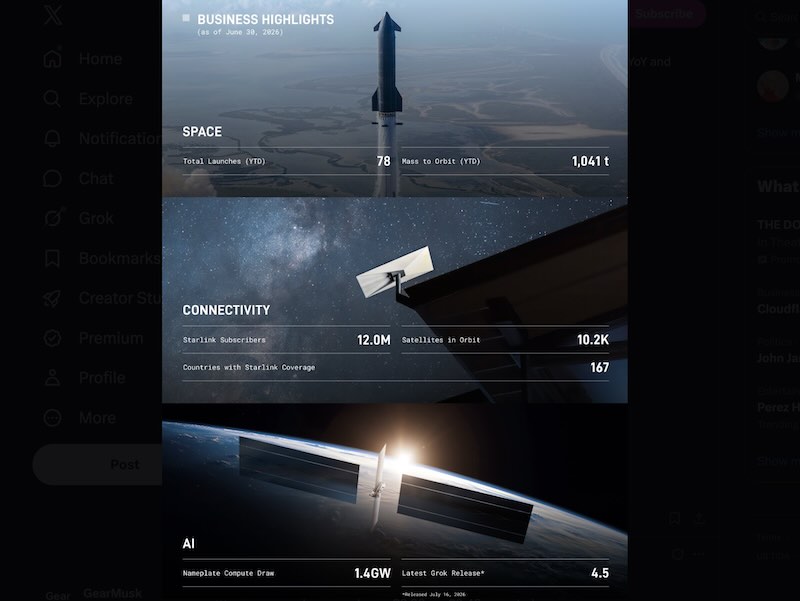
Nameplate capacity has reached 1.4 gigawatts, up from 1.0 GW in Q1 and 0.4 GW just a year ago. The company also signed cloud services agreements totaling $14.1B in contracted sales, generating $1.6B of incremental AI infrastructure revenue during the quarter. Total capex reached $18.3B, with $15.8B attributed to AI infrastructure alone, compared to $749M a year ago.
AI adjusted EBITDA turned positive for the first time, landing at $1.14B, versus a $609M loss in Q1. That’s a $1.75B swing in a single quarter. Whatever skepticism existed around SpaceX’s AI ambitions, the financials are starting to make the argument themselves.
Connectivity segment brought in $4.29B this quarter, up 66% YoY, with enterprise and government revenue growing 108% to $1.8B. Consumer revenue reached $2.48B, up 44%. Connectivity adjusted EBITDA came in at $2.597B, and the segment’s operating income was $1.65B.
Starlink now serves 12 million subscribers across 167 countries, doubling its subscriber base from a year ago. ARPU has held steady at $66 per month, which signals that pricing power remains intact even as the service scales globally.
New aviation partnerships with Southwest, Virgin Atlantic, Iberia, and Aer Lingus joined the previously announced American Airlines agreement. International carrier partnerships with SoftBank, NTT Docomo, and Spark NZ expanded Starlink Mobile’s reach further, that’s where things get genuinely interesting for the broader telecom industry.
During the earnings call, SpaceX’s President and COO offered a direct assessment of the legacy wireless market. Combined, the three major U.S. carriers generate roughly $600 billion in annual revenue, and she expressed confidence that SpaceX can pull meaningful customer share from all three. Comments were pointed enough that Verizon, AT&T, and T-Mobile each dropped 4.5% in after-hours trading.
Starlink Mobile’s differentiation isn’t just coverage — it’s reliability. Dead zones, natural disasters, rural gaps, these are the failure modes that legacy carriers have never fully solved. SpaceX’s satellite-backed approach, reportedly supplemented by ground-based infrastructure using existing Starlink dishes, could reduce capital requirements while expanding terrestrial reliability, even in dense urban environments.
Meanwhile, Starshield secured more than $6B in multi-year U.S. government contracts, primarily from Space Force, adding another durable revenue stream that doesn’t depend on consumer behavior.
SpaceX completed 38 launches in Q2, deployed 485 metric tons to orbit, and now operates roughly 10,200 satellites. Constellation’s scale creates compounding advantages that no competitor can replicate quickly.
If Q2 2026 is any indication, SpaceX isn’t just launching rockets anymore — it’s launching an entirely different kind of company. Question now isn’t whether SpaceX can disrupt telecom. It’s whether telecom is ready to launch back.
Related Post
SpaceX Unveils AI Satellites, New Starlink Terminals & Terafab Factory Plans
SpaceX Buys Cursor for $60B: What It Means for AI Coding Tools
SpaceX IPO Filing Reveals $28.5T TAM, Starlink Profits, Retail Access — What You Need to Know