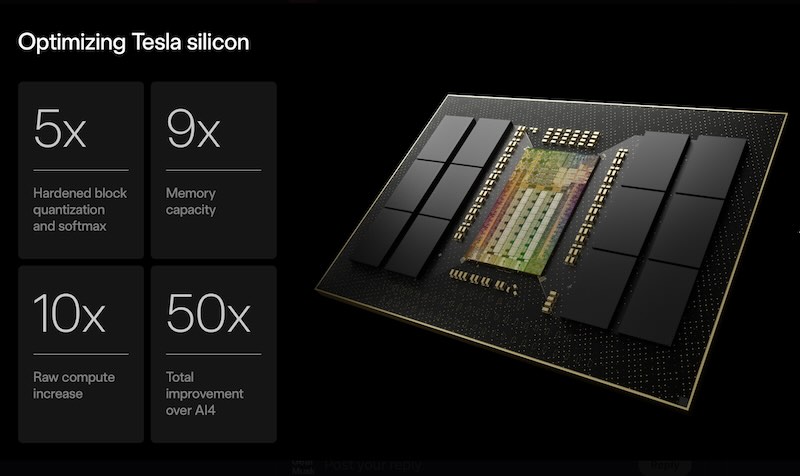
Memory constraints are reshaping Tesla’s next-gen AI hardware roadmap. Elon has confirmed that both the AI5 and AI6 platforms are launching with reduced memory configurations, not by design, but because the global memory supply chain is under serious strain. It’s a pragmatic call, and it tells us a lot about where Tesla’s hardware priorities actually sit right now.
Numbers are stark. AI5 has been cut from 144GB to 72GB of LPDDR5, AI5 chip uses half-reticle design to double manufacturing yield, while AI6 has taken an even steeper hit, dropping two-thirds, from 432GB to 144GB of LPDDR6. Elon has described current memory prices as “pretty insane,” and the pressure isn’t easing anytime soon.
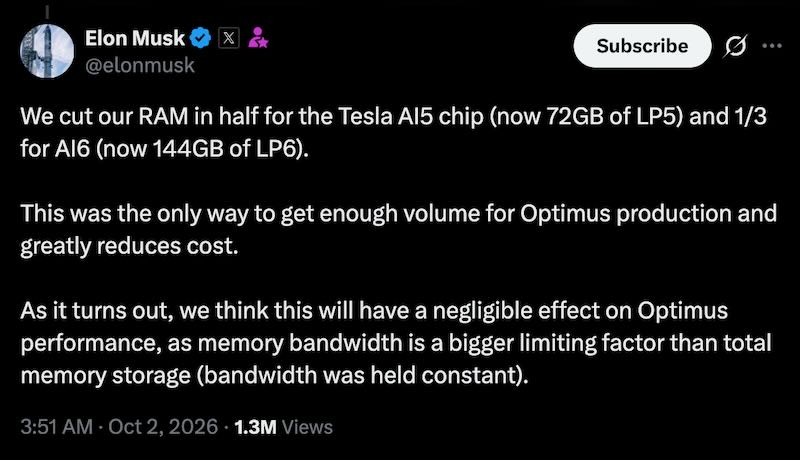
Because AI systems require far more high-speed memory than conventional computing, memory availability is becoming a key variable in AI competitiveness. Tesla isn’t alone here. Musk has echoed Apple CEO Tim Cook’s description of the crisis as a “hundred-year flood,” and the ripple effects are hitting every major AI hardware program across the industry.
Cuts to AI5 and AI6 aren’t the result of some breakthrough that suddenly makes less memory sufficient. This looks far more like a tactical response to cost and supply pressure, a short-term concession to a supply chain that simply can’t keep up with demand at scale.
Memory supply constraints are expected to persist through at least 2028, according to industry analysts, which means Tesla can’t afford to wait this out. Reducing memory specifications now keeps timelines intact.
Here’s where it gets interesting. Tesla’s current AI4+ platform, deployed in the CyberCab, runs on 64GB of memory. That figure is already surprisingly close to AI5’s reduced 72GB configuration, close enough to raise a reasonable question: are AI4+ and AI5 converging toward the same practical use case?
Short answer is probably yes, at least for the near term. Distinction between the two platforms isn’t raw power, it’s product focus. AI4+ appears more specifically optimized around FSD, while AI5 is being built with additional compatibility for Optimus, Tesla’s humanoid robot program.
Elon has stated that “AI4 is enough to achieve much better than human safety for FSD,” which signals that the current hardware generation may already be sufficient for the next phase of unsupervised autonomous driving. That’s a notable admission.
Recently refreshed Model 3 and Model Y, built around the AI4+ platform, may end up being the definitive Tesla vehicle refresh for quite some time. If AI4+ can handle unsupervised FSD, there’s no immediate hardware urgency to push AI5 into passenger vehicles.
Elon has confirmed that the initial focus for AI5 will be Optimus and Tesla’s supercomputer clusters — not cars. That separation of priorities makes the memory cuts easier to understand. Higher-memory configurations of AI5 and AI6 are more likely to define Tesla’s medium- and long-term robotics platforms than the next wave of consumer vehicles.
Should Tesla’s Terafab project achieve significant production scale, the facility aims to produce between 100 billion and 200 billion custom AI and memory chips annually using advanced 2-nanometre process technology. At that point, the full memory configurations could return, but that’s a longer-term story.
For now, Tesla’s hardware roadmap is making a calculated trade: deliver on schedule with less memory, and let the robotics ambitions wait for supply to catch up. In the race to put AI on the road, sometimes less memory is the only move that keeps you in the drive.
Related Post
SpaceX Terafab Tax Break Approved: What Grimes County Gets in Return
Tesla AI5 Chip Targets 250W Power Consumption, Production Delayed Until 2027
Tesla AI5 Chip Production Starts 2027: 40× Faster Performance, Elon Confirms Timeline