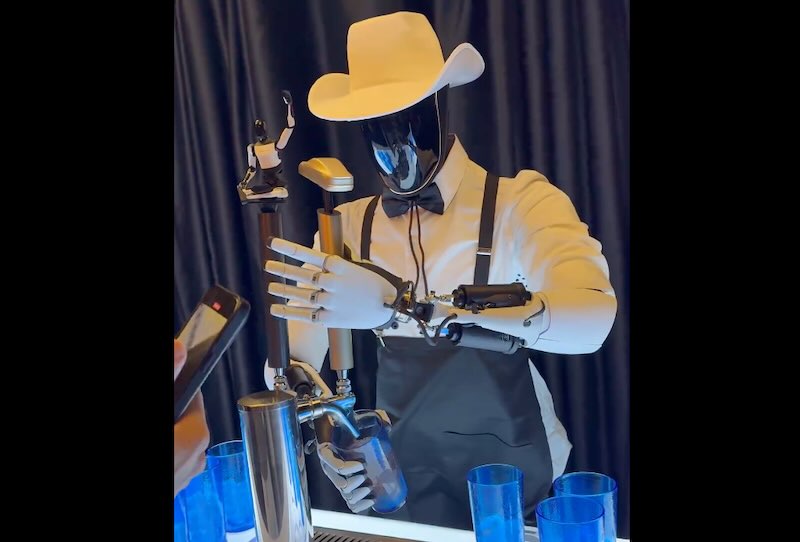
Tesla’s latest Palo Alto job listing isn’t for a battery engineer or a chassis designer. It’s for a Machine Learning Engineer on the Realtime Games team, a role that puts Digital Optimus, screen-reading AI agent Elon announced in March, at the center of what may be the company’s most technically ambitious project yet.
Position calls for building agents that play AAA titles, navigate the web, and operate professional software at superhuman levels. Interestingly, that description reveals more about Tesla’s AI trajectory than any earnings call could.
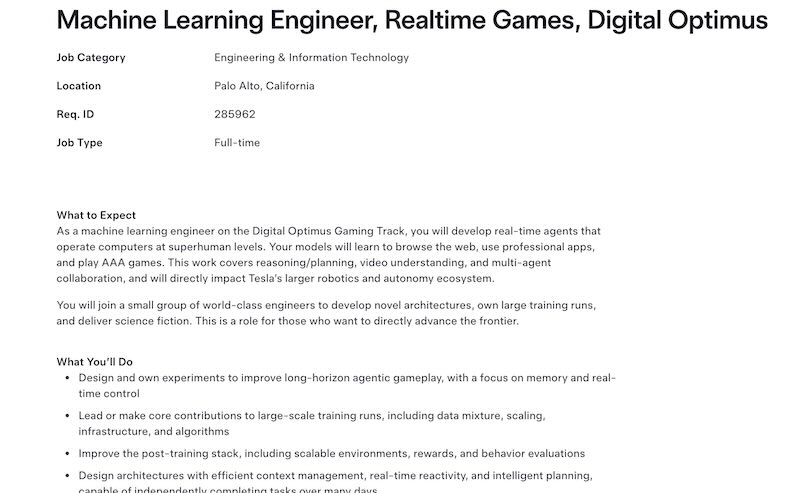
Why digital Optimus needs games more than games need it? Games aren’t the destination, they’re the proving ground. AAA titles offer what controlled labs can’t readily replicate: real-time, high-stakes environments that never repeat identically, where adversarial conditions appear at every level. That combination makes them natural infrastructure for training any agent ultimately destined for unpredictable, real-world inputs.
DeepMind’s SIMA project takes a structurally similar approach, training agents across multiple game environments to evaluate how skills generalize. Spanning both Tesla and xAI, Digital Optimus reads raw screen video and responds with keyboard and mouse inputs, operating at the human interface layer, not through privileged API access.
The Palo Alto listing ties the work directly to benchmarking skill transfer: how competencies built in one game carry over to another, and eventually to general computer use, FSD systems, and Optimus robot control loops. Team isn’t building entertainment software; it’s engineering a transferable reasoning layer for task execution across diverse environments.
Elon gave the clearest public account of where Digital Optimus stands today: “We’re making interesting progress here. Digital Optimus can play about halfway through the Diablo campaign so far just by looking at the screen like a human. Skill at Counter-Strike and other fast games is good too. League is also in training. Goal is to generalize across all games.”
Reaching Diablo’s midpoint without API access isn’t trivial. It requires real-time inventory management, adaptive combat decisions, multi-step planning from visual input alone. Counter-Strike and League of Legends, which layer in latency-sensitive reactions and coordinated team dynamics, raise the complexity ceiling significantly.
Digital Optimus operates at the intersection of Tesla and xAI. Skills it develops in gaming environments map directly onto FSD perception pipelines and Optimus humanoid control loops, where the agent must read visual input and execute precise, timed physical responses. Job description makes that connection explicit — not implied.
Training across games before deploying into production systems isn’t a workaround. It’s a deliberate architectural decision, one that prioritizes scale, variety, and real-time pressure before the stakes become physical.
At this rate, Digital Optimus isn’t just learning to play games, it’s optimizing for the only one that matters.
Related Post
Tesla Optimus V3 Robot Hand Patent Reveals Tendon-Driven, Human-Like Finger Architecture
Tesla Unified AI Architecture: How FSD and Optimus Share One Brain
Tesla Begins Optimus Robot Factory Construction at Giga Texas, 10M Unit Capacity