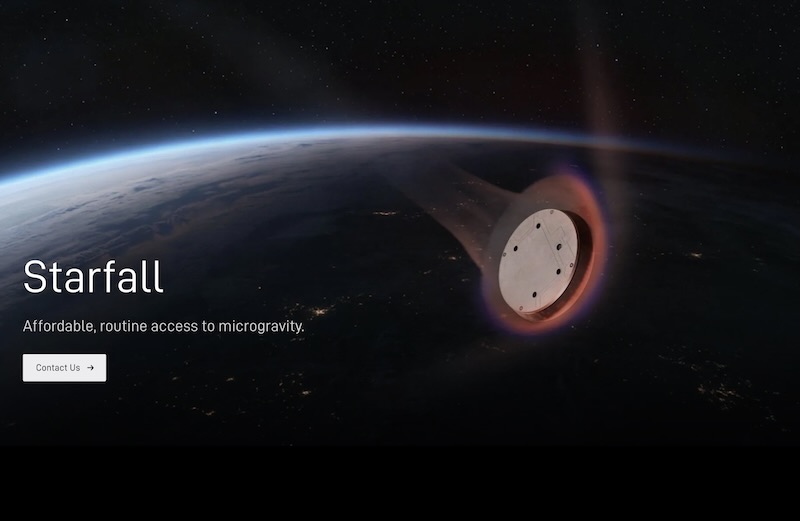
SpaceX has never been shy about disrupting established markets, and with Starfall, the company is taking direct aim at one that’s historically been reserved for government agencies and deep-pocketed research institutions. The platform, now formally marketed to commercial customers, promises routine, affordable access to microgravity, a resource that’s long been treated as a rare commodity rather than an operational environment. If SpaceX delivers on that promise, the downstream effects on biomedical research, drug development, and advanced manufacturing could be significant.
Starfall had already proven itself before any commercial pitch was made. Spacecraft completed a test flight aboard Falcon 9 in June 2026, validating the disc-shaped, cylindrical reentry capsule that measures approximately 3.1 meters in diameter and 0.75 meters in height. That geometry isn’t arbitrary, it’s engineered to maximize usable payload volume within a compact footprint, accommodating up to 1,000 kg of cargo per mission.
The platform’s technical profile is straightforward, which is part of its appeal. Starfall provides 1 kW of onboard power, Ethernet data connectivity, and continuous Starlink coverage throughout each mission, meaning researchers aren’t working blind once the capsule clears the atmosphere. Mission duration is customizable, giving commercial operators the flexibility to structure experiments around their own timelines rather than a fixed launch window.
Last point matters more than it might seem. Parabolic flights, traditional workaround for researchers who need microgravity but can’t access orbit, deliver exposure measured in seconds, not weeks. For biological systems, crystal growth, or semiconductor fabrication processes that require sustained microgravity conditions, that’s not a viable path. Starfall changes the calculus entirely, supporting experiments that need continuous microgravity exposure over extended periods.
Interestingly, SpaceX didn’t wait for a formal market launch to line up customers. European Space Cargo had already committed to a Starfall mission slated for 2028 before the platform entered its broader commercial rollout phase. Kind of early adoption signals genuine confidence from the research and logistics community, not just speculative interest.
Target applications SpaceX is positioning Starfall toward span several high-value sectors. Biomedical researchers stand to gain from an environment that supports implant development, organoid cultivation, and stem cell experimentation under conditions impossible to replicate on the ground. Drug discovery teams are particularly interested in the platform’s potential for growing more uniform protein and pharmaceutical crystals, a development that could meaningfully improve the consistency of materials used in therapeutic applications. Materials science and semiconductor research round out the initial target verticals, both areas where microgravity-enabled processes could unlock production advantages.
None of this would scale without Starship in the background. Starfall’s value proposition depends heavily on launch frequency, specifically, kind of cadence that Starship is designed to support. Routine microgravity access only becomes commercially viable when researchers can plan repeatable experimental runs rather than waiting years for a single flight opportunity. Starship’s architecture makes that kind of regularity feasible in a way that previous launch systems simply couldn’t support.
SpaceX is also clearly treating Starfall as a brand, not just a program. The company’s online store has introduced Starfall-themed merchandise, T-shirts among them, a move that reads less like a novelty and more like a deliberate signal that this platform is entering the mainstream product lineup.
Transition from development and demonstration into active commercial marketing marks a genuine inflection point. Microgravity research has long operated at the margins of what’s financially practical for most commercial operators. With Starfall, SpaceX is betting that it won’t stay that way.
For companies that have been watching the space research sector from the sidelines, the window for early positioning is opening. Starfall may just be the platform that finally makes the business case for orbit.
Related Post
SpaceX Q3 2026 Earnings: $14.58B Revenue, 830% SI Growth & Starlink Hits 13.6M Subs
SpaceX Announces Starbase, Louisiana, A $100B Spaceport That Could Change Everything
SpaceX Unveils AI Satellites, New Starlink Terminals & Terafab Factory Plans