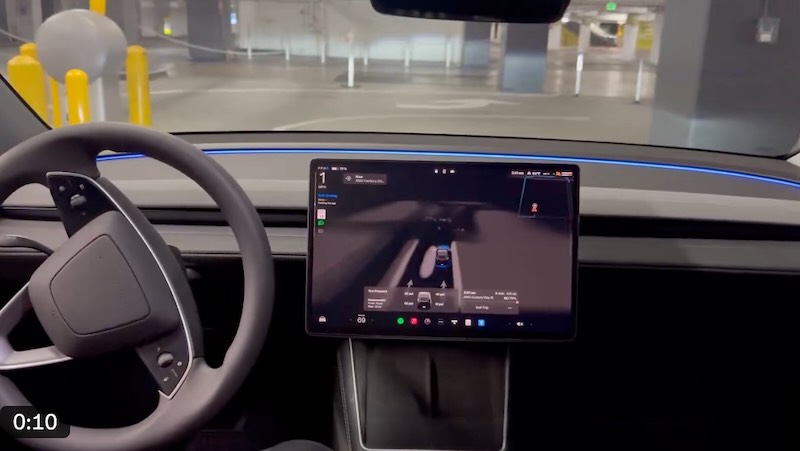
Tesla’s FSD V14 is introducing something remarkable that most drivers may never notice: the ability to recover from system faults without human intervention. Subtle but profound change represents a significant architectural shift in how Tesla’s autonomous driving system handles problems.
When earlier FSD versions encountered issues like intense sunlight glare on front-facing cameras, they immediately triggered “red hands” alerts, disengaged, and handed control back to the driver. FSD v14 takes a dramatically different approach – when facing similar challenges, it continues operating while reasoning about its next move, even as alerts appear.
Tesla Self-Driving 14.1.2 automatically recovers from red hands of doom (system fault) pic.twitter.com/I7Zdz6HFRa
— Whole Mars Catalog (@WholeMarsBlog) October 17, 2025
Shift moves Tesla away from traditional L2 autonomy logic of “stop and surrender control” toward something more sophisticated. Instead of immediately disengaging, FSD v14 appears to downgrade capabilities while attempting to maintain safe operation.
Change directly supports Tesla’s Robotaxi vision – a future without drivers or even steering wheels. Such vehicles will need robust self-recovery capabilities since human intervention won’t be an option.
For typical drivers, this means fewer unnecessary disengagements and a more seamless experience. System can now work through temporary perception issues, dropped sensor frames, or confidence fluctuations without throwing in the towel.
Creating self-healing autonomous systems requires extraordinary engineering. Tesla has apparently implemented a restricted fallback mode where FSD v14 can limit speed, increase following distance, or restrict complex decision-making while maintaining basic planning and control functions.
In practice, this might mean the system gradually pulls over, activates hazards, or simply drives more conservatively until conditions improve or the fault resolves itself.
What makes this particularly challenging is the need for reliable confidence estimation – system must accurately judge when it can safely recover versus when it truly needs help. A system that incorrectly believes it can manage a situation poses greater risks than one that quickly surrenders control.
Architectural change represents one of FSD v14’s most significant advances, despite being largely invisible to casual users. By developing sophisticated fault management and self-recovery capabilities, Tesla’s FSD v14 takes a crucial step toward true self-reliance – the foundation necessary for full autonomy.
The evolution from supervised driving assistance to systems that can handle their own problems marks a pivotal moment in autonomous vehicle development. As FSD continues to mature, these self-recovery mechanisms may ultimately prove more important than flashier features that get more attention.
Related Post
Tesla FSD V14.1.2 Introduces Mad Max Mode: Higher Speeds, Aggressive Lane Changes
Tesla AI5 Chip: 40x Performance Boost Coming to Power Next-Gen FSD v14 | Elon Reveals
Tesla Robotaxi App Launches Nationwide on iOS: You Can Join Waitlist for Autonomous Rides