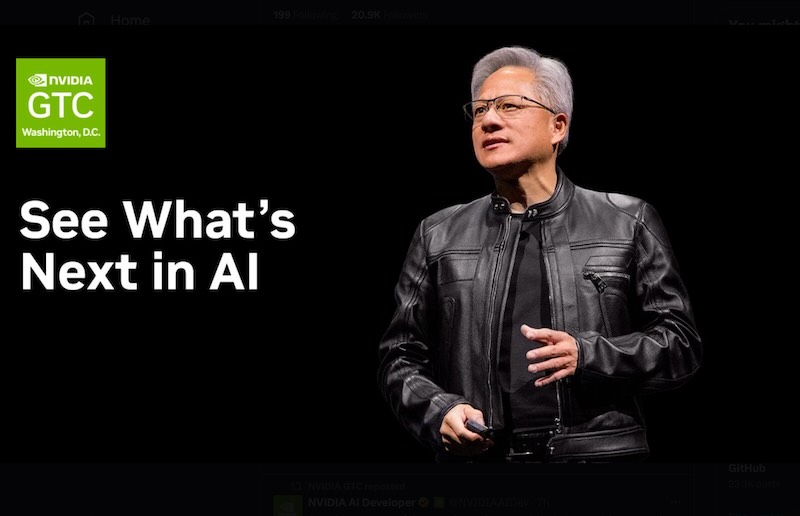
Nvidia announced two partnerships at its GTC conference that signal a transformation in how the company positions itself beyond graphics processing. Announcements landed on October 28, in Washington, D.C., where CEO Jensen Huang used the keynote stage to showcase collaborations with Palantir Technologies and a sprawling network of autonomous vehicle manufacturers. Deals represent Nvidia’s calculated shift toward becoming the infrastructure provider for AI-powered decision-making across industries—from supply chains to self-driving cars.
The Palantir Technologies partnership merges Nvidia’s accelerated computing stack with Palantir’s Ontology framework. Organizations in defense, healthcare, manufacturing, and supply chain management can now process massive data sets into actionable intelligence without building custom infrastructure from scratch. Lowe’s has already deployed the system to create a digital twin of its supply chain operations, targeting cost reductions and faster response times to market fluctuations.
Technical foundation includes Nvidia’s CUDA-X libraries and Nemotron models, which enable customizable AI agents that adapt to specific operational requirements. Future implementations will leverage the Blackwell architecture, though Nvidia hasn’t specified deployment timelines for that hardware generation.
Traditional enterprise software required manual analysis and delayed decision cycles. Integration automates that process by connecting sensor data, business logic, and AI inference in a continuous loop. Manufacturing facilities can adjust production schedules based on predicted equipment failures. Healthcare systems can optimize staff allocation based on patient flow patterns. The applications span any operation that generates structured data at scale.
Jensen closed the keynote with autonomous driving announcements, positioning Nvidia as the computing backbone for what the company now calls AI-powered transportation. Strategy centers on Nvidia DRIVE AGX Hyperion 10, a reference architecture that delivers 1,000 TOPS of INT8 performance through the Thor platform. Runs safety-certified Drive OS and accommodates 14 cameras, 9 radars, 1 lidar unit, and 12 ultrasonic sensors—all customizable to partner specifications.
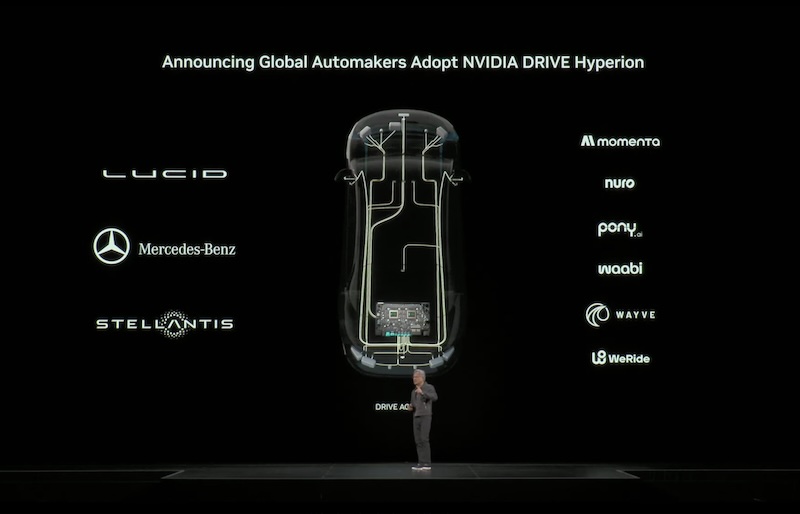
Nvidia secured partnerships across three vehicle categories. Mercedes-Benz, Stellantis, and Lucid will integrate the technology into passenger vehicles, with the next-generation Mercedes S-Class reportedly supporting Level 4 autonomy. Robotaxi segment includes Momenta, Pony.ai, WeRide, Avride, May Mobility, Nuro, and Wayve. Long-haul trucking partners include Volvo, Waabi, and Aurora.
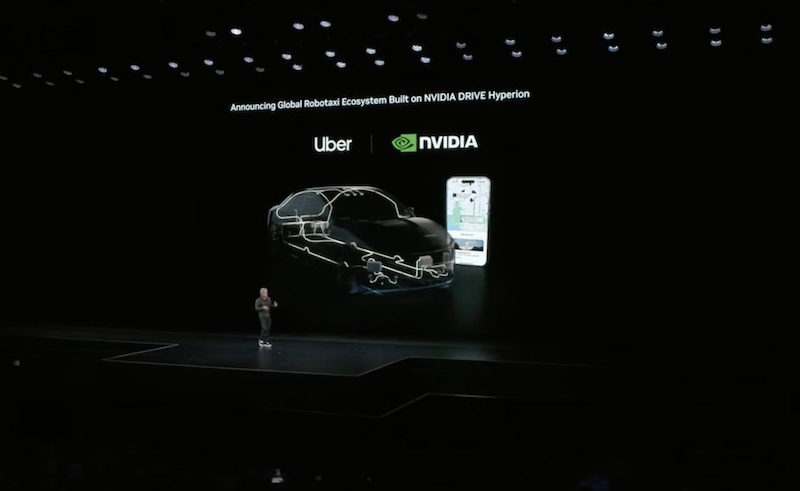
Uber partnership targets deployment of 100,000 autonomous vehicles by 2027 across Uber’s global fleet. Timeline represents an acceleration of autonomous ride-hailing beyond limited pilot programs into city-scale operations.
Nvidia’s approach contrasts with Tesla’s vertically integrated model. Instead of building vehicles, Nvidia provides the processing architecture that multiple manufacturers can adapt. In Europe and North America, this positions Nvidia as the primary alternative to Tesla’s closed ecosystem for autonomous driving technology.
Partnerships announced at GTC demonstrate how Nvidia turns autonomous driving challenges into opportunities for accelerated computing deployment at scale.
Related Post
Nvidia CEO Delivers Desk-Sized Petaflop AI Supercomputer DGX Spark to Elon at SpaceX Starbase
NVIDIA DRIVE AGX Thor Developer Kit: Pre-Orders Open for September Shipping
Nvidia Partners with GM on Self-Driving Tech, Unveils Groundbreaking Cosmos System