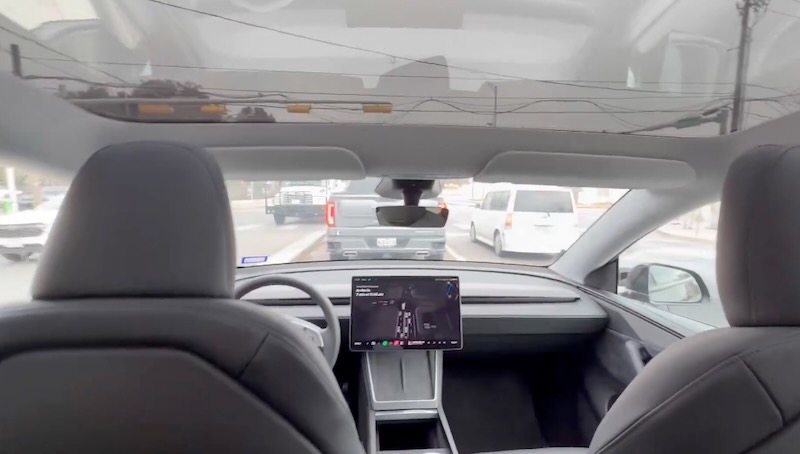
Tesla has officially begun offering paid, fully driverless Robotaxi rides to the general public in Austin, Texas. Service operates without safety monitors in the vehicle, representing what may be the company’s most significant autonomous driving milestone to date.
After conducting a month of testing without safety drivers, (Model Y Robotaxi drives empty on Austin roads, no safety driver), Tesla opened access to external riders through a pilot program. The launch video, which circulated widely across social media platforms, featured Dr. Zhenhua Yu (TSLA99T), a former Tesla AI engineer who’s believed to be the first public participant in the Tesla launches unsupervised Robotaxi rides in Austin program. While his previous role at the company has sparked discussion, there’s no evidence it influenced his selection. He reportedly resides in Austin and was included as Tesla began expanding access.
In passenger seat now pic.twitter.com/rjfkos2ZCe
— TSLA99T (@Tsla99T) January 22, 2026
3-party monitoring systems indicate that seven vehicles are currently operating in fully autonomous mode within Austin’s city limits. Tesla’s broader Texas deployment includes 68 Robotaxi vehicles, while 165 units are active in California’s Bay Area, though those vehicles operate under different regulatory frameworks and supervision requirements.
Austin rollout differs from previous demonstrations or controlled pilot initiatives. Real passengers are paying for transportation with no safety operator present, a threshold that few autonomous vehicle companies have crossed outside geofenced zones.
This pilot provides the clearest indication yet of how Tesla intends to transform Full Self-Driving from a driver-assistance feature into a commercial ride-hailing operation. The company has long promised that Tesla launches unsupervised Robotaxi rides in Austin would eventually become reality, and this marks the first tangible step toward that vision at scale.
However, significant questions remain. Can Tesla expand beyond a handful of vehicles while maintaining safety standards? Will regulatory bodies approve broader deployments? These factors will likely determine whether this Austin pilot becomes a blueprint for national expansion or remains a limited experiment.
For now, though, Tesla has achieved what it set out to prove: fully autonomous, commercial rides are no longer theoretical.
Related Post
Tesla Embeds Hidden “Unsupervised” FSD Geofence in Bay Area, Only be Good News
Tesla Robotaxi App Launches Nationwide on iOS: You Can Join Waitlist for Autonomous Rides