
For years, satellite internet has carried a reputation as a last resort — something rural households tolerate rather than choose. That narrative may be shifting faster than expected. The Federal Communications Commission this week approved a sweeping overhaul of its satellite spectrum-sharing rules, and the beneficiaries aren’t just the companies launching hardware into low-Earth orbit. Everyday consumers, particularly those in underserved communities, stand to gain the most from what regulators are calling a generational update to decades-old policy.
Vote targets the Equivalent Power Flux Density (EPFD) limits — regulations drafted in the late 1990s that capped how much energy satellite systems could transmit to and from ground equipment. At the time, those rules made sense. The technology they were designed to govern looked nothing like what’s orbiting the planet today.
Core problem with the EPFD framework wasn’t that it was wrong — it’s that it aged poorly. Designed to prevent interference between high-orbiting geostationary (GSO) satellites and lower-orbiting systems, the limits were built around theoretical models from an era before modern constellation engineering existed.

The result? Next-generation satellite operators like SpaceX’s Starlink were effectively penalized for being more advanced. FCC acknowledged this directly, noting that government-imposed overprotection of legacy GSO systems meant American households weren’t receiving the fastest space-based broadband that domestic innovation could actually deliver.
That’s a notable admission from a regulatory body — essentially conceding that its own rulebook had become a constraint on the industry it governs.
The revised framework swaps rigid power caps for performance-based protections that account for how today’s satellite constellations actually operate. Practical upside is significant.
Under current EPFD limits, only one satellite could effectively serve a given geographic area and frequency band at a time. Updated rules could allow up to eight satellites to serve the same area simultaneously — a sevenfold increase in regional capacity. SpaceX conducted real-world tests supporting this figure, demonstrating that a low-Earth-orbit system could scale from one to eight active satellites in a given region without generating meaningful interference.
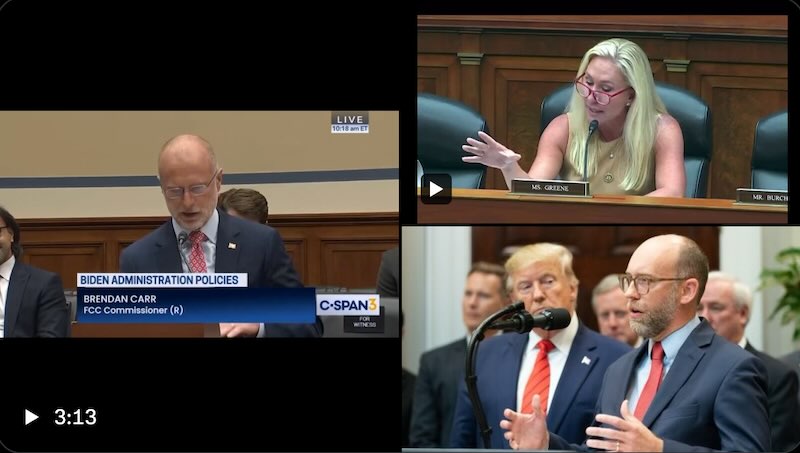
FCC Chair Brendan Carr put it plainly during the vote: “Americans are now about to see a big upgrade.” He also acknowledged that the existing rules were “holding back” newer satellite internet offerings, adding that modern satellite designs make spectrum-sharing far more manageable than older regulations assumed.
Increased capacity doesn’t just mean faster speeds for existing users. It creates room for competitors to deliver equivalent service quality with smaller constellations — a dynamic that could drive prices down over time.
Who benefits beyond Starlink? While much of the immediate attention centers on Starlink, rule change carries broader implications. Amazon’s forthcoming satellite internet service, currently positioned as a direct Starlink competitor, also supported updating the spectrum-sharing policy. A more permissive regulatory environment benefits any operator building or planning a LEO constellation.
That competitive dimension matters. Starlink has faced real capacity constraints in certain U.S. markets, where the network is oversubscribed and the company has resorted to one-time demand surcharges for residential plan access. A sevenfold increase in regional satellite availability doesn’t eliminate that problem overnight, but it does give SpaceX — and its rivals — significantly more headroom.
Carr also framed the vote as a geopolitical signal, suggesting the updated rules position the U.S. to lead internationally on next-generation satellite services rather than wait for a global consensus that may never materialize.
It’s worth noting the FCC adopted the new rules with editorial privileges, meaning targeted revisions remain possible. DirecTV and other established operators have urged changes to limit potential interference, while SpaceX has pushed back on those proposals as attempts to water down the updated policy.
Timeline for SpaceX to operationalize the new capacity gains remains unclear. But the regulatory foundation is now in place — and when it comes to satellite broadband, the FCC has officially changed the orbit of the conversation.
Related Post
SpaceX Wins FCC Approval to Expand Starlink Dish Elevation Angles
Trump Names Brendan Carr as FCC Chairman: A New Era for Telecommunications Policy
FCC Fast-Tracks SpaceX Million-Satellite Plan, Public Comments Open Until March 6