
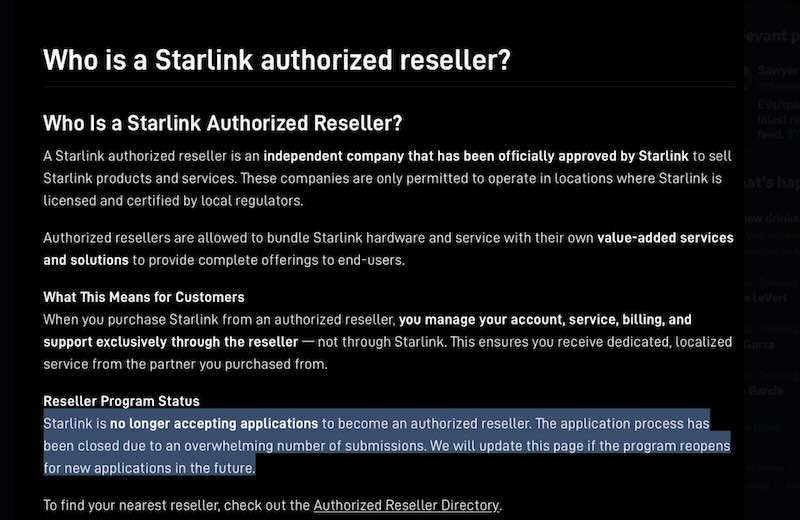
SpaceX has officially closed applications for its Starlink reseller program, citing an overwhelming volume of submissions from interested businesses. The notice, quietly posted to Starlink’s support page, reads plainly: the application process is closed, and there’s no confirmed timeline for reopening. For an industry watching Starlink’s every move, that’s not a small development — it’s a signal.
Getting into the Starlink reseller program was never straightforward. SpaceX had set a high bar, requiring applicants to demonstrate a credible business plan targeting at least $5 million USD in annual recurring revenue from Starlink data services alone. Prospective resellers needed deep financial resources, a tolerance for upfront spending, and, frankly, extraordinary patience.
SpaceX already operates a reseller network of roughly 200 vendors globally. Closing the door on further expansion, then, isn’t just a logistical call. It suggests the company is making deliberate choices about who sells its product and how.
More revealing detail sits in SpaceX’s handling of its related Indirect Reselling Program, which it also paused last month. That program had a lower barrier to entry, that appears to be precisely the problem. SpaceX stated it wants indirect arrangements reserved for situations involving genuine strategic barriers: licensing constraints, language access, operational reach, or regulated market conditions.
“The current approach has created compliance risk and reduced visibility into end customers,” the company acknowledged on its support page.
That’s a significant admission. Starlink has attracted a genuinely broad customer base — remote workers, maritime operators, disaster response teams — but also, reportedly, online fraud networks in Southeast Asia and drug trafficking organizations using the service in hard-to-reach regions. When your product reaches those kinds of end users through a loosely monitored reseller chain, liability exposure grows fast.
Timing matters here. SpaceX is reportedly preparing for a public offering that could raise up to $800 billion. Before any company of that scale goes public, cleaning up compliance gaps isn’t optional — it’s mandatory. Tightening the Starlink reseller program fits neatly into that pre-IPO housekeeping.
Simultaneously, SpaceX is rolling out a travel registration policy that requires customers to submit passport details and a live portrait when accessing Starlink outside their registered home country. The company is also moving to discontinue a location data function that some users have exploited to work around GPS spoofing and jamming. Taken together, these moves point toward tighter operational control across the board.
Starlink’s been adding thousands of subscribers daily, so the demand clearly isn’t the issue — it’s the distribution of that demand that SpaceX is now actively reshaping.
Related Post
FCC Overhauls Satellite Rules, Giving Starlink a 7x Capacity Boost
SpaceX Cuts Starlink Aviation Prices – New GA Plans Start at $200/Month
SpaceX Wins FCC Approval to Expand Starlink Dish Elevation Angles