Elon Musk’s latest post on X has reignited a debate that’s been simmering in autonomous driving circles for years. Post juxtaposed two images: one representing what the human eye perceives as a standard RGB scene, the other a visualization reconstructed from Tesla FSD’s AI-driven photon-processing pipeline. His caption was direct — “This is why Tesla FSD can see so well at night or through extreme glare.” The implication? Vision-only autonomous driving systems aren’t the liability critics claim. They might, in fact, be an advantage.
That’s a significant claim. But the underlying engineering makes a compelling case.
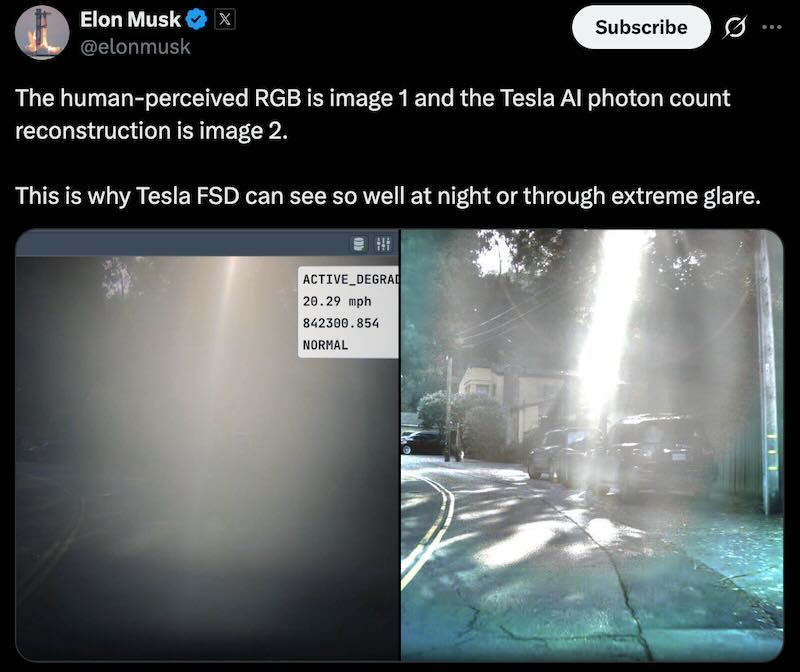
Here’s what matters: the Tesla FSD model doesn’t “see” the second image the way humans process visuals. That reconstruction is derived from the camera’s RAW sensor data — data that preserves the sensor’s full dynamic range before Image Signal Processing (ISP) is applied. It’s tone-mapped and compressed solely so humans can interpret it on a screen.
In reality, RAW data consumed by Tesla FSD stack contains substantially more information than any screen-displayable image can convey. Includes subtle gradients in extremely bright regions, faint signals buried in dark areas, richer spectral detail, and temporal data accumulated across multiple frames and processed statistically over time. No single image can capture that.
Critically, the human visual system operates differently. Our retina and visual cortex perform their own form of biological image processing — and in doing so, they discard enormous amounts of raw photon-level data before conscious perception even occurs. We never actually “see” everything the light hitting our eyes contains.
For years, the dominant counterargument to Tesla’s camera-only approach has been straightforward: LiDAR gives competitors a structural advantage in low-visibility conditions. Criticism isn’t wrong — but it may be increasingly incomplete.
When a system bypasses traditional ISP pipelines and directly processes RAW sensor data, the comparison between human vision and machine perception shifts considerably. Model is operating on a far richer layer of visual information than what human eyes alone can access. That’s not a marginal improvement — it’s a structural one.
Consider real-world validation. During a China drive using XPeng’s VLA 2.0 — a competing system built on similar principles, multiple sudden sandstorms hit in Xinjiang. Human visibility dropped dramatically. System kept operating with notable stability. That’s not anecdotal noise; it’s a repeatable demonstration of what high-dynamic-range hardware combined with a capable RAW-processing software stack can do.
Autonomous driving industry is approaching an inflection point, Elon’s post signals that Tesla is leaning into its architectural bets rather than walking them back. Combination of high-dynamic-range camera hardware with software capable of directly leveraging RAW sensor data challenges long-held assumptions about what vision-only systems can achieve.
Comparisons between human sight and Tesla FSD perception aren’t just misleading at this point — they’re measuring the wrong thing entirely.
So the next time someone argues that autonomous vehicles can’t handle what human drivers can, it’s worth asking: which layer of reality is each one actually seeing?
In autonomous driving, it turns out, FSD doesn’t just keep up with human vision — it’s operating on a whole different frequency.
Related Post
Tesla FSD V14.3 Released: Faster Reactions, Smarter Vision and Major RL Upgrades
Tesla AI Engineer Yun-Ta Tsai Explains Why More Sensors Could Actually Hurt Autonomous Driving
Tesla Raw Vision Gambit: Vision-Only Active Safety, Pure Vision and Sensor Fusion