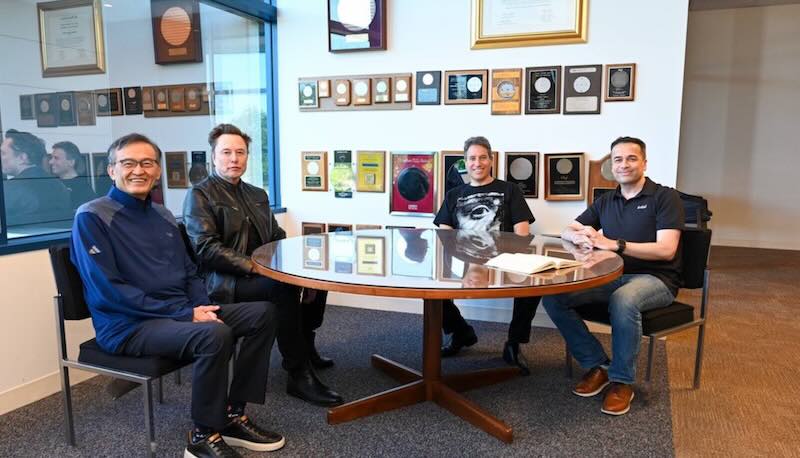
It’s not every day that a chip company, a rocket manufacturer, and an electric vehicle giant announce plans to build a semiconductor factory together. Yet, that’s exactly what’s unfolding with Terafab — a joint initiative that could reshape how the U.S. approaches domestic chip production. SpaceX posted on X confirming that Intel is joining the effort, with Elon Musk calling it “the most epic chip-building effort ever,” combining logic, memory, and advanced packaging under one roof.
Intel CEO Lip-Bu Tan didn’t hold back either, stating that Terafab “represents a step change in how silicon logic, memory, and packaging will get built in the future.”
Why Terafab matters now, timing here isn’t coincidental. Elon announced in March that SpaceX and Tesla would team up to develop chips for AI compute, satellites, SpaceX’s planned space data center, and to support autonomous vehicles (AI5 chip 40× faster performance) and robotics. Ambition was clear, 1TW per year of compute. The how, though, remained conspicuously vague.
Question had an obvious problem attached to it: neither SpaceX nor Tesla has any experience in semiconductor fabrication. Building a chip fab is one of the most capital-intensive corporate infrastructure projects imaginable, typically demanding upwards of $20 billion and years of construction before a single wafer rolls out.
Enter Intel. The company has spent considerable effort rebuilding its foundry business, actively seeking large anchor customers to justify that investment. It now has two significant ones in SpaceX and Tesla.
Intel says its ability to “design, fabricate, and package ultra-high-performance chips at scale” will directly support Terafab’s compute targets. That’s a meaningful commitment from a company that, frankly, needed a high-profile win. Rivals like Nvidia and AMD have consistently outmaneuvered Intel in advanced processor development, and the “fabless” model — where chip designers outsource manufacturing entirely — left Intel looking like it was defending legacy ground.
Intel’s stock climbed more than 3% on the announcement, signaling that investors recognize the strategic value here.
Still, some caution is warranted. Investors who anticipated that Terafab would introduce a disruptive, greenfield engineering approach — one shaped by SpaceX’s and Tesla’s unconventional problem-solving — may find this partnership more conventional than expected. Intel brings expertise, but it also brings existing methodologies.
The Texas-based facility’s scope remains undefined, and Intel hasn’t disclosed further operational details beyond its corporate post.
Whether this collaboration fundamentally rewires the U.S. semiconductor industry or simply gives Intel a lifeline remains to be seen — but one thing’s certain: Terafab is no longer just a concept. It’s Intel.
Related Post
Tesla Launches Terafab: Inside the Company In-House Chip Manufacturing Ambition
Tesla AI5 Chip Uses Half-Reticle Design to Double Manufacturing Yield
Tesla Restarts Dojo 3 Supercomputer After AI5 Chip Breakthrough