Tesla’s Q4 2025 earnings report didn’t just share financials, it dropped the clearest signal yet that FSD has transformed from experimental tech into a cornerstone of the company’s business model. For the first time, Tesla disclosed cumulative FSD sales figures, and they reveal a strategy that’s already reshaping how the automaker thinks about revenue, software, and autonomous infrastructure.
Headline number: 1.1 million users have purchased FSD as of Q4 2025, with 330k currently subscribed rather than buying outright. In 2025 alone, Tesla delivered 1.6 million vehicles globally and added 300k new FSD users, an 18.75% attach rate.
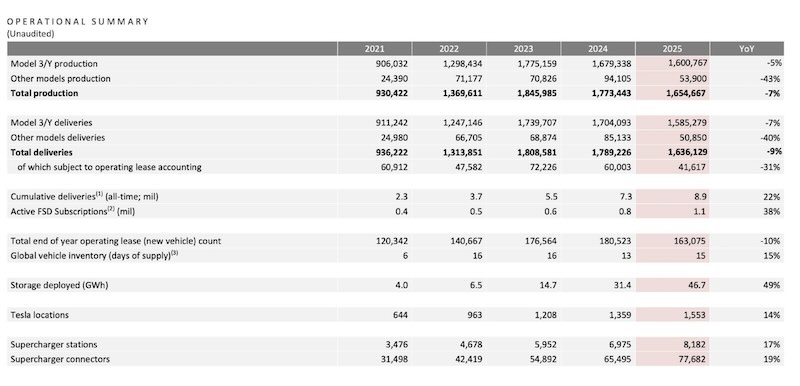
That might seem unremarkable until you account for geography. FSD remains primarily a North American offering in terms of both functionality and uptake. Tesla sold 589k vehicles in North America last year, which means roughly 50% of buyers in that region opted into FSD. In its core market, FSD isn’t a novelty anymore. It’s standard practice.
Tesla has already announced its next shift: starting February 14, 2026, FSD will no longer be available as a one-time purchase. Every new buyer will subscribe instead. Given the data, that move looks less like disruption and more like validation of an existing trend.
Tesla is simultaneously scaling the infrastructure required to support this pivot. As of Q4 2025, the company’s AI training capacity equals approximately 120k Nvidia H100 GPUs, around 120 EFLOPS of compute power dedicated to advancing real-world autonomy.
Tesla’s Robotaxi program now operates roughly 500 vehicles across the San Francisco Bay Area and Austin, Texas, collectively logging 650k miles. Austin represents a significant milestone: operates without safety drivers or trailing support vehicles, marking Tesla’s first fully driverless commercial deployment.
In 2026, Tesla plans to expand Robotaxi operations into Dallas and Houston, Phoenix, Miami and Orlando, and Las Vegas and Tampa, a rollout targeting some of the country’s most challenging urban environments. To power this expansion, Tesla intends to activate its Cortex 2 compute cluster in Mid-2026, boosting total AI capacity to approximately 280 EFLOPS.
Strategy is becoming unmistakable. FSD isn’t just software anymore, it’s a subscription platform backed by industrial-scale compute and an expanding autonomous fleet. Tesla isn’t merely promising autonomy. It’s driving it forward.
Related Post
Tesla Promises Free HW3 Upgrades for Early FSD Buyers, Elon Confirms Commitment
Tesla FSD v14 Already Has Reasoning Features, Says VP Ashok Elluswamy
Tesla Grok Navigation Commands: Natural Voice Control for FSD Drivers