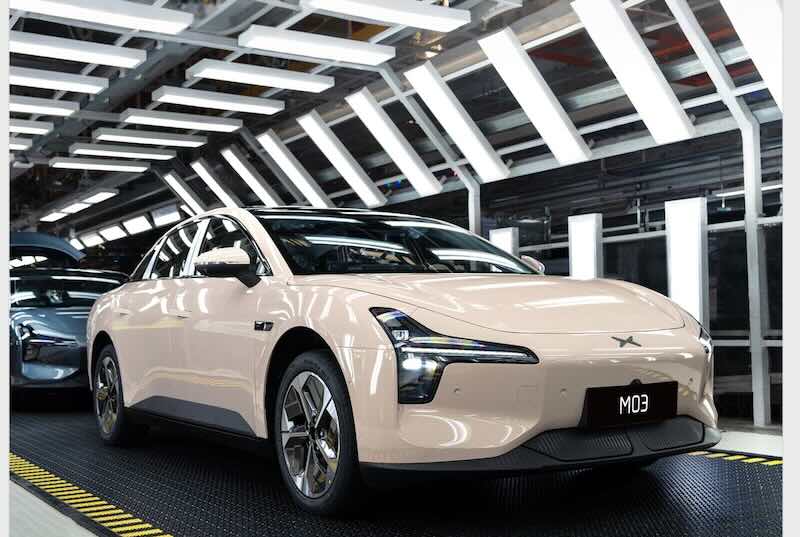
XPeng has unveiled VLA 2.0, a complete rethink of its autonomous driving stack. The company released demonstration clips showing the system navigating real-world traffic, and the underlying technology shift is significant. Unlike its predecessor, VLA 2.0 abandons LiDAR in favor of a vision-first approach, with radar serving as backup. It’s a strategic pivot that echoes Tesla’s methodology, but XPeng insists the decision goes beyond simple cost-cutting.
Why XPeng dropped LiDAR, transition wasn’t arbitrary. XPeng executives cite three primary factors: scalability of AI training, reduction in hardware expenses, and streamlined vehicle integration. Vision-based systems can ingest vast quantities of video data from the fleet, which accelerates machine learning iteration. LiDAR, while precise, introduces complexity in both manufacturing and software development. By removing it, XPeng aims to speed up deployment across its vehicle lineup without sacrificing performance.
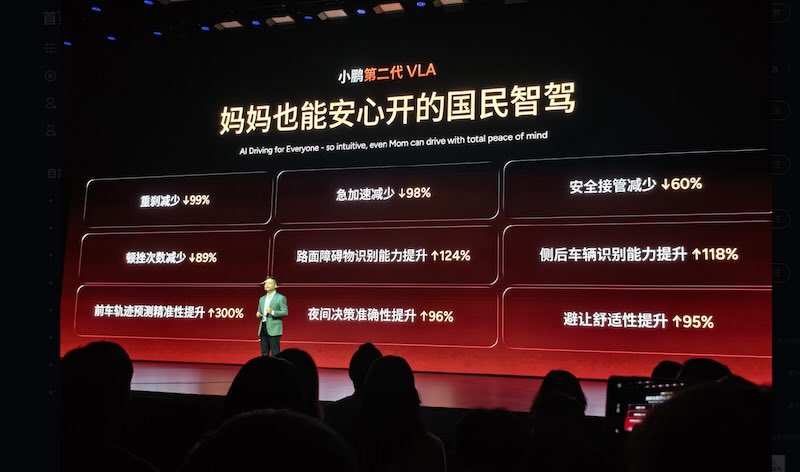
Internal testing data reveals that hard braking events have declined by 99% compared to the previous generation. That’s not incremental progress, it suggests the longitudinal control algorithms were rebuilt entirely. Drivers who’ve experienced both versions will likely notice the change immediately, particularly in how the vehicle manages speed and stopping distance in unpredictable scenarios.
Cities like Guangzhou China present a stress test for any autonomous system. Pedestrians weave between scooters, cyclists occupy car lanes, and road design often feels ad hoc. In these conditions, smoothness becomes the ultimate benchmark. Early feedback suggests XPeng’s VLA 2.0 handles these scenarios with noticeably less hesitation and smoother transitions than prior iterations.
CEO He Xiaopeng clarified that VLA 2.0 began as a dedicated project two years ago. This wasn’t a software patch layered onto existing infrastructure, it’s a fundamentally different modeling approach. The company hinted that L4 autonomy could reach meaningful scale within the current year, though regulatory and technical hurdles remain.
Driver impressions will determine whether XPeng’s VLA 2.0 delivers on its vision-led promise.
Related Post
XPeng CEO: Vision Will Beat LiDAR by 2027, Autonomous Driving Revolution
XPeng Unveils Turing Chip for Pure Vision Autonomous Driving – 1500+ TOPS Performance
XPeng Accelerates European Expansion: CEO Confirms Local Production Plans for Market Conquest