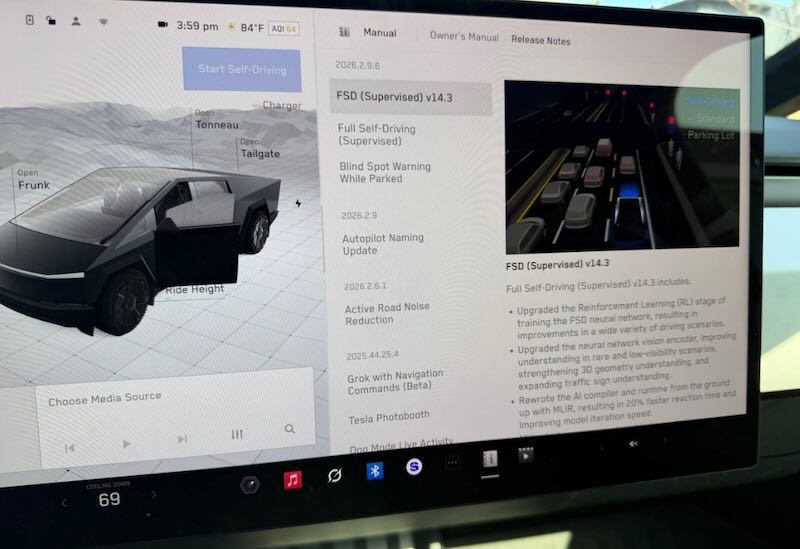
Tesla FSD V14.3 is here, and it’s not a minor patch. Released officially this week, the update lands across the Tesla fleet with a list of changes that signals a meaningful step forward in how the system processes, reacts, and ultimately drives. From a ground-up rewrite of the AI compiler to sharper emergency vehicle recognition, 14.3 is pushing the boundaries of what consumer-grade autonomy looks like in 2026.
This isn’t just a software update. It’s a structural shift in how Tesla’s Full Self-Driving system thinks.
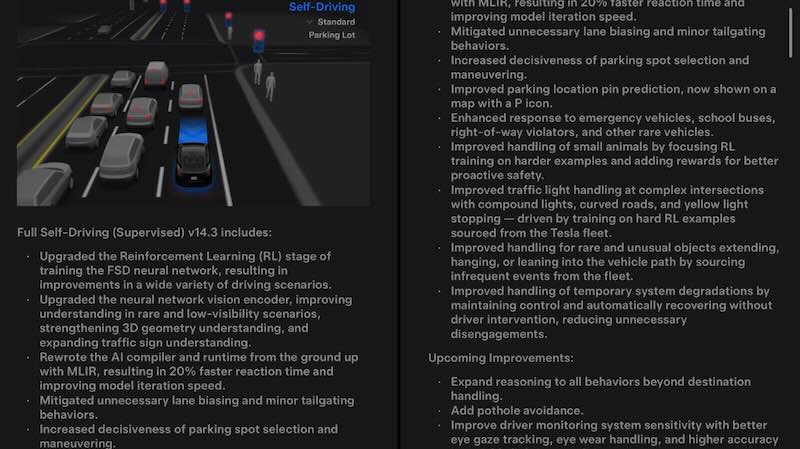
At the core of this release is something most drivers won’t see directly — but they’ll certainly feel. Tesla has rewritten its AI compiler and runtime from scratch using MLIR (Multi-Level Intermediate Representation), resulting in a 20% improvement in reaction time. That’s not incremental. That’s the kind of gain that changes how the car handles split-second decisions, and it accelerates the pace at which Tesla can iterate on future model training.
Alongside that, the Reinforcement Learning (RL) stage of the FSD neural network has been upgraded, producing measurable improvements across a wide variety of driving scenarios. Neural network vision encoder also received an upgrade — strengthening 3D geometry understanding, improving recognition in low-visibility conditions, and expanding the system’s ability to read traffic signs it previously struggled with.
One of the most notable areas of improvement in FSD V14.3 is how it handles situations that fall outside normal driving patterns. Enhanced response to emergency vehicles, school buses, right-of-way violators, and other uncommon vehicle types has been documented in this build.
Handling of small animals has also improved, with Tesla sourcing harder training examples from the fleet and introducing rewards for proactive safety behaviors. Similarly, rare objects extending, hanging, or leaning into the vehicle path are now handled more reliably — again, driven by fleet-sourced edge-case data.
Traffic light interpretation at complex intersections has also been addressed. Compound lights, curved road geometry, and yellow-light stopping decisions have all been refined using hard RL examples pulled directly from real-world Tesla fleet data.
Early real-world testing is reinforcing these claims. DirtyTesLa, FSD driving blogger noted that navigation directed the system to turn the wrong way into a parking lot — and instead of complying, the car appeared to read a “Do Not Enter” sign and self-corrected. That’s the kind of contextual reasoning that separates a capable system from a truly intelligent one.
Beyond the architectural changes, V14.3 addresses several behavioral friction points that have frustrated drivers in past builds. Unnecessary lane biasing and minor tailgating behaviors have been mitigated. Parking location pin prediction is now more accurate, displayed on a map with a P icon, and the system’s decisiveness in selecting and maneuvering into parking spots has noticeably increased.
Perhaps more importantly, system now handles temporary degradations more gracefully — maintaining vehicle control and recovering automatically without requiring driver intervention. That means fewer disengagements, and a more stable overall experience during edge-case conditions.
DirtyTesLa have reported two minor instances of unexpected braking, described as “gentle” and far less pronounced than in earlier builds — a significant improvement in ride quality perception.
What’s coming next? Tesla has outlined several capabilities currently in development. Pothole avoidance is on the roadmap, as is an expansion of reasoning to all driving behaviors beyond destination handling, a substantial leap in system-wide intelligence. Driver monitoring system is also slated for improvements, including better eye gaze tracking, eyewear handling, and higher accuracy in variable lighting conditions.
These aren’t distant promises. Given the pace of iteration that Tesla FSD V14.3 itself represents, the next release cycle could arrive sooner than expected.
Tesla’s autonomous driving ambitions have always been framed around a simple thesis: the more miles driven, the smarter the system gets. With 14.3, that thesis is compounding — and for anyone watching the autonomous vehicle space, the question isn’t whether Tesla FSD V14.3 is moving the needle. It’s whether the rest of the industry can keep up with the full self-driving pace Tesla is setting.
Related Post
Tesla AI Engineer Yun-Ta Tsai Explains Why More Sensors Could Actually Hurt Autonomous Driving
Tesla FSD Supervised EU Approval: Netherlands RDW Date Set for April 10th
Tesla $20B Budget: Why Computing Beats Cars | The Future of Automotive Investment