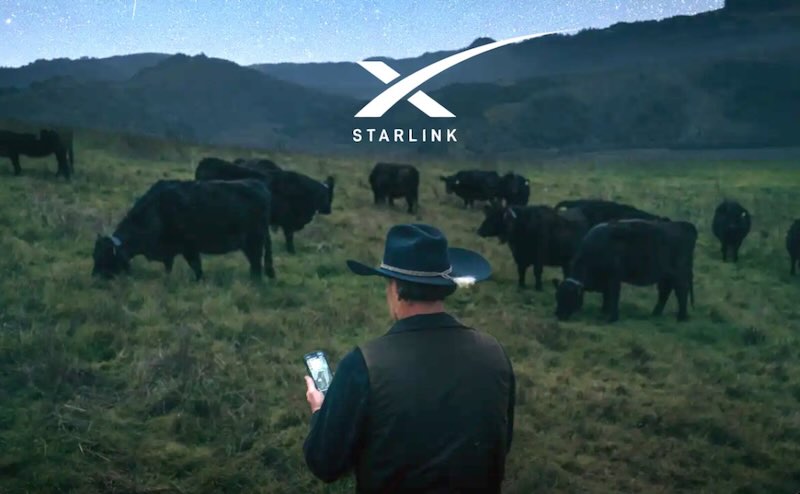
Smart cattle management has always hit a wall at the ranch’s edge. Cell towers don’t reach rugged terrain, and proprietary radio infrastructure costs ranchers both time and capital. Halter, New Zealand-based agtech company, is changing that today with the launch of direct-to-satellite connectivity powered by SpaceX’s Starlink, a world-first that eliminates the need for any ground-based infrastructure whatsoever.
The announcement is significant. Until now, Halter’s solar-powered, GPS-enabled smart collars relied on custom radio towers that cost roughly $4,500 each and covered about five miles of range. That’s a real constraint for operations spanning thousands of acres across isolated terrain.
With Starlink integration, those collars now communicate directly with SpaceX’s orbiting satellites. Ranchers can monitor, manage, and redirect their herds from a smartphone — anywhere there’s open sky. No tower installation. No proximity requirements. Just connectivity.
What makes Halter’s direct-to-satellite system genuinely compelling isn’t just the tech — it’s the timing. U.S. beef operations are contending with rising fuel costs, persistent labor shortages, and an aging workforce. Removing infrastructure dependency doesn’t just modernize ranching; it makes it operationally viable in places it previously wasn’t.
Halter’s internal modeling estimates this capability expands coverage of the U.S. beef cattle market by 2.5x. That’s not a marginal improvement — that’s a structural shift in who can actually use the product.
Collars themselves do more than track location. Each unit can emit audio commands to steer cattle away from restricted areas. If a cow ignores the sound cue, the collar delivers a low-level pulse — roughly one-tenth the strength of a traditional electric fence. Over time, most cattle respond to sound alone, with vibration cues covering the rest.
Ranchers can now draw, adjust, and move virtual fence lines in real time, directly from their phones, with no physical infrastructure required. Paired with new tools for reproduction tracking, animal behavior analysis, and precision pasture management, Halter’s direct-to-satellite rollout amounts to a full-stack upgrade for cattle operations.
Service is currently live for beef operations in the U.S. and New Zealand — with Australia and Canada coming soon. In New Zealand, Halter is running through One NZ, SpaceX’s in-country carrier partner. A U.S. telecom partner is expected to be named shortly.
Broader implication here matters for the entire IoT sector. SpaceX’s Jeff Ahmet framed it plainly: this is Starlink Mobile moving beyond dead-zone smartphone fixes and into total connectivity for every acre. Last year, One NZ explored satellite links for beehive monitoring — a hint that rural IoT was already on this trajectory.
Ranching has never been easy, but with Halter’s direct-to-satellite, it’s finally getting a signal.
Related Post
SpaceX Starlink Mobile Gen 2: 150Mbps Speeds from Space Coming Mid-2027
Starlink Standard 4 vs Standard 4 X: SpaceX New Dish & Router Bundles Explained
SpaceX Launches Updated Starlink Mobile Site With V2 Satellite Details and Global Coverage Map