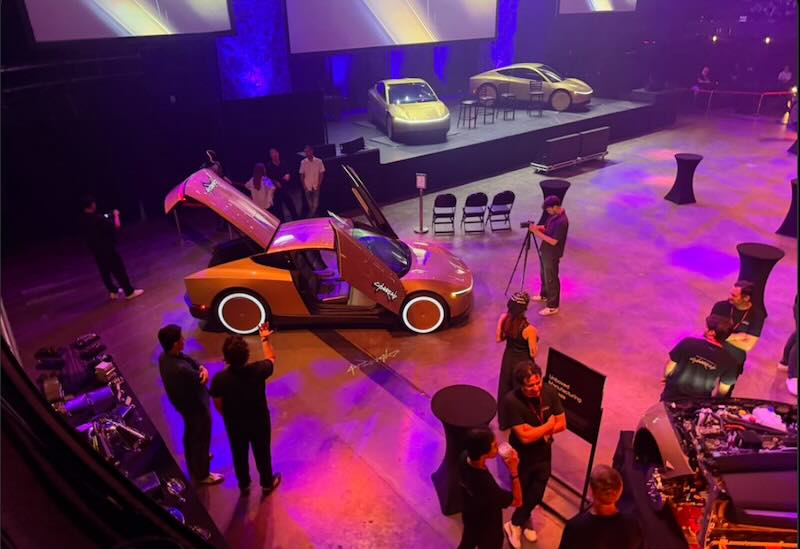
Tesla didn’t just launch a car on September 3rd, it opened the door to an entirely new commercial ecosystem. The company published a form on its website soliciting interest from parties looking at “Cybercab fleet vehicle purchasing,” and the response has been nothing short of staggering. Eric, Tesla’s vehicle and robotaxi engineering lead confirmed via X that the company has already received tens of thousands of submissions through that webform, team is actively working through them.
That kind of demand, frankly, signals something much larger than a vehicle launch.
Eric was direct: volume of inquiries is so high that it’ll take time to align each opportunity with Tesla’s near- and mid-term plans. He emphasized completing the form as “the best way to engage with the team in an organized and efficient way.” Importantly, the interest form, which says it “helps us build our robotaxi network,” suggests Tesla sees promise in widening the circle to include third-party companies.
That’s a notable strategic pivot. Until recently, Tesla seemed committed to keeping its robotaxi business in-house, first testing and operating its own fleet of robotaxis with Model Y vehicles and now the purpose-built Cybercab.
So what exactly are these tens of thousands of companies lining up to buy? Cybercab is engineered around one central premise: efficiency. It carries a 47.6 kWh battery with an estimated range of 293 miles and a consumption rate exceeding 6.1 miles per kWh, figures that make a compelling case for fleet economics. Motor output sits at 163 kW (219 hp), curb weight comes in at 3,113 lbs, and the rear trunk offers 20.2 cubic feet of cargo space.
What’s remarkable is the interior. Despite being Tesla’s narrowest and smallest production vehicle at just 69 inches wide, narrower even than the original Tesla Roadster, it delivers 43.4 inches of rear legroom and the largest screen of any Tesla currently in production. Step-in height is 16.3 inches, ground clearance is 5.7 inches, and interior headroom measures 38.3 inches.
Designed exclusively for autonomous operation, it has no steering wheel, pedals, side mirrors, or rear window, and uses a camera-only autonomous driving system. Tesla has targeted an operating cost below $0.30 per mile, a figure that fleet operators in mobility and logistics will find very difficult to overlook.
By July 2026, Tesla’s unsupervised fleet had logged more than 380k miles across 6 cities in two states, and the pace is only accelerating. Nevada Transportation Authority unanimously approved permits clearing Tesla to run commercial robotaxis in Clark County, authorizing up to 8,000 driverless vehicles over the next 12 months.
The company’s interest form allows parties to select from several categories, including Cybercab fleet purchasing, mobility hubs and infrastructure, event collaboration, and “other.” That breadth tells us Tesla isn’t thinking about one use case, it’s thinking about an entire ecosystem.
With tens of thousands of inquiries already in queue, race to own a piece of the Cybercab economy is very much a cyber-serious business.
Related Post
Tesla Robotaxi Receives Autonomous Vehicle Network Company Permit in Nevada — What It Covers
Tesla Cybercab Launch Event: Autonomous Rides, App Update & What’s Next
Tesla Austin Robotaxi 80 Wireless Charging Hub Signals Cybercab Imminent Launch