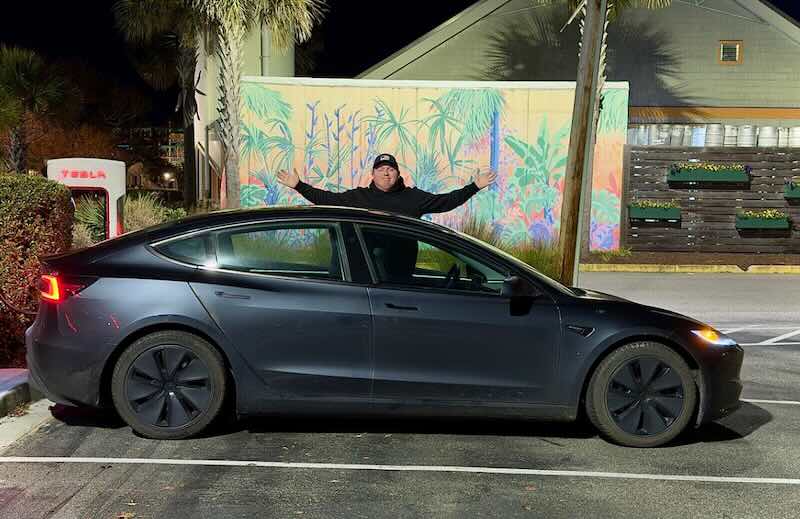
A Tesla Model 3 has successfully traveled from Los Angeles to Myrtle Beach, South Carolina, using FSD v14.2.1.25 without requiring human intervention. Owner David Moss documented the 2,732-mile journey, which took 2 days and 20 hours to complete. Achievement marks a turning point for autonomous vehicle technology and fulfills a development target first announced eight years ago.
Route presented significant obstacles beyond typical highway cruising. David deliberately selected a path that relied exclusively on Tesla’s Supercharger network, (owner documents coast-to-coast journey), forcing the system to navigate urban streets, parking lots, and locations without direct highway access. Created a real-world stress test spanning more than 4,300 kilometers across varied terrain and traffic conditions.
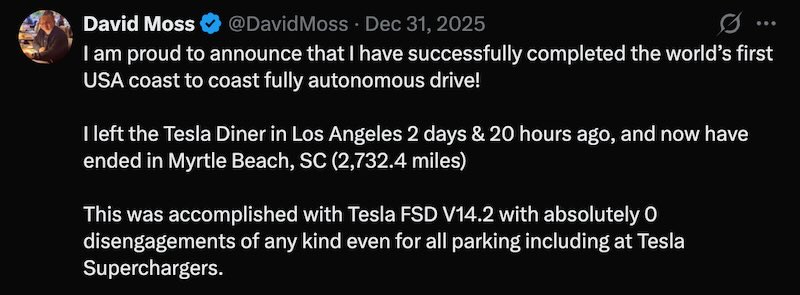
From an engineering perspective, zero-intervention result demonstrates remarkable system generalization. Vehicle encountered countless scenarios—construction zones, weather variations, different road types, and complex intersections—yet maintained autonomous operation throughout. Level of consistency differs substantially from controlled demonstrations conducted in limited geographic areas.
Tesla CEO Elon Musk originally established the coast-to-coast challenge as an internal benchmark in 2016. Goal served as both a development milestone and a public commitment. Former Tesla AI director Andrej Karpathy confirmed that achieving this objective consumed significant team resources, with engineers conducting extensive review sessions analyzing intervention cases and edge scenarios.
Karpathy noted that progress came through methodical problem-solving rather than breakthroughs. Team systematically categorized failures, prioritized improvements, and gradually expanded the system’s operational domain. Approach contrasts with companies pursuing limited-area deployments with high-definition mapping support.
Paril Jain, who previously led FSD planning and controls at Tesla, emphasized the significance of customer-driven validation versus curated demonstrations. Companies developing autonomous systems frequently showcase polished videos recorded under optimal conditions. David’s journey occurred on production hardware with standard software available to Tesla owners, representing genuine product capability rather than prototype performance.
Karpathy also revisited his analysis comparing Tesla’s software-focused approach to hardware-dependent alternatives like Waymo. He maintains that software challenges prove more tractable than hardware limitations, suggesting Tesla FSD could complete routes that geofenced systems cannot currently handle. Whether this assessment holds under scrutiny remains debated within the autonomous vehicle community.
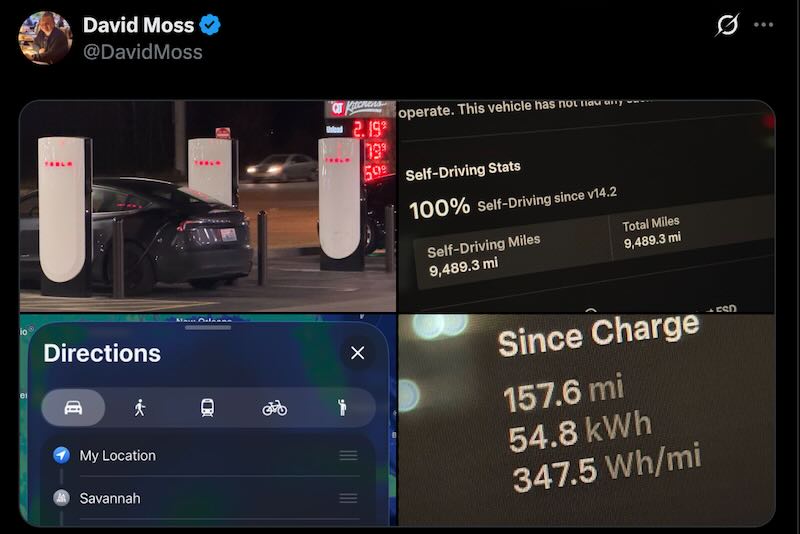
The documented journey from Los Angeles to South Carolina represents only part of David’s total distance traveled under FSD. He departed Seattle before beginning the coast-to-coast segment, accumulating more than 10,000 miles without interventions. Third-party analytics platforms confirm that vehicle telemetry transmits directly to Tesla servers, creating tamper-resistant records of system performance.
Technical architecture prevents retroactive data modification, meaning any human takeover would permanently break the zero-intervention streak. Verification method adds credibility to performance claims in an industry where validation standards remain inconsistent.
Tesla FSD completing a transcontinental drive shifts conversations about autonomous capability from theoretical potential to demonstrated performance. Achievement doesn’t eliminate questions about safety margins, statistical significance, or regulatory approval. However, it establishes that current sensor configurations and neural network architectures can handle diverse driving environments without geographic restrictions.
Perhaps most notably, David Moss works as a lidar salesman, creating an unexpected twist given Tesla’s camera-only approach explicitly rejects lidar technology. His professional background lends additional weight to his documentation of Tesla FSD crossing the country without human intervention.
Related Post
Former Tesla AI Director Andrej Karpathy Calls HW4 Model X “Amazing” – FSD Makes Quantum Leap
Waymo Vehicles Freeze During SF Power Outage, Released an Official Statement
Tesla Grok Navigation Commands: Natural Voice Control for FSD Drivers